
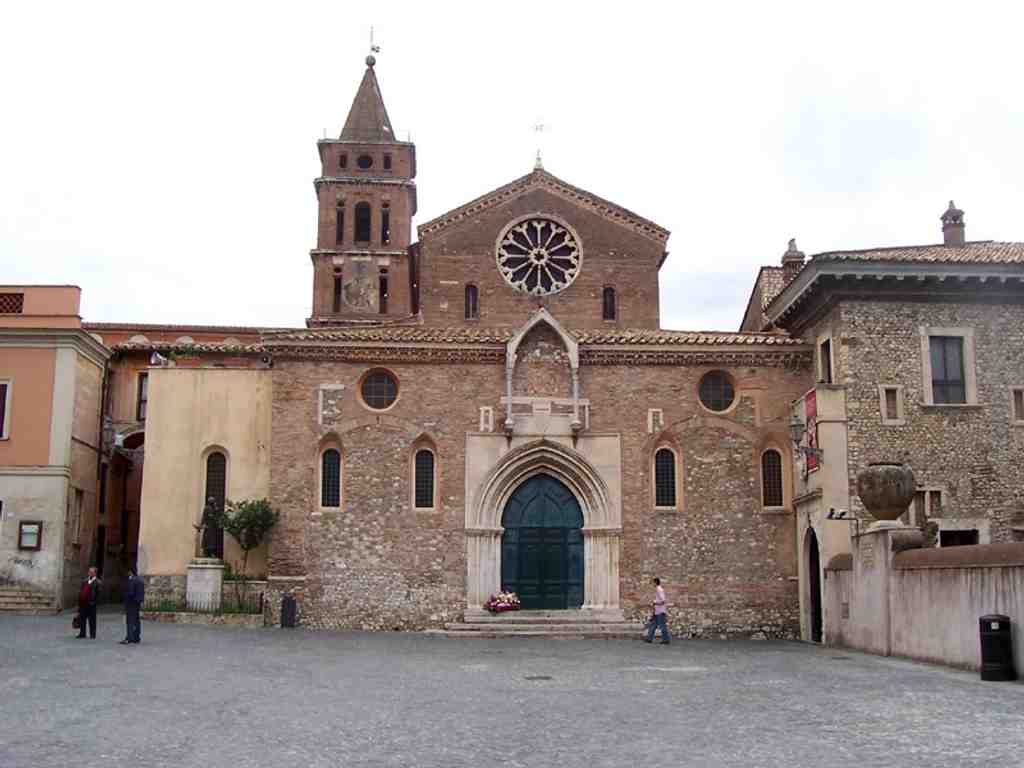
You are looking at a beautifully textured brick and stone facade featuring a large circular rose window and a deeply recessed, pointed Gothic archway framing the main wooden doors. Just a minute ago, we were exploring the magnificent Villa d'Este, but the history of the ground right in front of you reveals exactly how this town constantly builds its present directly on top of its past. Long before any church stood here, this exact spot was a sprawling Roman estate. Today, underneath the floorboards of the church, lie the repurposed ruins of that ancient residence, which once belonged to the Roman historian Sallust.
Local tradition claims that Pope Simplicius built the very first church over those Roman ruins back in the fifth century. You might remember Simplicius from our earlier stop at the Cathedral. Well, to complete his grand vision for the town, he supposedly donated two sacred icons painted by Luke the Evangelist. He gave an image of the Savior to the Cathedral, and an image of the Virgin Mary right here to Santa Maria Maggiore.
Those famous icons are the very ones used in the Inchinata procession we learned about at the Cathedral. Every year, the piazza right in front of you becomes the destination for that centuries-old ritual. When the image of the Savior finally arrives to meet the Madonna here, the two sacred frames are tilted to bow to each other underneath arches made of myrtle branches.
But high-stakes spirituality often breeds charming local folklore. Legend has it that one year, an overly curious elderly woman decided she wanted to know exactly what the statues of the Mother and Son talked about when left alone overnight in the nave. She secretly hid inside to eavesdrop. The divine punishment for spying on a sacred mystery was swift. When she was finally discovered the next morning, she had been struck completely deaf and mute.
While the common folk were busy weaving legends, the powerful were actively reshaping the stone. When Cardinal Ippolito d'Este arrived in fifteen fifty, he took the old Franciscan convent attached to this church and transformed it into the lavish villa you just saw. Yet, despite his incredible wealth, he died deeply disillusioned by court politics. He was buried inside this very church. His nephew later hired a sculptor to build a massive, monumental tomb, but the project mysteriously fell apart before it even began. As a result, the incredibly powerful Este cardinals remain buried under a remarkably simple stone slab in the floor.
Even the sacred art inside had to survive this constant cycle of chaos. In sixteen eighty-seven, a lightning bolt struck the main altar, nearly destroying a priceless thirteenth-century painting. A flawless copy was quickly painted to replace it, a clever trick that actually fooled modern art scholars for decades.
The wheel of history never stops turning here. Now, let us direct our steps toward an imposing fortress that changed the city skyline forever. We will head to Rocca Pia, which is just a brief three-minute walk away.


