
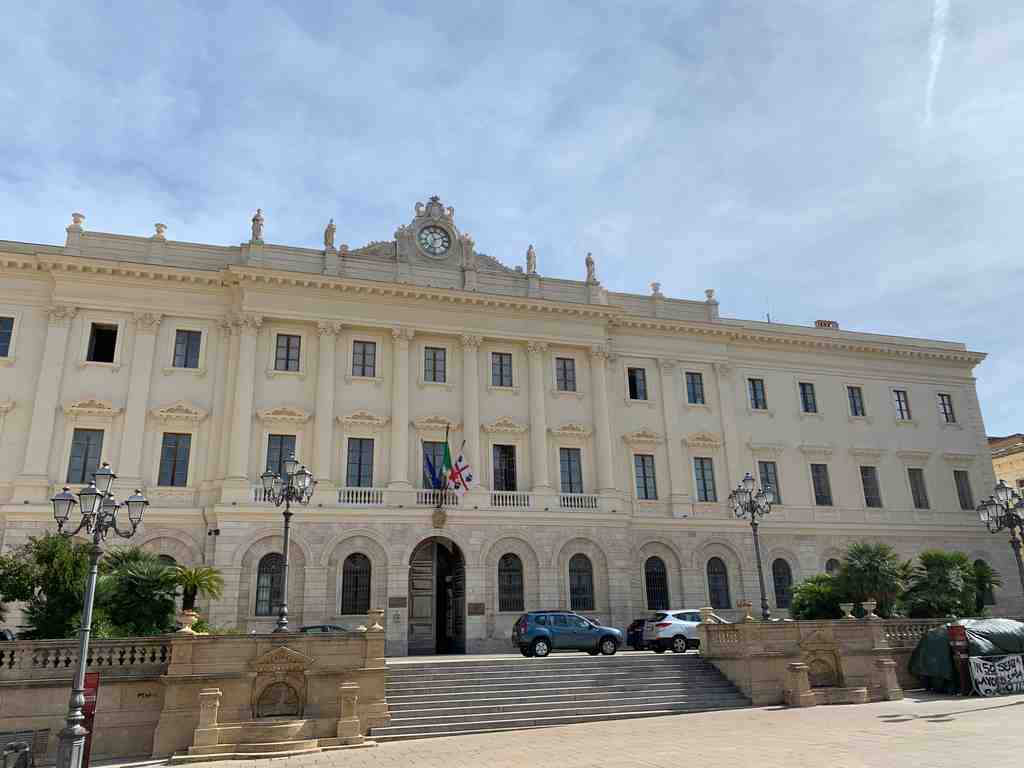
To spot the Palazzo della Provincia, look straight ahead for a grand cream-colored building with tall arched windows, elegant columns, and an ornate clock above the entrance in the center, flanked by statues lining the roof.
Now, let’s dive into the story! Imagine the year is 1872. Sassari’s city officials, squeezed into disjointed buildings like sardines in a can-Teatro Civico, Palazzo d’Usini, and Palazzo Ducale-decide enough is enough! They band together, scrape together a whopping 600,000 lire (which would buy you a lot of gelato), and declare: it’s time for a palace worthy of their ambitions. The chosen spot? The northeast side of what is now the glorious Piazza d’Italia-back then, just a dusty field as large as a football pitch. Picture the hustle and the excitement as plans unfurl for a palace in the latest late neoclassical style, something to make the neighbors jealous.
The responsibility falls to two determined engineers, Giovanni Borgnini and Eugenio Sironi, who stubbornly insist on working side by side. Construction gets underway with local firms building the shell, fashioning fixtures, and-one can only imagine-quarreling over the color of the drapes. On October 18, 1873, shovels strike the ground.
In a dizzying five years, the new Palazzo is ready, with intricate frescos finishing up by 1882 and the proud civic clock, crafted in Turin, set ticking away from 1880. Not bad, except the final bill? A jaw-dropping 1,100,000 lire. Worth every penny, if you ask the officials-who now lounge in 265 rooms across a sprawling 4,456 square meters. The main entrance (take a peek at those elegant steps!) opens into a grand atrium where silent marble slabs remember the local fallen of the Great War; just past this, a corridor connects visitors to luxurious salon after salon. You’ll find parquet floors polished enough for a ballroom dance and ceilings so high you might get a nosebleed from just looking up.
The most famous room? The Sala Sciuti, the heart of the building. On the top floor, you’ll find this enormous council chamber, its vaulted ceiling stretching a dizzying 12.6 meters. There are 12 sculpted figures here, the moors with bandaged eyes, frozen mid-story. Back in 1875, the city challenged artists across Italy to imagine a grand mural-a scene to inspire pride. Emerging victorious, Giuseppe Sciuti from Sicily gets the job. Not content with mere sketches, he hunts down ancient costumes and arms, and even sketches locals to capture Sassari’s true spirit. The finished fresco tells the story of Giommaria Angioy riding into town in 1796, bringing a breeze of rebellious hope.
But there’s more: a second, grand mural shows the Proclamation of the Sassari Republic. Here, elders gather in the old town hall, intently listening as ambassadors of Sassari debate with Genoa, winning precious self-rule in 1294. Spot Eleonora d’Arborea and Amsicora lurking on the walls-local legends caught in paint. Up above, an allegory of the Fatherland unfolds, dazzling in just 90 square meters.
There’s a touch of modern artistry, too; in 1983, Aligi Sassu gifted a mighty painting of Prometheus that now guards the grand staircase. Meanwhile, in 1899, the city crowned it all with a monument to King Vittorio Emanuele II-placed right outside, perfectly in line with the entrance.
Today, the Palazzo della Provincia isn’t just a vital hub for the city’s government, it’s a symbol-so iconic it’s even pictured on the 29th page of the Italian passport. So, as you gaze at those imposing columns and that dignified clock, remember: this palace was born from ambition, vision, and just a hint of architectural one-upmanship. And if anyone asks, yes-265 rooms do require a very good map and maybe a pair of roller skates!
Exploring the realm of the the palace, the main façade or the the interior? Feel free to consult the chat section for additional information.


