
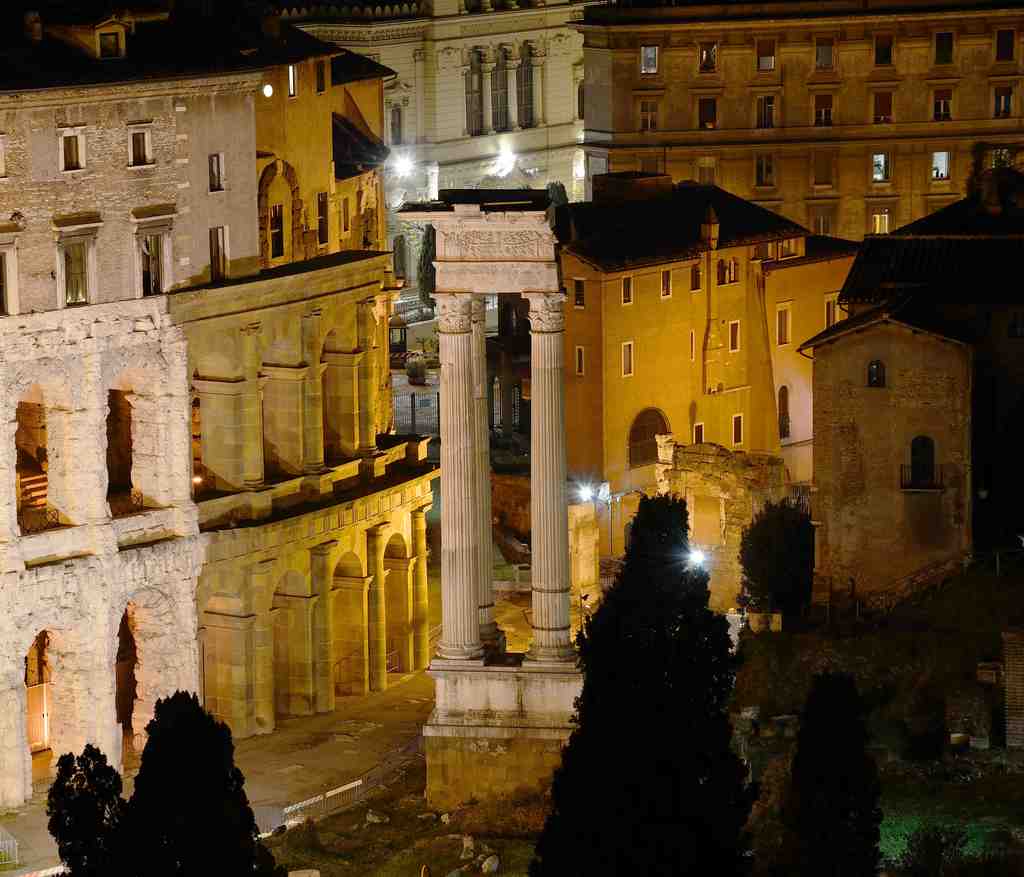
Look ahead for three tall, marble columns standing proudly together, almost like ancient sentinels illuminated near the Teatro di Marcello-spot them just beside the taller ruins and you’ll know you’re in the right place!
Welcome to a spot where the spirit of Apollo, the god of music and healing, seems to hum through the air! You're now standing before the Temple of Apollo Sosianus, where stories stretch back, not just centuries, but literally millennia. Take a deep breath-you’re about to travel through time (no time machine needed, just imagination).
Let’s rewind to the middle of the fifth century BC. Picture a patch of green outside ancient Rome’s early walls-the prata Flaminia. It’s here, around 431 BC, that Romans, shaken by a devastating plague, decided they needed some divine intervention. With all sincerity, they built a sacred area (known as the Apollinar) and dedicated the very first temple to Apollo as a healer. And hey, when you’re desperate to banish a plague, you’ll try anything-even a little divine housewarming!
But like any real estate in Rome, this prime spot got makeovers through the centuries. By the third century BC, the temple had taken its first facelift-restored and restored again, keeping up with the ever-changing city. They say ancient Rome never stopped building, and that certainly seems true right here!
Now, fast-forward to the second century BC. Imagine statues everywhere-Apollo maybe looking a bit smug, his mom Latona beside him, his twin sister Artemis, and even the nine Muses thrown in for inspiration. Pliny the Elder himself tells us that these statues were crafted by Philiscus of Rhodes. You know your temple is fancy when people are writing about the art centuries later!
Then came the age of Julius Caesar. Nearby stood the Temple of Diana until it was demolished to make room for the grand Theatre of Marcellus. Maybe Apollo was lonely, so Romans probably rededicated this spot to include Diana as well. After all, what’s better than one god? Two, obviously-especially if they’re siblings.
And now for a bit of drama! Around 34 BC, a certain Gaius Sosius decided the temple needed another extreme makeover-think of it as the ‘Augustan Edition,’ all marble and magnificence. But, wouldn’t you know it, history loves to throw a plot twist. Political trouble erupted between Octavian (later Augustus) and Mark Antony. With Gaius Sosius stuck on Antony’s team, all renovations screeched to a halt-imagine construction stopped mid-project, columns half up, architects tearing their hair out. Once Augustus and Sosius patched things up (thanks to a good old-fashioned bit of political arm twisting), the work resumed. Augustus, now emperor, made sure Sosius paid for the rest-and demanded that it be done in truly lavish style. When the emperor tells you to splash out, you don’t skimp!
The result? The temple, as you see the remains today, faced nearly due south and boasted a marble façade so dazzling, it made neighbors jealous. Six colossal columns lined the front, crafted from Carrara marble bright enough to strike awe even in the blinding Roman sun. Intricate capitals (sort of like leafy crowns for the columns) sported a riot of plant motifs and laurel-symbol of victory and a not-so-subtle nod to Augustus. Inside, African marble columns glistened, and the decorated frieze above showed off epic battle scenes, marking Octavian’s triple triumph in 29 BC. (Nothing like turning your greatest hits into wall art!)
And you, lucky visitor, are gazing at something extra special-the original three columns were discovered nearly flat on their faces in the 1930s and then re-erected in 1940. So the trio before you aren’t quite in their ancient spots, but they’re standing tall, showing off thousands of years of history and resilience-even after medieval buildings swallowed the ruins and centuries hid them from sight.
The decorative details here are quirky too-some flutes on the columns are wider, some are narrower, in a playful experimentation that shows Roman architects were testing out new styles, like designers on the edge of a trend.
Nearby, the grand Portico Trionfale once stretched for a mile, with its arches passing just behind this temple. In the shadows, there used to be a sacred circular fountain for purification ceremonies-proof this area buzzed with both spiritual and social energy.
So, as you look at those three steadfast, marble columns, imagine priests in white, musicians playing lyres, the murmur of prayers, crowds celebrating festivals, artists admiring the statues, and even the clatter of builders nervously working under Augustus’s ever-watchful gaze. If these stones could talk, oh, the tales they’d tell-and thankfully, you’ve just heard a few!
Interested in knowing more about the description, other buildings in the area or the image gallery




