
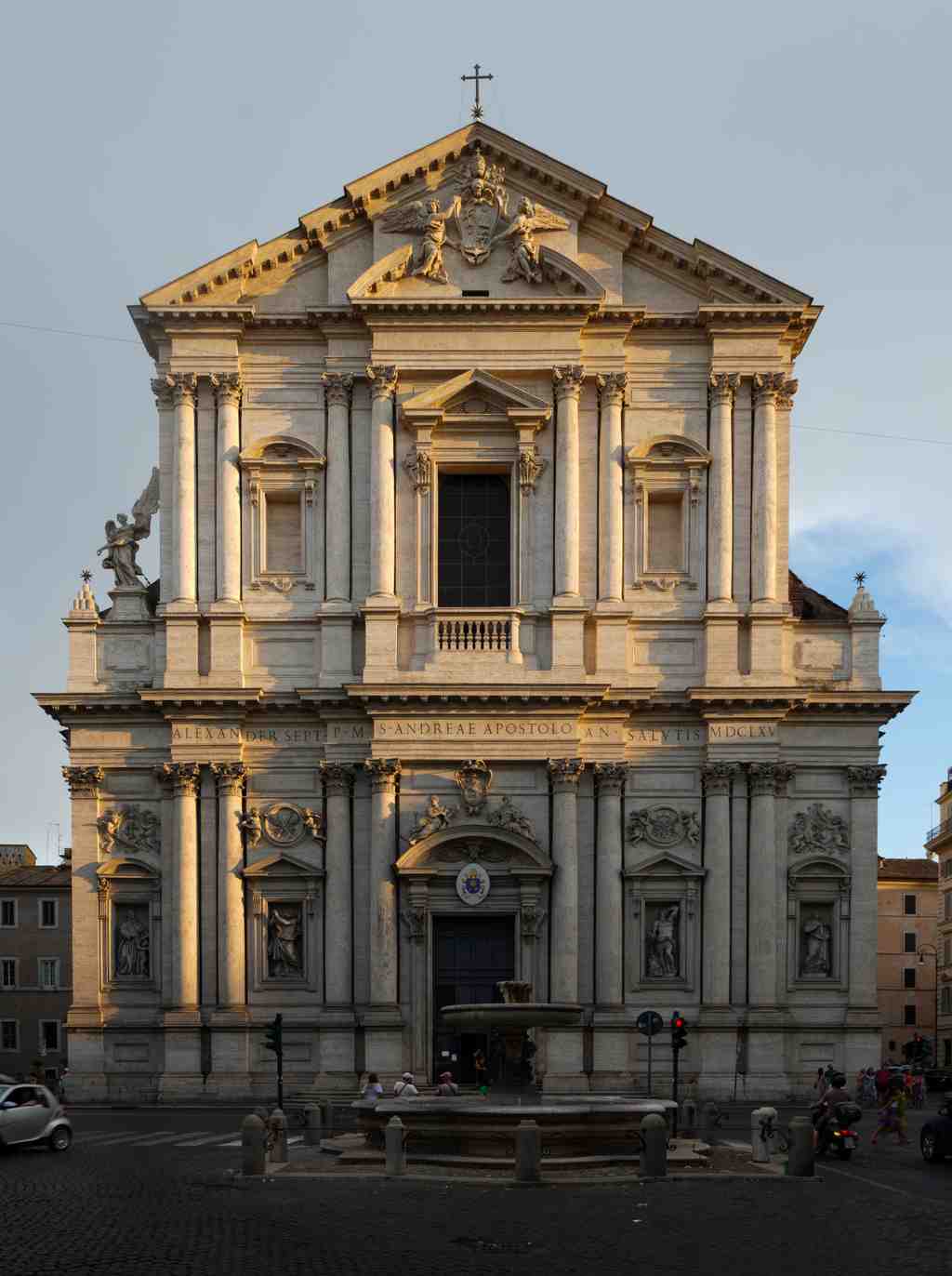
Take a look just ahead-you’ll see an enormous, cream-colored Baroque church with a stunning dome rising up above the traffic, looking like it’s ready to burst into song right here on Piazza Vidoni. If you’re facing the busy Corso Vittorio Emanuele, that impressive facade with its sculpted saints and grand staircase is your target: Sant’Andrea della Valle.
Let me set the scene, my friend: imagine it’s late 16th-century Rome, a time when big ideas and even bigger egos collided to shape the city’s spiritual skyline. The Theatines, a brand-new religious order determined to dazzle the world with their devotion, were handed this spot by Donna Costanza Piccolomini d’Aragona-a woman with a name as long as her family tree, tracing all the way to Pope Pius II. Her palace and a humble church sat here, just waiting for a makeover. Why dedicate it to Saint Andrew? Well, Amalfi’s patron saint and Donna Costanza’s hometown hero sounded like the perfect figurehead for such an ambitious new sanctuary.
So in 1582, Rome’s architects and artists got to work. First, Giacomo della Porta, famed designer of fountains and domes, and then Pier Paolo Olivieri, left their mark. But Rome’s real specialty? Delays. After Donna Costanza’s death, work slowed to a crawl until Cardinal Alessandro Peretti di Montalto-let’s call him Cardinal Saint Deep Pockets-swooped in with a huge endowment, equivalent to winning the 17th-century lottery. Imagine spending 150,000 gold coins on a church-today, you’d probably get a penthouse in central Rome, but back then you got soaring domes and gilded chapels.
Speaking of domes, step closer and gaze upwards. Lanfranco’s masterpiece (completed in 1627) shimmers with illusionistic frescoes high above you. This dome was, for centuries, third only to St. Peter’s and the Pantheon-a little sibling with big aspirations to the dome world. The story of this dome reads like a Renaissance soap opera: Giovanni Lanfranco versus Domenichino, two star pupils of Carracci. Cardinal Alessandro wanted Lanfranco, but Pope Gregory XV’s family wanted Domenichino. The solution? Why not both! And the result is a sky crowded with saints, swirling clouds, and angels so lively they seem about to swing down and join you on the piazza for a quick espresso.
There’s more waiting inside. On the right, chapels like jeweled boxes, starting with the Ginetti Chapel: white marble, a dramatic angel (inspired by Bernini) hustling the Holy Family out of Egypt faster than you can say “Roman holiday.” A little further down, the Strozzi Chapel holds bronze copies of Michelangelo’s statues-the originals too famous to leave Florence, of course. If you peer carefully, the Strozzi family cenotaphs rest under shadowy black marble-Rome’s equivalent of a family photo wall, but with more togas.
The left side offers its own mix of art and drama: the Madonna della Purità, angel-laden cupolas painted in 1912, and the tomb of another illustrious cardinal-proof that this church was, and still is, a high society address. Wander to the left transept and meet Saint Cajetan, founder of the Theatines, immortalized in painting, while allegorical statues at his altar stand for Abundance and Wisdom-qualities every tour guide aspires to bring.
The side chapels overflow with stories: Saint Sebastian was immortalized by Giovanni de’ Vecchi after surviving, well, more than one round of arrows, and the Rucellai Chapel celebrates three Blessed Theatines with paintings by Pomarancio and a ceiling fresco that looks like a celestial choir rehearsal. Don’t miss Saint Martha on the far left-sculpted so energetically by Francesco Mochi she seems about to step right out into the nave, perhaps to get a better view of the next Mass.
Don’t leave without looking up into the apse. Here, Alessandro Algardi’s decorations and Domenichino’s frescoes tell the history of Saint Andrew: his crucifixion, his martyrdom, and his final rest, all beneath scenes of Virtue and triumph. Mattia Preti supplied drama with his own frescoes, no doubt hoping no one would ever outdo him in any Roman church ever again.
If you’re lucky, as you stand here, you might catch faint music echoing-Sant’Andrea della Valle hides a majestic pipe organ built in 1845, still played on afternoons by a modern organist who, rumor has it, scares away pigeons with perfectly pitched notes. Puccini was so inspired by this place, he set the first act of his opera ‘Tosca’ here-albeit with a little dramatic license. You won’t find the famous Cappella Attavanti, but you will find inspiration, the spirits of popes Pius II and III resting in peaceful grandeur, and art that’s leaped from centuries past straight into your afternoon walk.
So, take a long look. Time, money, rivalry, and devotion have all carved their stories into these stones. And if you ever want to upstage your local church back home, just mention the dome-third biggest in Rome! That’s one giant leap for Saint Andrew and one small step for Roman architectural flair.
Curious about the overview, pipe organ or the varia? Don't hesitate to reach out in the chat section for additional details.




