
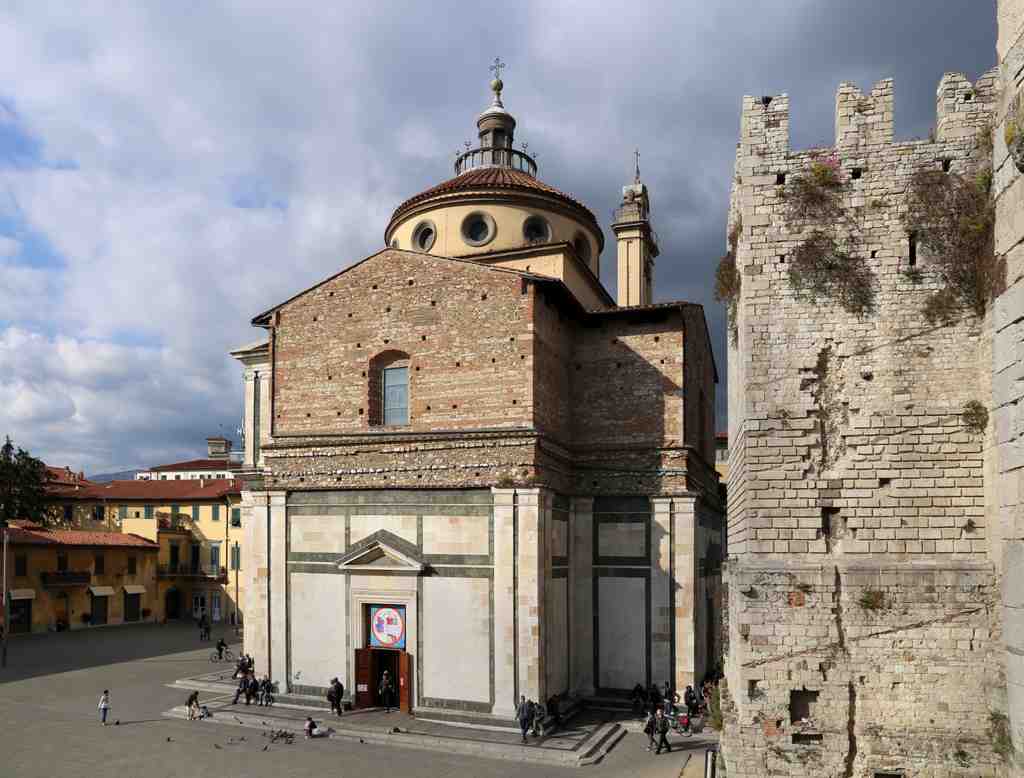
On your right, you’ll spot a squat, perfectly symmetrical church faced in clean stripes of white and green stone, with four equal arms and a compact dome-like a Renaissance jewel box that’s landed squarely in its own peaceful piazza.
Now, this isn’t just any church-it’s Santa Maria delle Carceri, literally “Saint Mary of the Prisons.” Not exactly the friendliest name, right? But as usual in Italy, there’s a story here that is stranger than fiction. Back in 1484, in the shadow of what were the city’s grim public jails, a sick little boy named Jacopino Belcari-nicknamed “della Povera” for his family’s poverty-claimed the image of the Madonna and Child painted on the jail wall came alive. Suddenly, Jacopino was miraculously cured. Word spread like wildfire-imagine TikTok, but with more monks and less dancing-and what started as a simple painted wall became a pilgrimage hotspot almost overnight.
The growing devotion brought some heavyweights onto the scene, including none other than Lorenzo de’ Medici-the same “Lorenzo the Magnificent” who pretty much ran Florence and, by extension, these parts. Lorenzo handpicked his star architect, Giuliano da Sangallo, to design this basilica. But Lorenzo wasn’t here for “just another church.” He wanted something new-so Sangallo, taking a page from the genius of Brunelleschi, used a Greek-cross plan: four arms of equal length, all hugging a round central dome. Symmetry ruled, every measurement balancing its neighbor-a bit of Renaissance obsession that would echo all the way to Rome’s St. Peter’s Basilica and even sneak into Raphael’s projects.
Take a look at the facade. Those stripes aren’t just for show-they’re a nod to local style, using light alberese stone with bands of deep green serpentine. At the corners, you’ll see slim columns called lesene-basically, architectural cufflinks, if you will-framing the structure with neat geometry. The dome? Another Brunelleschi call-back, but with a twist: it’s perched elegantly atop a twelve-eyed drum and topped by a dainty lantern.
Now, there’s an astronomer’s trick hidden here: around summer solstice, the midday sunlight filters through the dome’s lantern and-just for a few moments-illuminates the fresco of the Virgin. It happens every June, like clockwork, and you can almost imagine the gasps when it was first noticed. Another solar spotlight hits in mid-July, lining up with the day Jacopino had his vision. Renaissance architecture: not just pretty, but precision-tuned for cosmic drama.
Inside, the wow-factor keeps rising. Stand beneath the dome and you’re surrounded by crisp, harmonious lines-every angle and bracket echoing Sangallo’s devotion to balance. Stained glass windows by Ghirlandaio beam jewel-toned light, and Antonella della Robbia’s blue-and-white medallions add a touch of color above. The marble high altar, inspired by Rome’s Pantheon, frames the very fresco that started it all-boxed and wrapped like the city’s most prized relic.
This place was such a stunner that Jules-Giuliano da Sangallo-used it to show off his chops for the new St. Peter’s in Rome, and even his brother and Raphael took notes for their own masterpieces.
Ready for Palazzo della Pubblica Assistenza L’Avvenire? Just head southwest for about two minutes and you’ll be there.




