
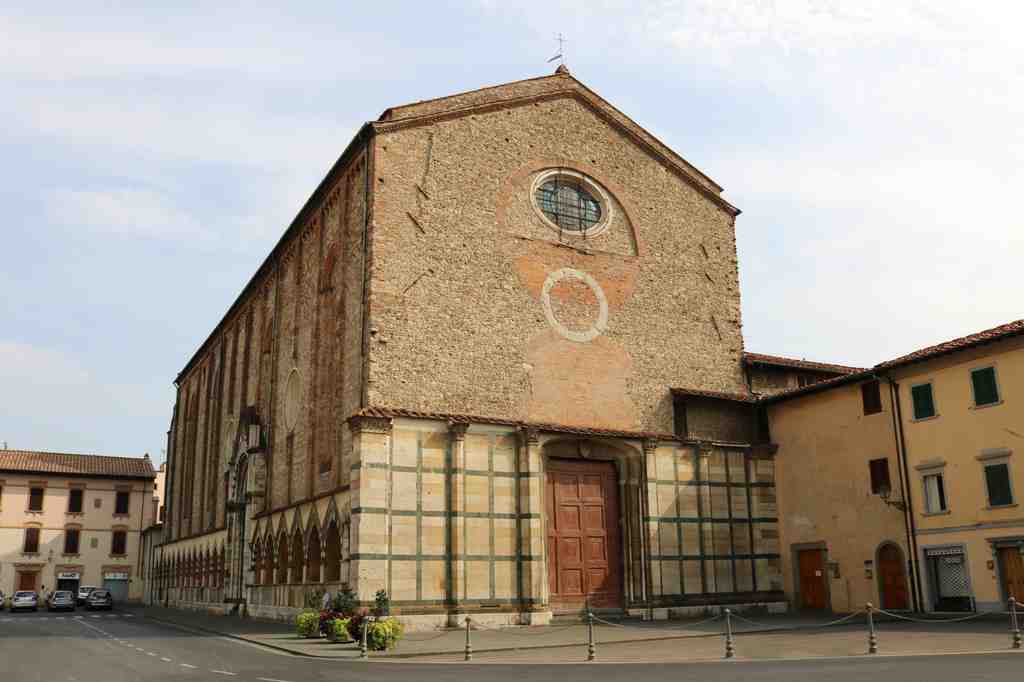
Look to your left for a church with an unfinished stone facade and striking bands of dark and pale stone, a tall red brick bell tower peeking out back-the Church of San Domenico welcomes you with its stern, unmistakable profile.
Now, San Domenico looks a bit like it’s auditioning for a role in a medieval drama-serious, stoic, definitely no-nonsense. Founded back in 1281, it was built over three decades, smack in the heart of the so-called “mendicant” church wave. These were churches built by humble orders that got by on donations and a lot of elbow grease from their followers. So, yes, you’ll notice a bit of humility here... but with some stylish flourishes. Check those chunky pillars-dressed with neat stripes of alberese and serpentino stone. That geometric rhythm, and those two-tone arches over tombs at ground level, almost look like medieval graphic design-well before Photoshop.
The real showstopper out back? That bell tower of red brick, capped off in 1314, is a minor masterpiece in itself. Take a good look-its upper levels are pierced by elegant twin and triple windows. Inside, you’ll find three church bells, each with a story of its own, the oldest cast nearly three centuries ago by a Florentine craftsman. The smallest bell, cast by a local named Santi Gualandi, is dedicated to St. Francis of Assisi and St. Anthony of Padua-two saints who definitely knew how to keep good company.
Back in 1647, disaster struck-quite literally. Lightning hit, a fire raged, and the church’s grand Gothic windows had to be sealed up, making way for lighter, airier Baroque interiors. Walk inside and you’ll notice that blend-lofty, arching ceilings, 12 massive stone “niches” lining the walls, and that calm, crafted contrast between the cool gray stone and bright, creamy plaster. Fun fact: the baroque organ loft above you was designed by Silvani, and houses a prized 17th-century organ.
Now, if these walls could talk, they’d have more than a few thrilling tales. The painter Fra Bartolomeo lived here for a stretch, and a wealthy Florentine named Riccuccio once commissioned Giotto-yes, *the* Giotto-to paint a masterpiece for the church. Unfortunately, that iconic work vanished in the fire, probably worth millions today, but imagine commissioning a great artwork in 1312 for a sum that’d translate to a cool couple hundred thousand dollars now.
You’ll notice tombs and commemorative slabs around the complex-if you have time to peek into the old convent, its Renaissance cloister is lined with the resting places of several local notables, including the famed playwright Sem Benelli.
Alright, ready for a change of scene? When you’re set, Palazzo degli Alberti is a four-minute walk to the southeast.




