
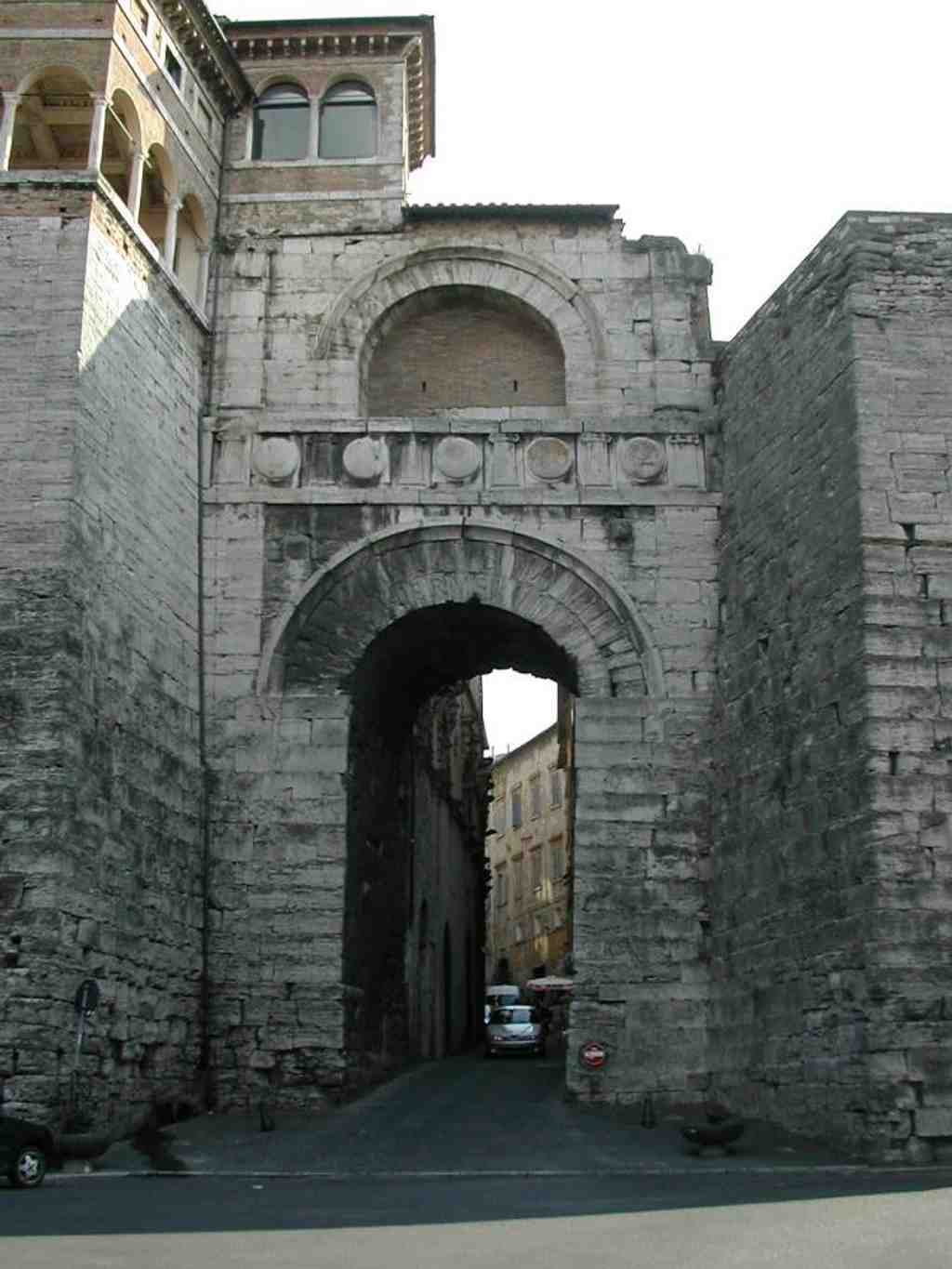
Right in front of you stands a mighty stretch of stone wall, weathered and monumental, interrupted by a grand arched gate-look for massive blocks stacked upon each other and a soaring entranceway that’s almost as old as storytelling itself.
Let’s step back into time with a little imagination-picture yourself here, two thousand years ago, when Perugia was already a bustling city, and the walls before you were as much a part of daily life as the sunrise. These are the legendary Walls of Perugia, the city’s ancient protective embrace.
Now, Perugia isn’t just content with one ancient hug; it boasts not one but two entire circles of walls. Inside, the oldest-the Etruscan walls-snake around the historic core for about three kilometers. Built over 2,300 years ago, they are so massive, you’d be forgiven for thinking the builders were giants in disguise. Each block was so big that I bet even Hercules would’ve asked for help moving them. These walls weren’t just impressive; they were practical, defending the city against invaders, wild animals, and the occasional overenthusiastic lover trying to serenade from outside. Over time, the Romans, never ones to pass by a good project, tweaked them, and in the medieval period, the walls got even more updates-like upgrading your phone, but with way more stone dust.
At the core of the Etruscan walls, there are legendary gates. The most majestic, right before your eyes, is the Arco Etrusco, or Etruscan Arch-also called Augustus’ Arch for a touch of imperial glamour. Built in the third century BC, it’s like a jaw-dropping front door to a whole other epoch. This archway isn’t just big; it was a status symbol, showing both guests and would-be enemies that Perugia was a city to take seriously. At one point, folks even called it "porta pulchra," which means "the beautiful gate"-the medieval city’s own version of rolling out the red carpet.
Some gates have their own stories. Porta Marzia is decorated with mysterious statues-imagine Jupiter himself and the twin heroes Castor and Pollux peeking down at folks coming into town, flanked by a couple of stately stone horses as if they’re still standing guard. Other gates got a medieval facelift. Porta Trasimena survived, but with tweaks, while Porta Sole, once perched high up since ancient times and even cited by Dante in his Divine Comedy, was long ago fortified and later destroyed in a dramatic popular revolt. The ghosts of these gates seem to cheer as you walk by, proud survivors of earthquakes, wars, and city expansions.
By the Middle Ages, Perugia had grown so much that a second set of walls was needed. In the 1200s, the city added a new, larger circle-like buying a belt one size up-just three meters outside the old Etruscan walls. But medieval architects soon realized they were battling the mischievous hills of Umbria: the earth kept shifting, threatening the old walls with collapse. So, they added buttresses, and when those didn’t solve the problem, they threw in massive supporting arches. Around 1330, right above those arches, they built what is now Piazza Matteotti-back then called Piazza del Sopramuro. It was the town’s very own floating square, perched above a fortress of stone, where citizens would gather for news, market days, and maybe a rumor or three.
Centuries later, every new addition had a story. In the 1400s, the hospital of Santa Maria della Misericordia built shops nearby, and the university set up its headquarters right next door. The city kept building, layer upon layer, until by the late 1500s, after the flamboyant lord Braccio Fortebraccio was gone, Perugia realized the growing weight of all this stone needed new supports-Braccio’s buttresses, they called them. And after all that, the biggest problem wasn’t armies or emperors. Nope-it was rain eroding the clay underfoot, making the walls wobble. Talk about problems with your foundation!
To this day, remarkably, most of Perugia’s medieval walls are still standing-nearly nine kilometers circling the city, embracing not just the old town, but the new suburbs that grew up around the ancient gates. Step closer, put your hand on the stone, and you can almost feel centuries of history pulsing through your fingertips. These walls may not talk, but trust me, if they could, they’d have some wild stories-and a few stone-cold jokes-about every era, every siege, and every feast Perugia has ever seen.
Congratulations, explorer! You’ve reached the last stop on this winding journey. The Walls of Perugia have sheltered emperors, poets, merchants, and now, thanks to you, digital tourists armed with curiosity and good walking shoes. Safe travels, and may your own adventures be as legendary as these ancient stones!




