
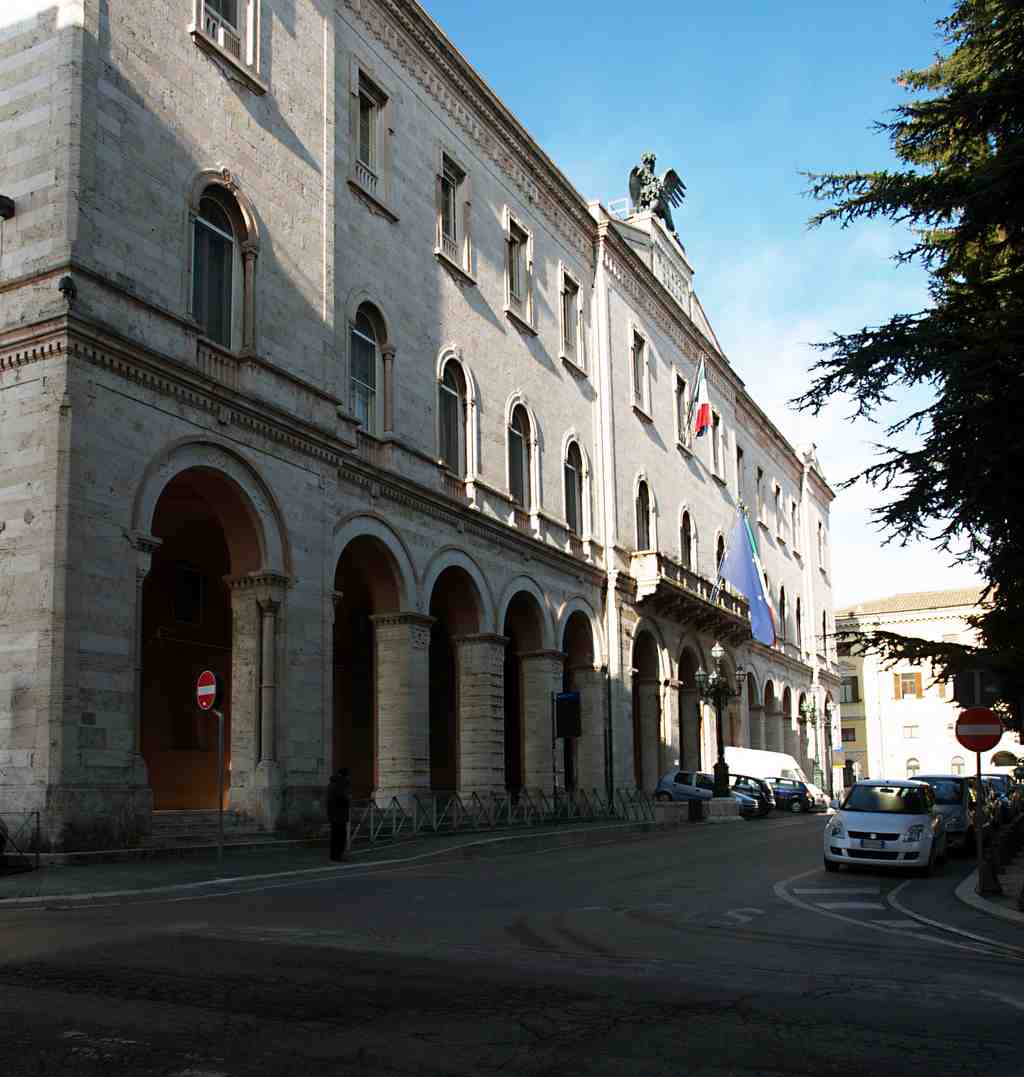
To spot the Palace of the Province and the Prefecture, look for the long, elegant facade made of alternating bands of pale and pinkish stone, marked by its grand, arched portico running along the street and the statue of a griffin perched above the central entrance.
Now, pause for a moment in front of this grand palace and let your imagination travel back to a time when Perugia was buzzing with controversy, rivalry, and ambition-yes, all over a building! The Palace of the Province and the Prefecture stands here today because something formidable once stood beneath your feet: the mighty Rocca Paolina, a fortress so massive it took a revolution and a wrecking crew to bring it down. After the old fortress was demolished, Perugia was left with a gaping hole in its heart-both literally and symbolically. So, what do you do when you have a giant crater in your city center? You build something big, bold, and, in this case, rather controversial.
In the late 1860s, the city called in Alessandro Arienti, a Milanese engineer who had only recently earned his Perugian stripes, to design its replacement. Why bring in an outsider? Let’s just say local architects had been entangled in so many arguments, you’d think they were auditioning for an opera. Arienti, inspired by the spirit of the Italian unification, looked north for his ideas, mixing Lombard forms with his own eclectic tastes and the delicate rose-and-white stones of Umbria. He even took a stand against the Roman style favored by the papal regime-after all, Perugia wanted a future, not a reminder of old rulers!
At the time, Arienti’s vision was met with more eye rolls than applause. The palace, some muttered, was too low for its bulk, too odd for its neighbors, and didn’t fit the medieval city at all. Local architects like Calderini and Biscarini must have felt like the city’s best cake recipe had been snatched from their hands. Still, Arienti had the last laugh: his design, with those porticos running like ribbon around the building and its airy, open arches, ended up being practical, cost-effective, and-over time-well-loved.
If you look closely, the building’s facades aren’t just pretty faces-they look out to the north, south, east, and west, equally grand on all four sides. The main entrance behind you opens onto the piazza, and if you were rich and powerful enough to stroll the rear, you’d find a balcony hanging above a view that inspired the poet Giosuè Carducci to write one of his great works, “Il canto dell’amore.” Not bad for a back porch!
Notice how the arches at the base recall Roman architecture, while the pale-pink and white stripes chase sunlight across the stone. Above you, a solemn griffin stares out from the center, wings wide-a symbol not just of the city, but of the whole province, which once reached as far as Rieti and Sabina.
Inside, the palace is a treasure chest of stories. Six local painters startled visitors in the 1870s with rooms filled with glowing color, gold, and heroic tales of Italian unity. The Council Hall, with its dazzling stained glass and allegorical women representing towns from Perugia to Spoleto and Rieti, is so striking it’s been called the “neo-Venetian style”-think of it as a Renaissance party thrown by people who’d just discovered Italy was one country at last. The walls are covered with images celebrating not just kings and queens but local heroes, the kind who might have sat right here during the city’s most passionate moments.
Other rooms are filled with painted “tapestries” bordered by mock velvet and gold, scenes of artists, scholars, and proud townsfolk who made Perugia shine. And for those who prefer “name-dropping” rather than sightseeing, you’ll discover busts of famous figures from the Italian Risorgimento-but if your name isn’t on a marble pedestal, don’t take it personally.
Nowadays, beneath your feet, the CERP exhibition center is tucked into the old fortress ruins. Every so often, you might catch the hum of a cultural event or art show from below.
So, as you marvel at the palace, remember: this is a building built on the bones of the past, born from rivalry, shaped by ambition, and brought to life by artists with a passion for unity and hope. Not bad for a place that started out as just “the new building” with no purpose, isn’t it?
Curious about the architecture, interior decoration or the straka-coppa collection? Don't hesitate to reach out in the chat section for additional details.




