
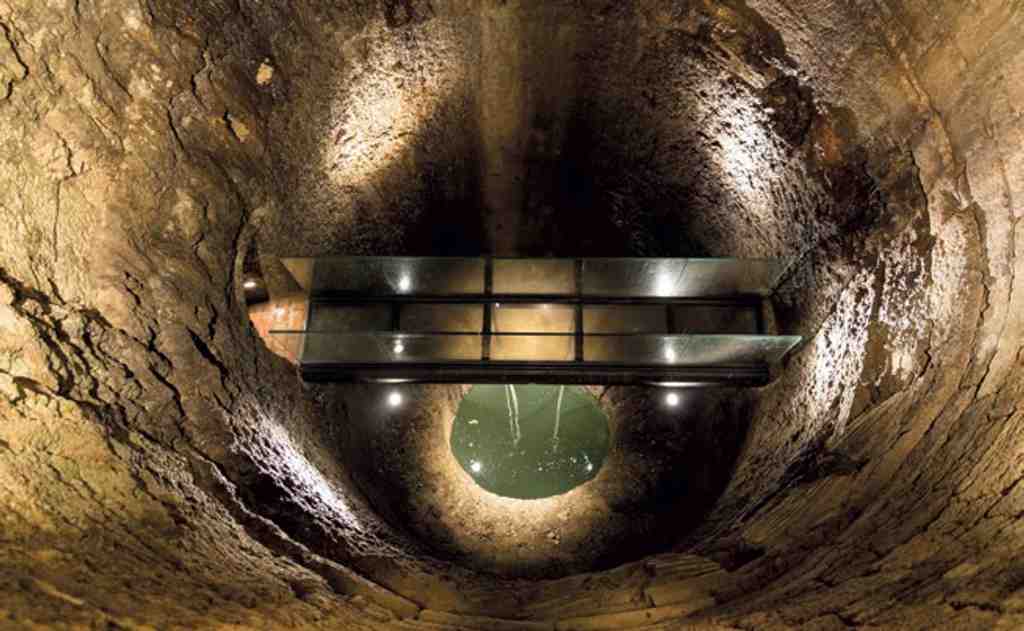
To spot the Etruscan Well, look for a deep, stone-lined cylindrical opening near number 18 in Piazza Danti, next to Palazzo Sorbello - peer down into its depths if you dare, and you’ll catch a glimpse of water far below!
Welcome to the Etruscan Well, the city’s ancient answer to the ultimate thirst - and as you stand here, imagine being greeted not by the buzz of tourists, but by the distant chatter of people jostling for fresh water nearly 2,300 years ago. Just steps away from the highest point in Perugia, in the shadow of what was once the city’s powerful acropolis, this marvel was born from pure necessity in the third century BCE. Built when the Etruscans ruled Perugia, the well provided water for the growing city. You could say it was Perugia’s own “wet bar” - just without the cocktails!
Now, close your eyes for a moment (don’t fall in!) and picture ancient hands chipping away at the earth and rock, lowering stone after stone, crafting a shaft nearly 37 meters deep. This cylindrical tunnel, dug into layers of clay and rounded pebbles, stretches down like a giant drinking straw for the city. Walk further around and the structure changes: the first few meters beneath your shoes start as a simple square, but then the well bellies outward, forming a vast water chamber about five and a half meters wide. The top is ringed with massive blocks of travertine, so closely stacked you couldn’t squeeze a coin between them, and above, an ingenious double-beamed stone roof - not a nail or drop of cement in sight. Craftsmen from the 1400s to the Renaissance came after, adding their own repairs as time and occasional disaster demanded - sometimes not so gracefully, as one unlucky chunk of railing once tumbled all the way to the bottom!
Now, let’s add a little drama - the well was tough, but it wasn’t invincible. Medieval townsfolk would lower their buckets, scraping neat grooves into the stone with years of repetition. And then, in 1768, the aristocrats got fancy with a new iron pulley cover, etching noble family crests right into it. Someone must have said, “If you’re going to pull up water, do it with style!” That’s some high-class thirst.
Over centuries, Palazzo Sorbello grew up all around the well, the mansion you see behind you. Originally built by Niccolò Montemelini on the bones of medieval towers and homes, it was part Etruscan, part Renaissance, part soap opera-passing from one notable family to another. In 1780, Marquis Uguccione III Bourbon di Sorbello snapped it up, giving the family name to the well. But in a moment of rare neighborly kindness, he made sure everyone in the square could haul up water, no matter how fancy their title. Imagine the daily parade of locals crossing the piazza, buckets in hand - all thanks to a generous marquis who must have hated waiting in line at the public fountains.
But the well wasn’t only about utility. In the 1960s, scholars took a new interest. On the instructions of Uguccione V Ranieri Bourbon di Sorbello-quite a name for a man of history!-Perugia’s legendary professor Filippo Magi descended into its depths, finally proving what locals had whispered for centuries: this was one of the greatest feats of Etruscan engineering ever discovered. Suddenly, what was once just a neighborhood necessity became an archaeological superstar.
Imagine the water below you now - at full capacity, this well could hold more than 424,000 liters, always fed by three bubbling springs. It’s usually quiet here today, except for the occasional plop of water droplets breaking the stillness. But in 1996, the well was drained for photography: probably the first time in over two millennia anyone saw its bones dry!
Since 2016, thanks to the Ranieri di Sorbello Foundation, those ancient tunnels and the surrounding palazzo have been reborn as a museum. If you’re brave enough, you can descend inside - just remember, the Etruscans built it to last, so you’re exploring a living piece of history, still quenching the city’s thirst after all these years. Who’s thirsty for adventure?




