
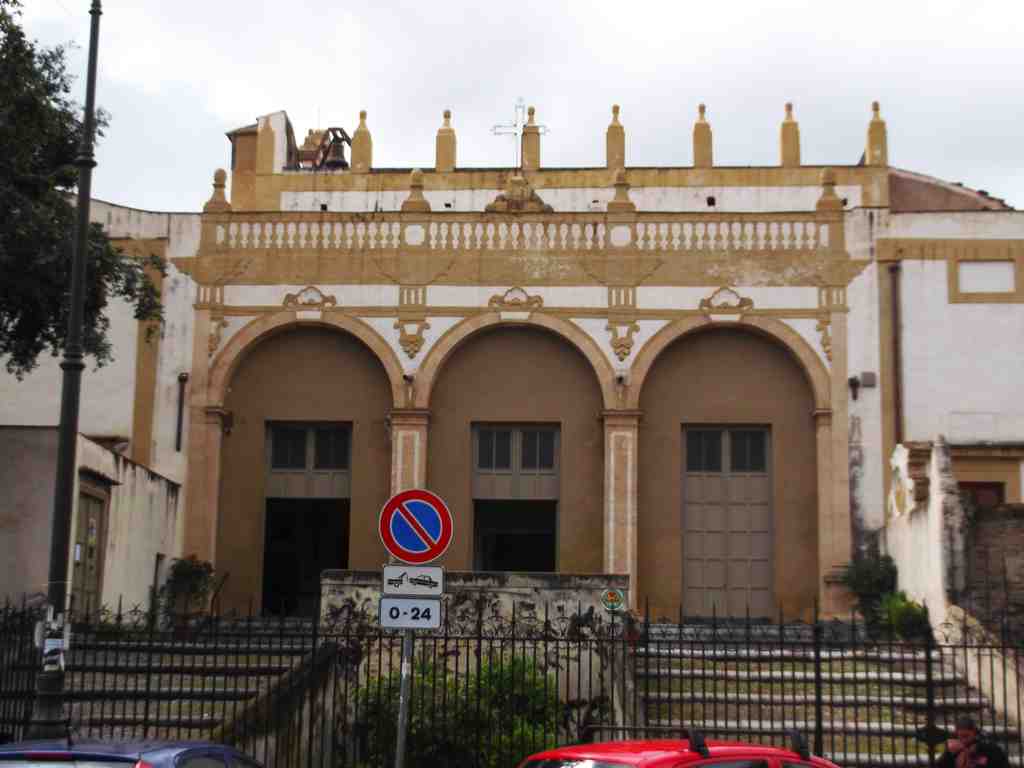
To spot the Church of Santa Maria di Monserrato, look straight ahead for a distinctive pale façade with three grand arches and a raised staircase lined with an iron fence, topped by a balustrade that almost looks like chess pieces waiting for their next move!
Now, let’s dive into the story, and trust me, this church has seen more drama than a Sicilian soap opera! Imagine yourself in the Palermo of the 1500s, outside the city walls, where nobleman Pietro de Luna owned lands and a lovely villa. Back then, this area was just calm countryside-well, at least until 1575 when history decided to spice things up. That year, a devastating plague, imported in true pirate fashion by corsairs, swept through the region. The villa and grounds you’re standing by were turned into a lazzaretto, a gloomy quarantine house for the sick. If you listen carefully, perhaps you’ll hear an echo of coughs, or maybe just someone sneezing in the café behind you.
After the crisis, life rolled on, but this building kept reinventing itself-think of it as Palermo’s version of a very determined chameleon. By 1600, Luca Cifuentes stepped in, dusted the place off, and made it a temporary home for Sicily’s Viceroys, those high-profile politicians arriving in the city, always looking for somewhere luxurious to stay while crowds got ready to welcome them triumphantly.
Still, plagues have a habit of knocking twice, and in 1624, a new wave hit. Just when you think you’ve washed your hands of the last outbreak, Palermo gets a relapse! Another lazzaretto. But the winds of fate soon shifted again: by 1668, the church was transformed into a refuge for poor girls under the care of the Congregation of the “Rifugio dei Poveri.” Suddenly, this place was alive with the sounds of young laughter and hope, its mission fueled by generous patrons and growing spiritual fervor.
Here’s a quirky twist: in 1690, a famous preacher arrived and led a heartfelt procession through the neighborhood to gather donations for these girls’ refuge. Legend has it, on the plain before the villa, they planted seven crosses-one for each of Mary’s seven sorrows. Suddenly, this area earned a brand new nickname: the Plane of the Seven Crosses. I can’t guarantee you’ll find all those original crosses today, but keep your eyes peeled-they say old stories sometimes leave faint footprints.
The church’s architectural history reads like Palermo’s greatest hits. The façade facing you was finished in 1853, thanks to the celebrated architect Giovan Battista Filippo Basile. He carved out those distinctive arches and gave the church its unique blend of Gothic, Norman, Chiaramonte, and even Catalan flavors. It’s almost like a recipe with all Palermo’s best ingredients-you just need a pinch of sunshine and a dash of sea breeze!
Step inside in your imagination: a single nave, three side altars tucked into serene chapels, and a ceiling painted with swirling angels and Mary grieving at the foot of the cross. The interior almost vibrates with the memory of processions and prayers, especially during Holy Week when emotional rituals for Mary of the Seven Sorrows fill every corner with songs and candlelight.
But history wasn’t finished testing this place. In 1943, World War II bombs blasted through Palermo, nearly wiping out the entire complex-except the tenacious chapel. Surviving destruction, it was rebuilt, adapted, and continued serving as a sanctuary of hope, even as the city modernized around it. And when the ancient Church of Santa Lucia al Borgo, once nearby, was destroyed, many of its precious artworks and statues found a safe haven here. In a way, this church became a guardian, cradling memories and relics of lost fellowships.
Fast-forward to modern times: restoration teams worked their magic in the early 2000s, polishing the murals, strengthening the roof, and restoring its shining face as the city’s own little miracle of resilience. As you stand here, take a moment to listen-not just with your ears, but with curiosity. The footsteps of viceroys, the prayers of quarantined souls, the laughter of rescued girls, and the determination of restorers-they all echo in these stones.
Now, wasn’t that a whirlwind? From plagues and politicians to bombs and blessings, this old church has seen it all-proving that in Palermo, even a quiet building can tell the most adventurous tales. Ready to continue? I promise the next stop will have fewer epidemics, but you never know in this city…
If you're curious about the facade, internal or the church of santa lucia al borgo, the chat section below is the perfect place to seek clarification.


