
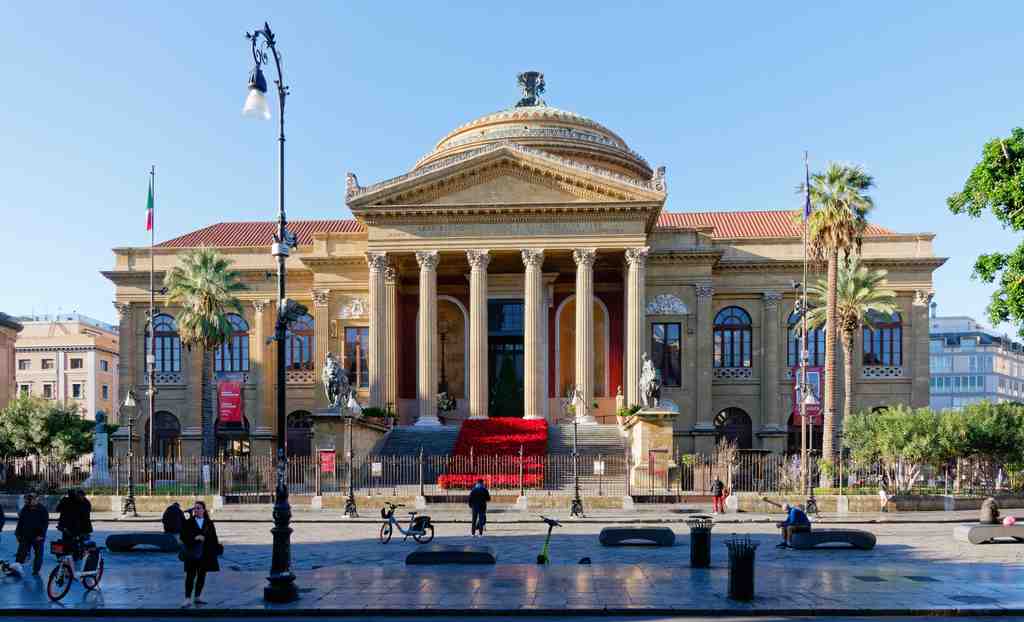
To spot the Teatro Massimo, look for a grand neoclassical building with a massive dome, a row of towering columns out front, and two fierce bronze lions guarding its wide staircase, right at the heart of Piazza Verdi.
Welcome to the magnificent Teatro Massimo, Palermo’s pride and joy. You’re standing before a building that’s more than just an opera house-this is Italy’s largest, where echoes of arias and whispers of intrigue still float through the Sicilian air. Go ahead, take in the impressive view: those big columns holding up the stately facade, crowned by a dome that rivals the best of ancient temples. And don’t miss the two bronze lions lounging near the steps, as if they’re listening in on the city’s secrets.
Imagine the streets here back in 1864, all bustle and excitement-a city recently united with Italy, eager to show off its new identity to the world. Palermo didn’t want to be just the “second city” after Naples. Oh no, Palermo wanted something monumental; something that would draw applause for centuries. So, when the mayor announced an international competition to dream up the “opera house to top all opera houses,” ambition was in the air. Architects across Europe sharpened their pencils, but in the end, the job went to Palermo’s own Giovan Battista Filippo Basile, a local legend of visionary design.
Picture the scene: Sicilian craftsmen hauling enormous blocks of stone, the din of hammers and shouts echoing across Piazza Verdi, all orchestrated by Giovanni Rutelli’s steam-powered crane-a marvel of its own. Basile dreamed of a theater fit for kings, inspired by the grand temples of Selinunte and Agrigento, and using the thick golden stone so characteristic of Sicily. When Basile passed away, his son Ernesto took the baton, running the final laps in the relay to glory.
Now, I can’t tell you there weren’t bumps along the way. Construction started in 1874, but after some initial progress, the theater hit the classic Italian pause-eight years of… well, let’s just say, “extended coffee breaks,” local politics, and maybe a little drama offstage! But like any great opera, after suspense and setbacks, triumph arrived: in 1897, twenty-two years after the first stone was laid, the Teatro Massimo opened its doors. The first opera? Verdi’s Falstaff-a performance as grand and lively as the building itself.
Step inside with your imagination: the rich scent of polished wood, plush velvet, tiers upon tiers of boxes rising in a horseshoe around the stage, and light glimmering off gold leaf. Once, the hall could hold over three thousand eager listeners, though these days, it’s a cozy 1,381-still plenty to host Sicily’s most glittering nights. And the acoustics? Simply perfect. The sound here is so clear, you could probably hear a tenor’s sigh from the back row, and maybe even a soprano’s grumble backstage!
The details make it all come alive. The interior dazzles with decorations by artists like Rocco Lentini and Ettore De Maria Bergler, and busts of famous composers, lovingly carved by Giusto Liva and his sons. Even the lions aren’t just there to scare naughty children-they’re the masterpieces of Benedetto Civiletti and Mario Rutelli, Giovanni’s talented son.
Of course, life at the Teatro Massimo hasn’t always been an endless standing ovation. In 1974, the curtain fell for what was supposed to be a quick renovation, but, cue dramatic music-cost overruns, scandals, and a healthy dose of Sicilian politics turned the pause into a 23-year intermission. When the house finally reopened in 1997, right before its hundredth birthday, the applause was thunderous, probably even waking up the decorative lions from their long nap.
In recent years, with artistic passion at the helm, the theatre turned the page and took on fresh adventures-new productions, unforgettable operas, and the steady beat of ballet slippers on its historic stage. Just imagine: if these walls could sing, they’d have centuries of stories, scandals, and show-stopping high notes to share.
You might even recognize this place from the movies: it played a starring role in The Godfather Part III, where fate, family, and opera collided under the same roof you’re looking at now. And in the second season of The White Lotus, fortunes and mischief danced through these halls once again.
So, whether the ghost of a baritone is warming up somewhere unseen, or the next grand performance is about to begin, you’re standing outside Palermo’s temple of spectacle, a place where grandeur, history, and maybe even a little touch of drama are always center stage. Are you ready for the next act of our tour? Let’s keep moving-just don’t try to out-sing the locals; they’ve got centuries of practice!


