
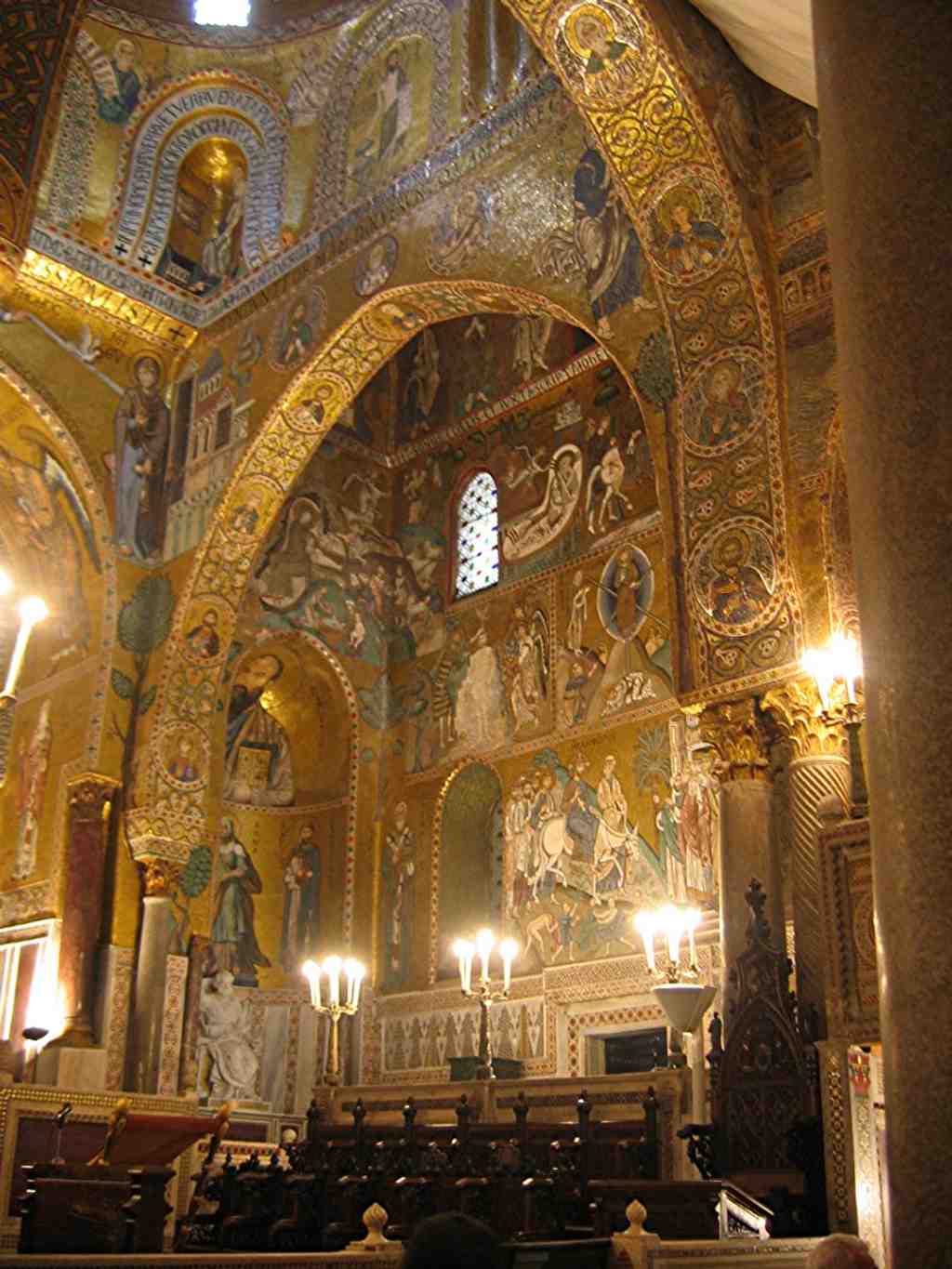
Right in front of you, you’ll spot the Cappella Palatina by its golden mosaics gleaming beneath grand arches, with intricate artwork shimmering within a cozy, lantern-lit chapel-just look for the richly decorated entrance beside the Norman Palace’s sturdy stone walls.
Now, get ready-because the Cappella Palatina is not just a chapel, it’s a swirling kaleidoscope of cultures, where Norman ambition, Byzantine artistry, and Arabic innovation come together like the world’s fanciest fruit salad. Picture yourself back in 1132: Palermo is buzzing, artisans from all corners of the Mediterranean are arguing about the best way to make gold sparkle, and King Roger II, with a twinkle in his eye and probably a beard full of bread crumbs, decides he needs a royal chapel that will knock everyone’s silk slippers off.
He commissions this masterpiece right on top of an older, much humbler chapel-the crypt below your feet. He wants a sanctuary so magnificent that even the Pope would say, “Well played, Roger.” Eight years go by, filled with clanging, chanting, and a language stew of Greek, Arabic, Latin, and a dash of grumbling Sicilian. By 1140, the chapel structure itself is complete, but the mosaics, those glittering stories in colored glass and gold, wouldn’t be finished for another decade.
Step inside, and the adventure begins: columns rescued from abandoned temples hold up arches that swoop like palm fronds, and every inch of ceiling or wall is singing a different note from Sicily’s multicultural chorus. The chapel’s ceiling is possibly its greatest wonder-the legendary muqarnas. Roger wanted a parade of geometry, stars and octagons carved in delicate wooden panels, painted and dazzling, suspended like a chandelier for the ages. This ceiling’s story is a mystery that would keep even an archaeologist guessing-was it inspired by Egypt’s Fatimids, imported from Syria, borrowed from North Africa, or crafted by local hands that already knew a thing or two about starry nights? The answer is, well, no one knows for sure, but it looks like a marriage of all worlds-artists fleeing troubled times and master craftsmen right here in Sicily, all putting their stamp on paradise.
And paradise is exactly what Roger was after. The ceiling, full of inscriptions mostly in Kufic Arabic script, showers down blessings of power and prosperity with every glance upward. There are nearly seventy-five of these invocations scattered, like cosmic post-it notes, among an assembly of musicians, dancers, banquet-goers, crowned kings (hello, Roger himself), hunters, and animals straight out of a far-off fable. At the very end, there’s a wild dinner party frozen in time-a scene so lively you half expect to hear laughter drifting down.
But we can’t stop at the ceiling! The chapel’s heartbeat is its staggering mosaic work, done in two acts. The oldest mosaics, spun by Byzantine artists, flicker on the ceilings and domes, showing saints elongated like candle flames, their robes flowing, their faces aglow with mysterious inner light. Along the north wall, St. John roams the desert and the Agnus Dei prances in a landscape more heavenly than earthly. Below, the Three Hierarchs-mighty Orthodox fathers of the church-stare out with solemn authority, framed by swirling ornamental borders. Each scene is its own little universe, parted from its neighbor by a labyrinth of pattern and color.
By the time the Latin-leaning mosaics pop up in the 1160s and 1170s, a new generation of local Sicilian craftsmen is taking a stab at the art. These pictures are more like storybooks-sometimes clumsy, always vibrant-with saints giving way to everyday scenes and even a glimpse of Sicily’s wildflowers and critters in what’s possibly the only great patch of secular Byzantine mosaic left in the world.
The whole chapel is a puzzle, a patchwork: Christian domes illuminated with Muslim stars, marble from who-knows-where, gold leaf fit for a pharaoh. Roger II made sure the throne and the altar had equal sway, a not-so-subtle flex to tell the mighty rulers of Europe, “I’m here to stay, deal with it.” Oh, and don’t miss the throne platform-if you spot two lions lazily decorating the frame, those are official seat warmers for the king himself.
So, as you stand here, take a deep breath and imagine choirs once filling this chamber with music, candlelight flickering off golden glass, and somewhere in the shadows a ruler sitting quietly, listening to the sounds of three continents meeting under one miraculous roof. Not bad for a royal chapel, eh? If only all power struggles ended with this much sparkle and style.
Interested in a deeper dive into the mosaics, muqarnas ceiling or the chapel? Join me in the chat section for an insightful conversation.


