
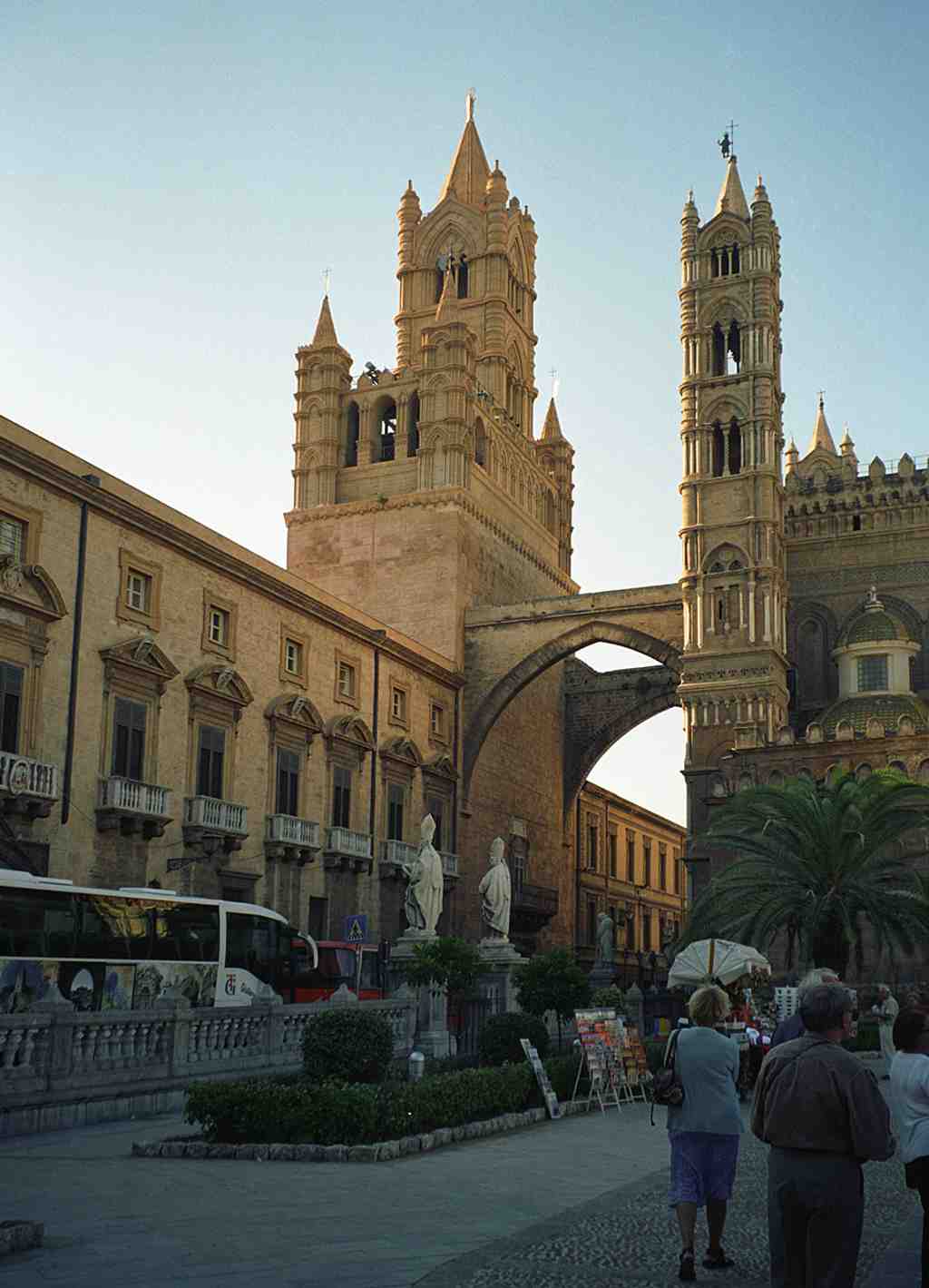
To spot the Archbishop Palace, look to your left-right next to the towering cathedral, you’ll see a long, elegant building with rows of ornate balconies and grand statues standing guard in front.
Imagine you’re standing here in Palermo, where the echoes of history bounce between sun-drenched stones. Right before you stands the Archbishop Palace: not just a building, but a silent witness to over five centuries of intrigue, art, and spiritual power. Take a deep breath and let’s travel back-not too far, you won’t need a time machine, just a bit of imagination.
It all began in the late 1400s, when the old archbishop’s palace near the cathedral had grown as tired as an overworked monk. Its bones creaked back to the fifth century! So Archbishop Simone Beccadelli made a bold move: he built this brand new palace right where you stand, facing the grand cathedral, wrapping around a medieval tower that was so ancient, even the pigeons probably had grandparents living there.
When the court moved into their spiffy new home in 1460, the chronicles buzzed about the palace’s Gothic windows and the mighty “Siculo-Catalan” portal-look closely, above the door is the stone Beccadelli family crest, proving once and for all that putting your name on things isn’t just for Instagram.
The Spanish era gave the palace an even fancier wardrobe. Balconies blossomed across its eastern face, all thanks to bishops with a flair for style-especially Diego Haëdo, who in 1592 added a grand balcony right above the main entrance. Cardinal Doria came along and built the wing to your right; Pietro Martinez y Rubio tackled the left, linking it all with the bell tower, and throwing in the “Porta Canonica” just opposite the cathedral’s main door for good measure-easy access for when the archbishop forgot his umbrella.
This Renaissance face-lift gave Palermo what was then the *trendiest* palace on the block. Now, see those rows of squared stones and those windows above the funky “goose-breast” shaped basement arches? Thirteen windows march in line on the top floor, but only the central one struts a fancy broken arch with a coat of arms-because who doesn’t want to stand out?
There’s more! On the corner balcony by Vincenzo Gagini, you’ll spot faces peeking from underneath-like a family photo in marble! They are the Gaginis themselves, Sicily’s most famous family of sculptors: father Antonello, sons, brothers, and Gagini carved their faces right into the palace for eternity. On the opposite end, the Pignatelli balcony, built in 1840 by Valerio Villareale, celebrates the city’s finest artists with portraits beneath its own ledge-a stone Oscars ceremony right above your head.
And if you’ve ever wondered where priests learned their craft, peer to the right: here stood the Seminario dei Chierici, the Archbishop’s school since 1580. They even had to evict an entire church-Santa Barbara la Sottana-just to expand the palace and make more room for learning. Don’t worry, the marble statue from that church survived and now lives safely in the Diocesan Museum next door.
Inside, the palace is even grander, with an honor staircase wide enough for a bishop’s biggest hat, and great halls lined with golden stucchi and paintings so dramatic, even Netflix would be jealous. Artists came from far and wide: the Flemish master Borremans painted the story of Christ’s childhood, including the famous “Flight into Egypt.” Later, as tastes changed and earthquakes rattled Palermo, new towers and fresh coats of paint kept the palace evolving-sometimes swapping out baroque drama for the cool tempera of neoclassical salons.
By the 20th century, the palace had felt the full sweep of history-host to bishops, artists, natural disasters, and countless city secrets. Today, it houses the Diocesan Museum and the offices of Palermo’s curia, with its grand salons now filled not just with airy whispers of the past, but the buzz of visitors who, just like you, stop to listen, wonder, and dream of old Sicily.
So take a moment. Stand in the shade of those watchful statues, let your mind trace the faces in the stone, and see if you can hear the gentle chime of history’s bells-welcoming you to Palermo’s richly woven tapestry of faith, power, and art.
Wondering about the description, seminar of the clerics or the church of santa barbara la sottana? Feel free to discuss it further in the chat section below.




