
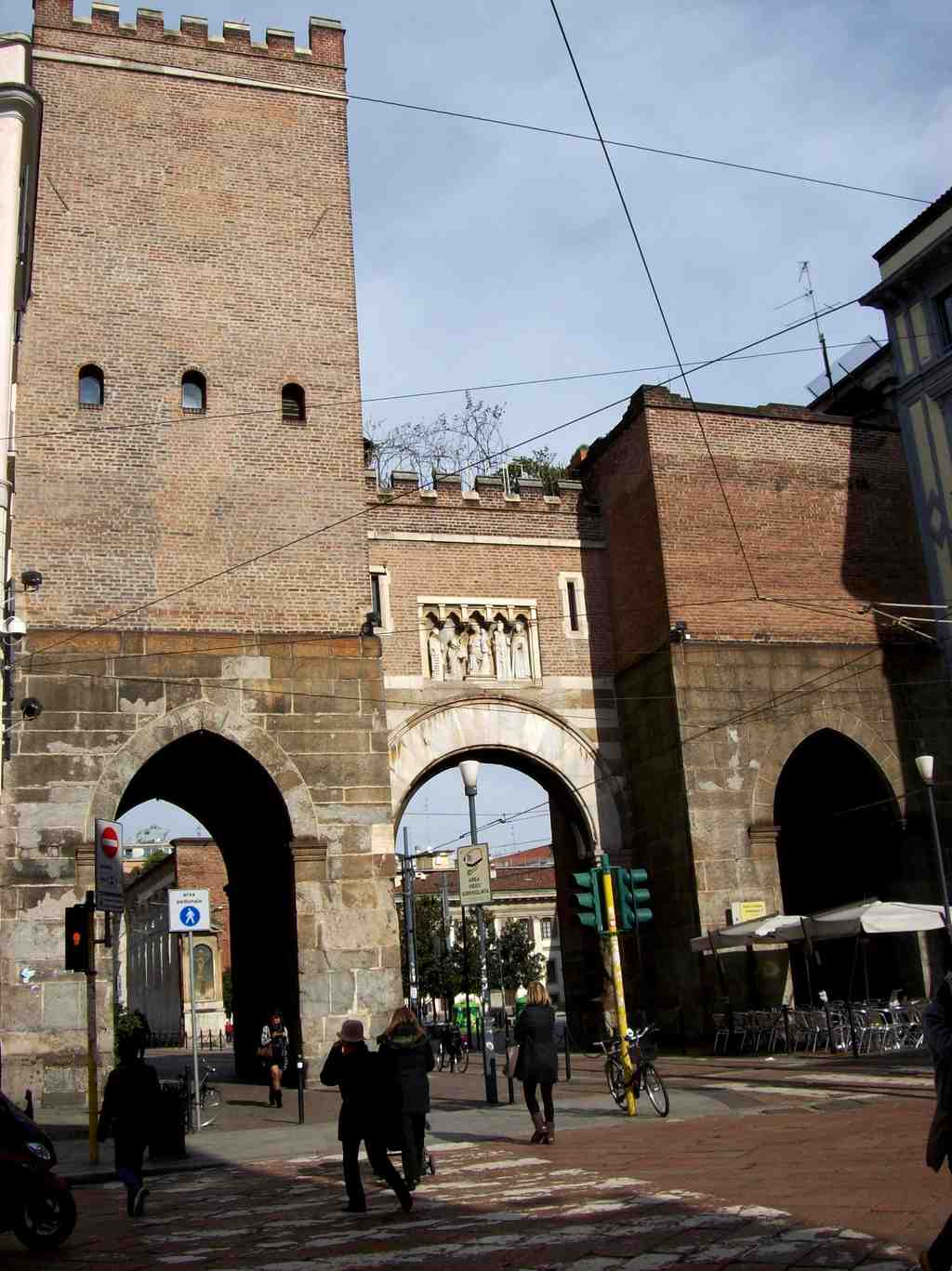
Right in front of you, you’ll see two sturdy stone towers joined by a brick wall with arched gateways and medieval battlements running along the top-look directly toward the broad, fortress-like entrance with smaller stone arches on either side, and you can’t miss the unmistakable outline of Milan’s Medieval walls.
Welcome to one of Milan’s best time machines! These old stones have seen more drama than a soap opera and held more secrets than a magician’s hat. Picture Milan in the year 1156-a city bracing itself for war, with worries as heavy as the walls before you. Back then, it was more swords and shields than designer handbags and aperitivos. The city’s Roman walls had just been smashed by the legendary emperor Frederick Barbarossa during a siege that tore through Milan in 1162. Ouch, that’s what you call a bad day for city planning. So how do you recover? You call in a military engineer-Guglielmo da Guintellino, an absolute whizz from Genoa. With a magician’s flair and probably quite a few tired workers, Guglielmo oversaw the creation of a defensive barrier that was wider, longer, and-well, muddier than before.
These fortifications weren’t made from shining marble or mountain stone. Milan sat far from any good rockpiles, so the workers dug deep and piled up whatever earth they found-then braced it with wooden palisades and built lookout towers from timber. The city’s rivers were recruited, too. The Seveso and the Pudiga were cleverly diverted to fill the new moats, their waters flowing in broad ditches around the city. You weren’t just protected from invading armies-you had city-sponsored water features, centuries before that became trendy.
But no wall lasts forever, especially with pesky things like gunpowder arriving on the scene. The invention of cannons and better siege weapons in the 16th century made these earth and wood fortresses a bit like trying to ward off a thunderstorm with an umbrella. So, the medieval walls were eventually replaced by the mighty Spanish walls, built entirely in solid stone.
Yet, in their heyday, these walls traced a great circle, hugging Milan like a giant protective arm, broken only by gates and smaller pusterle that opened the way to other towns-names you can still spot across the city if you know where to look. There was Porta Romana, where statues kept watch over travelers; grand Porta Nuova with its double arch and traces of ancient portcullises; Porta Ticinese, still standing today with two robust towers; and lower pusterle, those little secret gates for locals and light traffic. Some of Milan’s grandest churches-Sant’Ambrogio, San Lorenzo, San Babila-were outside the walls, sparking the growth of lively settlements and trade.
For centuries, the moats dug around these walls didn’t just defend the city-they hosted boats, turning the Cerchia dei Navigli into a network of watery streets where Milanese rowed and transported goods almost in the shadow of those battlements. You might say it was a city where your loaf of bread could travel by boat before you ate it.
And if you’re hunting for traces of the past, you’re in the right spot: you can see the Porta Nuova here, dating all the way back to the 1100s, those lateral towers leaning forward as if to eavesdrop on today’s traffic. Around the city, other portals survive-Porta Ticinese with its square towers and single arch, and the remains of ancient walls along via San Damiano, almost hidden like secret bookmarks in Milan’s modern story. Even a carved she-wolf from the old Porta Orientale has dodged destruction and now perches on a building in Corso di Porta Venezia. The old moats? They were used for centuries and only finally covered over in the 1930s.
These walls might be battle-scarred and battered, but they set the shape of modern Milan, tracing lines that later roads and neighborhoods still follow, proof that even the toughest defenses can end up charming pedestrians, cyclists, and the occasional digital tour guide like yours truly. So give these stones a wink-they survived emperors, engineers, and the occasional creative city planner. And they’re still standing, after nearly nine centuries of Milan’s highs, lows, reinventions, and aperitivo hours.


