
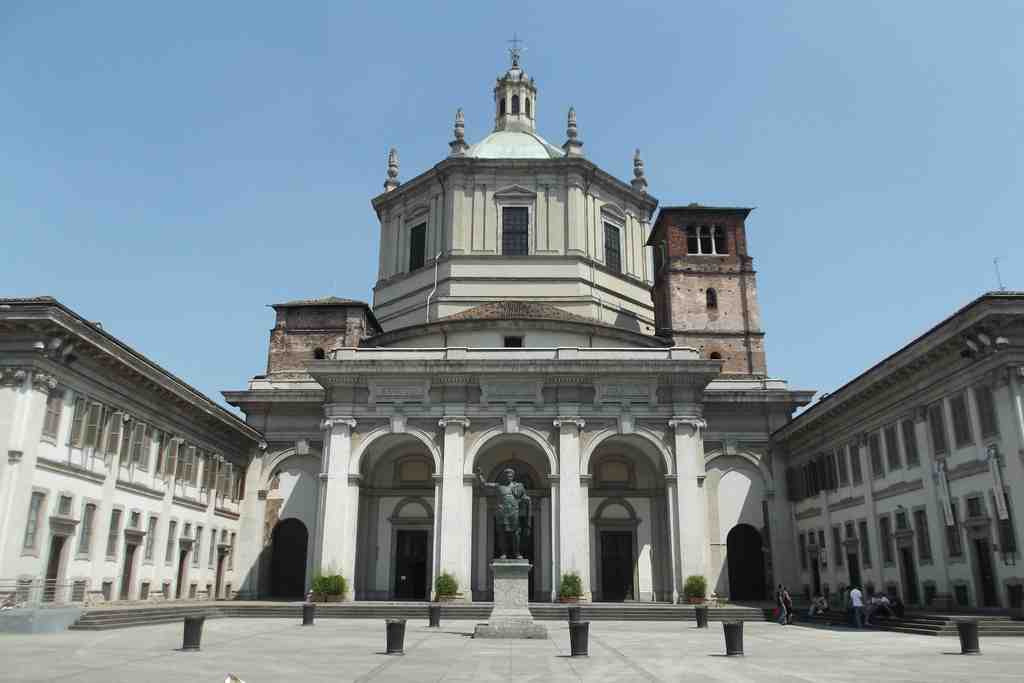
In front of you stands the Basilica of San Lorenzo, easy to spot by its grand, pale stone façade with three arched entrances, a domed octagonal tower rising high above, and flanked by two imposing old brick towers-don’t confuse it with any ordinary church, this one is truly monumental.
Alright, picture yourself right here in Milan almost 1,600 years ago, when emperors strolled these very streets, and the city’s fate teetered between glory and disaster with the breeze. This basilica was built back when Milan was called Mediolanum and was actually the capital of the Western Roman Empire-no small deal! While most other churches brag about their Gothic spires or their fancy decorations, San Lorenzo stands out with its massive octagonal dome. Back in late antiquity, around the year 400, architects here weren’t just constructing another church, they were making architectural history; this is one of the earliest centrally-planned churches in Western Christianity. Imagine the city bustling with Romans, horse carriages bouncing over the cobbles, and priests whispering prayers in echoing Latin beneath these very stones.
The basilica’s story is a true soap opera, complete with disasters, miracles, and rebuilds. In the Middle Ages, San Lorenzo survived not one, not two, but three massive fires! The roof and dome collapsed several times-talk about a leaky problem-and for centuries, Milanese builders raced to patch up the damage. Sometimes it felt like the basilica had more lives than a cat. During one rebuild in the Renaissance, the dome fell again in the middle of a religious ceremony-thankfully, nobody lost their head, literally or figuratively. These non-stop repairs did have a funny side effect: every grand architect who was anybody, from Bramante to Leonardo da Vinci, stopped by to study the place. Bramante even took inspiration from its central plan when he started dreaming up the first designs for St. Peter’s Basilica in Rome!
Now, let’s look a little closer at the building’s curious shape. The church’s floor plan is a tetraconch-don’t worry, that’s just a fancy way to say it’s built around a central square with four grand apses sticking out like the points of a compass. This bold design was so impressive that Renaissance scholars and artists traveled here just to figure out how such a huge dome could sit on such an unusual base. Milan’s river of ideas brought in influences from across the ages: you’ll find ancient Roman columns outside-those tall pillars in front called the Columns of San Lorenzo-looted from a Roman temple that once stood nearby.
But wait, it gets more mysterious. Urban legends once claimed this very spot was haunted by unlucky pagan spirits after an ancient temple to Hercules supposedly burned to the ground. Some said Emperor Maximian had a hand in building it, others swore the mausoleum of Galla Placidia, that legendary imperial princess, was hidden under the church. None of this was ever proved, but the real secret was found only two centuries ago, when archeologists discovered the stone foundations had clearly been set right after the year 390, using leftover blocks from the demolished Roman amphitheater nearby. Now that’s what I call eco-friendly recycling!
Inside, the basilica keeps its time-traveling credentials strong. Two of its oldest chapels-the octagonal Sant’Aquilino and Sant’Ippolito-hide pieces of the earliest Christian mosaics and colored marbles, with Christ and his apostles peeking at you from the walls. The air in those chapels is thick with centuries of incense, marble cool under your fingertips. During a stormy year in 1585, a miracle was said to have happened: a sick woman was cured in front of a painting of the Madonna, and soon enough, donations flooded in to save the crumbling basilica once again.
So as you stand right here, you’re in the company of emperors, ancient architects, curious Renaissance geniuses, and more than a few heroic Milanese repairmen. Next time your roof leaks, just remember: in Milan, a collapsed dome is just another chapter in a never-ending story!
Yearning to grasp further insights on the the early christian remains, architecture or the ordinaries' ordinaries? Dive into the chat section below and ask away.


