
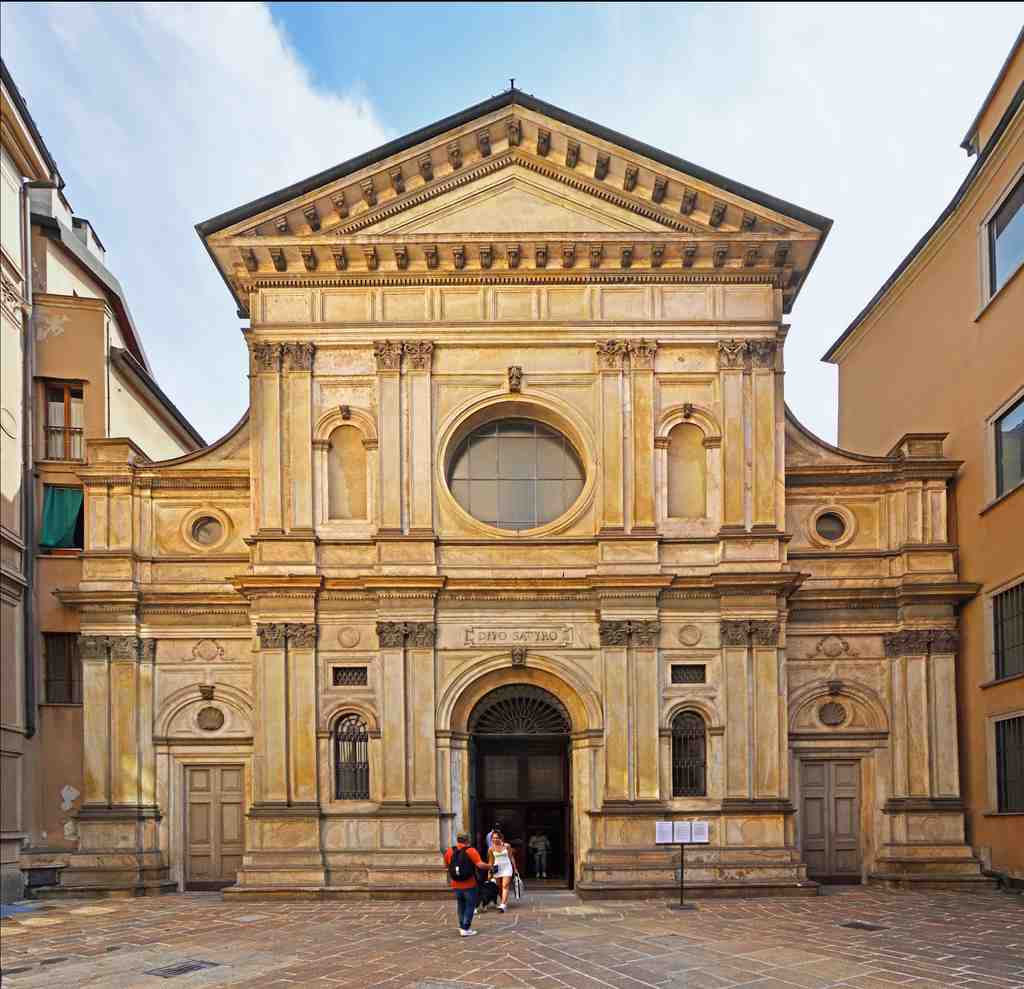
Legend has it that the church is built on the very spot where Archbishop Anspertus erected a primitive place of worship dedicated to Saint Satyrus back in 879, making it a truly historic site. However, the current church that you see today was commissioned by Duchess Bona di Savoia and Duke Gian Galeazzo Sforza in the 15th century.
While Donato Bramante is often credited with the design of the church, recent documents suggest that Giovanni Antonio Amadeo had a more significant role, especially in designing the façade. However, Bramante's touch can still be seen in the sacristy perspective, showcasing his remarkable talent.
Inside the church, you'll find a nave and two aisles with a barrel vault, giving it a grand and spacious feel. The nave is crowned with a beautiful hemispherical dome where it intersects with the transept. As you explore, you'll also notice the Romanesque bell tower, a remnant of the church before the reconstruction in the 1480s. And don't forget to visit the baptistry, which dates back to the 15th century.
Once adorned with white and gold paint, the interior of the church was a sight to behold. Unfortunately, the frescoes by Borgognone were transferred to the Pinacoteca di Brera, but the church still holds an altarpiece of the Extasis of St Philip Neri by Giuseppe Peroni.
One of the most remarkable features of this church is the choir. Due to the presence of Via Falcone behind the church, Bramante had to truncate its depth to only 90 cm. However, he cleverly replaced it with a painted perspective, creating one of the earliest examples of trompe-l'œil in the history of art.
As you explore Santa Maria presso San Satiro, take a moment to appreciate the centuries of history, the intricate architecture, and the artistic masterpieces it holds. It's a true gem within the vibrant city of Milan.




