
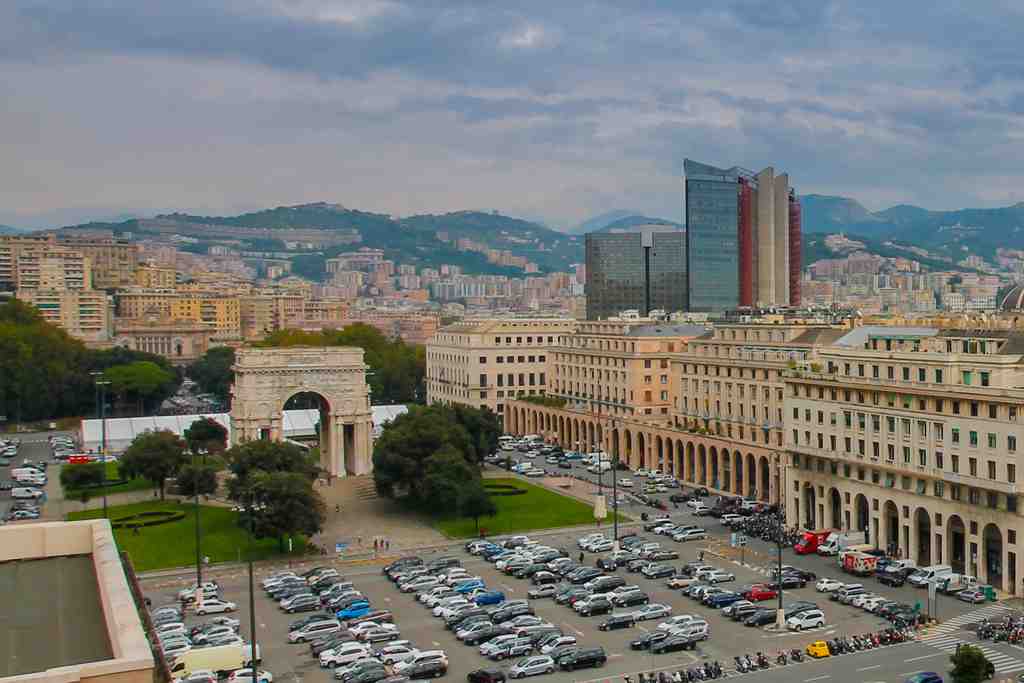
To spot Piazza della Vittoria, look ahead for a vast open square lined with grand marble buildings and dominated by a towering white triumphal arch rising from a patch of greenery-it’s hard to miss if you look towards the skyline just past the busy rows of parked cars.
Welcome to Piazza della Vittoria, the beating heart of modern Genoa! If you stand here and listen closely, you can almost hear the rumble of history echoing between the stately columns and the wide open air around you. This is much more than a parking lot with a fancy arch-though let's be honest, even the cars look classier next to all this marble.
But what if I told you that beneath your very feet, once upon a time, there was a village older than the Parthenon? During construction in the 1980s, workers dug deep to build an underground parking garage and found the probable remains of a stilt house, dating all the way back to somewhere between 4790 and 4460 BC. That’s before pizza was invented-and that’s saying something! Later, near the Brignole train station, archaeologists found an ancient wall and the remnants of old hearths and canals, suggesting bustling settlements and maybe even a prehistoric river port at the mouth of the Bisagno. Imagine the sound of ancient builders at work!
Fast forward a few millennia and this flat space was just a green field by the wide Bisagno River. Today, it’s nearly impossible to picture, but once there were city walls-they called them the "Fronti Basse"-torn down in 1892 for Columbus’s 400th anniversary. What came next? The space became a playground for Genovese families, a ground for fairs, a parade field, and even hosted the wild west thrills of Buffalo Bill’s traveling circus in the early 1900s. Can you hear the cheer of children and the roar of Buffalo Bill’s show?
This square isn’t all just fun and games; it’s also a stage for history’s most solemn and joyful moments. Popes have led open-air masses right here-Pope John Paul II himself twice, in 1985 and again in 1990, and more recently, Pope Benedict XVI in 2008. Even COVID-19 couldn’t stop Genoa’s traditions: in 2020, the city’s brand-new archbishop was ordained outdoors in this very piazza.
Perhaps you’re wondering about the architecture-all these elegant palaces around you, some with columns and sunny arcades. That’s the stamp of Marcello Piacentini and a team of renowned architects and sculptors in the 1930s, during Italy’s Fascist era. Next time someone tells you marble is out of style, just point to these buildings.
And, of course, front and center, the sight that makes this place unmistakable: the Arco della Vittoria, the Victory Arch, built in the 1930s. It’s covered in grand statues and bas-reliefs, a monument to the fallen of World War I. As you look closer, you’ll spot the steps rising behind, the Scalinata delle Caravelle-where the grass is planted to look just like Columbus’ three famous ships. If you ever wondered what a topiary fleet looks like, now’s your chance.
In recent decades, Piazza della Vittoria has become a space for everything-concerts, sporting events, and, my personal favorite, Oktoberfest. That’s right, every September, the spirit of Bavaria fills Genoa with laughter, music, and frothy steins, in Italy’s only officially recognized Oktoberfest outside Germany.
So take a breath and let your eyes wander. Behind the arch, you’ll see old and new Genoa side by side-the Andrea D’Oria High School, echoes of the city’s maritime legacy, and the modern towers of Corte Lambruschini. Connecting you to the rest of Genoa is Via XX Settembre, a vibrant, historic road that ties this huge piazza to Piazza De Ferrari and the Old Port. Even today, military parades sometimes march across the square, just like the old days.
Here you are, at the crossroads of past and present-where ancient river ports meet grand 20th-century vision, and where the spirit of Genoa continually comes alive. Keep your eyes and ears open-you never know what bit of history might surprise you next.


