
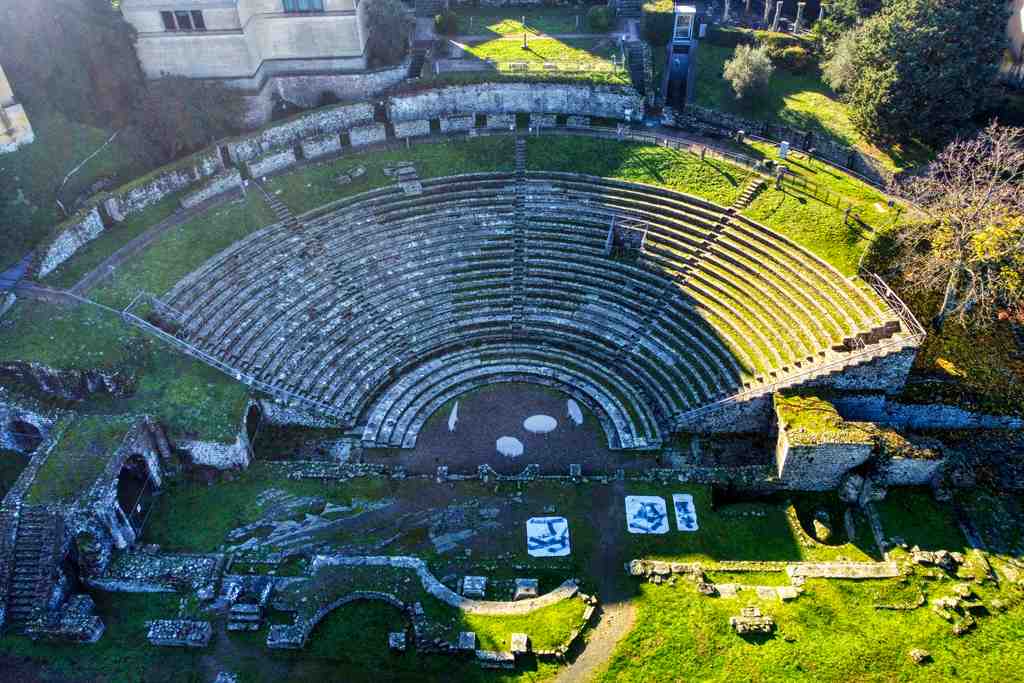
In front of you is a sweeping half-circle of ancient stone steps carved right into the hillside, forming an open-air theatre surrounded by green grass and fragments of old walls-you’ll spot it easily if you look down to your left for the large curve of weathered stone seating facing a central stage.
Welcome to the Archaeological Area of Fiesole-the time machine of Tuscany! If these stones could talk, they’d probably ask you for a standing ovation. Right where you’re standing now, centuries of history lie stacked atop each other, waiting for you to imagine gladiators, priests, emperors, and even a nosy nineteenth-century baron, all making their mark on this hallowed ground.
Let’s start your journey back in time with a little drama… in 1809, Baron Friedman Schellersheim, a Prussian with a keen eye for adventure (and probably a knack for muddy boots), ordered the first archaeological digs at a farm called the "Buche delle Fate"-the “Fairy Holes.” Legend has it, he hoped to unearth magical treasures, but instead stumbled upon ruined arches of Fiesole’s magnificent Roman theatre. For a while, after he found a few bits of Roman handiwork, the baron lost interest and moved on-imagine closing up a treasure chest just because you liked the box better than the jewels! The abandoned theatre was even ransacked for its stones, with chunks of it rumored to have ended up in the great Duomo of Florence.
Fortunately for us, the magic of Fiesole’s ruins wasn’t forgotten forever. In the 1870s, the town bought the land and official excavations began again-this time, the spotlight stayed on for good. In 1911, after more digging, cleaning, and yes, the occasional argument over how to put the rocks back together, Fiesole’s Roman theatre was finally restored for all to see, with the lower seating area still beautifully preserved. Picture this: nearly two thousand years ago, almost 3,000 Romans would have squeezed onto these very stone seats, snacking on olives or bread during summer spectacles.
Now, imagine yourself at the heart of ancient Faesulae, the old Roman name for Fiesole. Right beneath your feet was the city's bustling forum, surrounded by hills and crowned with sacred temples. And take a peek over your shoulder-the little museum building up here was designed a bit like a Roman temple itself (only it’s not quite as old!), sheltering all sorts of ancient treasures from the area. Inside you’d find everything from tragic Greek vases and shining bronze statues to Etruscan urns, each one whispering little secrets about who lived and loved here.
There’s more to see! The ruins behind the theatre are actually Roman baths-yes, the ultimate spa experience, first-century style. You can see the remnants of the calidarium, tepidarium, and frigidarium-the hot, warm, and cold rooms, each with their steamy atmospheres and pools. Someone could have spent a whole afternoon here, hopping from hot to cold, chatting politics, and complaining about the cost of olives.
Step a bit deeper and you’ll find the oldest foundations in Fiesole: the Etruscan-Roman temple. This sacred site dates back to at least the 4th century BC, but may have been used as a temple for even longer-it’s like a spiritual relay race, passed down through the centuries. Its three-side cella probably honored Jupiter, Juno, and Minerva, and archaeologists even dug up a little bronze owl here: a clue from Minerva herself, maybe. At one point, this was a hotspot not just for the gods, but for coins, tombs, and even a Christian church that later rose (and fell) atop these ancient rocks.
And, let’s not forget the “Fairy Holes” themselves-mysterious arches first seen by locals and mistaken for magical burrows, echoing with the rumor of ancient spirits beneath Fiesole’s soil. Even just standing here, you can feel how the whole area hums with stories-of Etruscans, Romans, Longobards, of lost temples, and summer nights when, to this day, you can hear opera or theatre filling the air in the ancient seats. The Archaeological Area is still alive-no magic needed, just a bit of imagination and a love of history. If you listen closely, the stones may tell you their secrets. Just don’t ask them for a song-they’re a bit out of tune after all these years!
Fascinated by the archaeological museum of fiesole, roman theatre of fiesole or the thermal baths? Let's chat about it




