
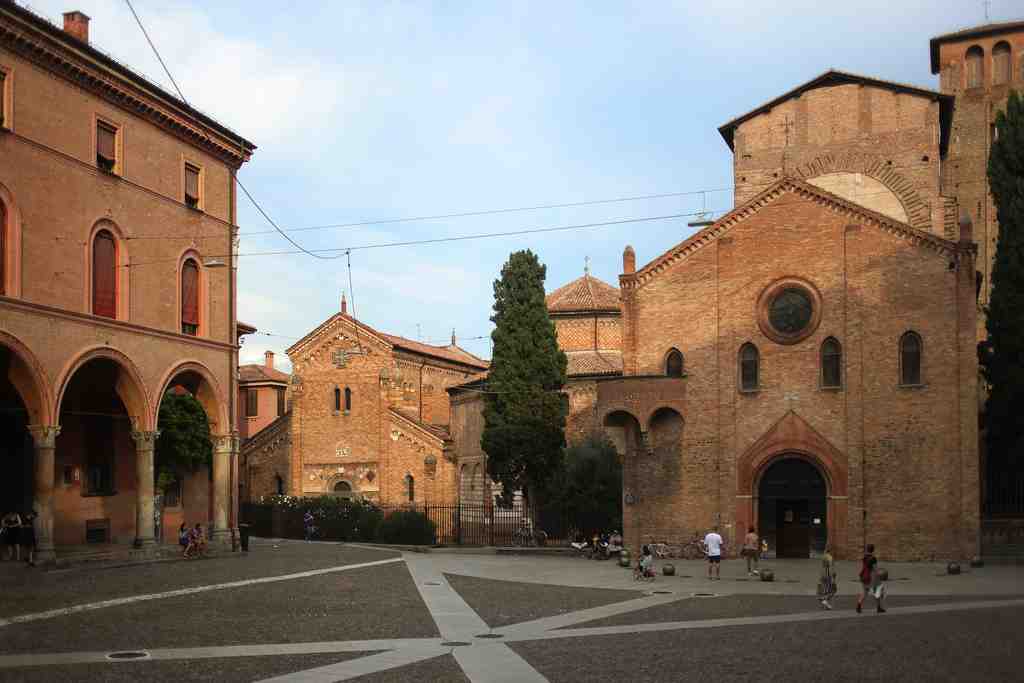
To spot the Basilica of Santo Stefano, look right ahead for a cluster of reddish-brown brick facades-three distinct Romanesque churches side by side, with triangular gables and a rose window above the main entrance.
Now, as you stand before these ancient walls, let your imagination travel back nearly two thousand years, when this very ground was a bustling, sacred place-even if, back then, you might have bumped into a Roman matron instead of a group of selfie-snapping tourists. Picture this: around the year 100 AD, a wealthy woman of Bologna built a temple here, not for any old god, but for the mysterious Egyptian goddess Isis. At its heart stood a round colonnade surrounding a spring-a place of magic, perhaps a whispered wish or two.
Fast forward to the crackling tension of the late 4th century. Bishop Ambrose of Milan, on a holy detective quest, discovered the graves of Vitale and Agricola-the city’s first Christian martyrs. Their devotion had cost them their lives, but their legacy would spark a construction frenzy. Soon, a tiny chapel-maybe just big enough for a few kneeling figures-stood beside the godless temple.
By the 5th century, Bishop Petronius, whose name still rings through Bologna like the chime of a bell, envisioned a basilica worthy of epic tales. The church would not only honor the martyrs but would also serve as his own resting place. Petronius had flair: he sprinkled water from the Jordan River over the old spring-don’t try that with your travel bottle-and transformed the pagan spot into a Christian baptistery inspired by the Holy Sepulchre in Jerusalem. Some say he wanted his basilica to make travelers feel like they’d set foot in the original Jerusalem!
But wait, the story’s just warming up! In 727, King Liutprand of the Lombards swept in, sword in hand, and constructed what’s now the Church of the Crucifix. Yet, if you listen carefully, you might sense the echo of fierce battles from the times of the Hungarian invasions in the early 900s. The complex was nearly demolished-imagine the chaos as monks scrambled to save ancient sarcophagi and precious relics.
During tense reinventions by the Benedictines in the 11th century, they rebuilt with determination: crypts for martyrs, thick defensive walls, the cloister for silent meditation, and the Courtyard of Pilate-named in memory of the place where Jesus was condemned. Look down the sides of the complex; see the strong lines and the nearly fortress-like unity: this is Romanesque architecture at its most captivating.
Now, there’s a good reason locals whisper of “Sette Chiese”-the Seven Churches-because this isn’t just one church but a whole spiritual village! Each layer, each brick, is seasoned with stories. Inside, you’ll find bones of ancient saints, and if walls could talk, they’d tell tales of popes so annoyed by local pilgrim fever that they banished fake relics to stop crowding out the real attractions in Rome. Oh, Bologna knows drama!
Peer to the right of the central door and you’d find, until a few decades ago, medieval sarcophagi that once sheltered the very first bishops of Bologna. Now they’re tucked in the garden. The churches are jam-packed with legends: a Roman column said to be the height of Jesus, and secret rites where local women circled the sacred tomb 33 times, each lap a prayer for the new life within them.
Here’s a detail for you: the oldest nativity scene with life-sized wooden figures ever found is inside this very basilica. Forget Christmas cards; this is three-dimensional history. The Benedictines, and now the Franciscans, have kept watch over these halls-making sure that the voices of saints, kings, and the occasional scandal linger on.
Today, these brick facades stand calm in the sun, but their walls have seen centuries of faith, fear, hope, and even a few stern papal letters. As you step closer, you’re not just a visitor-you’re joining a story that weaves ancient gods, brave martyrs, marauding kings, and generations of Bologna’s sons and daughters. And if you’ve got any secrets or wishes, well-this is still a good place to whisper them.




