
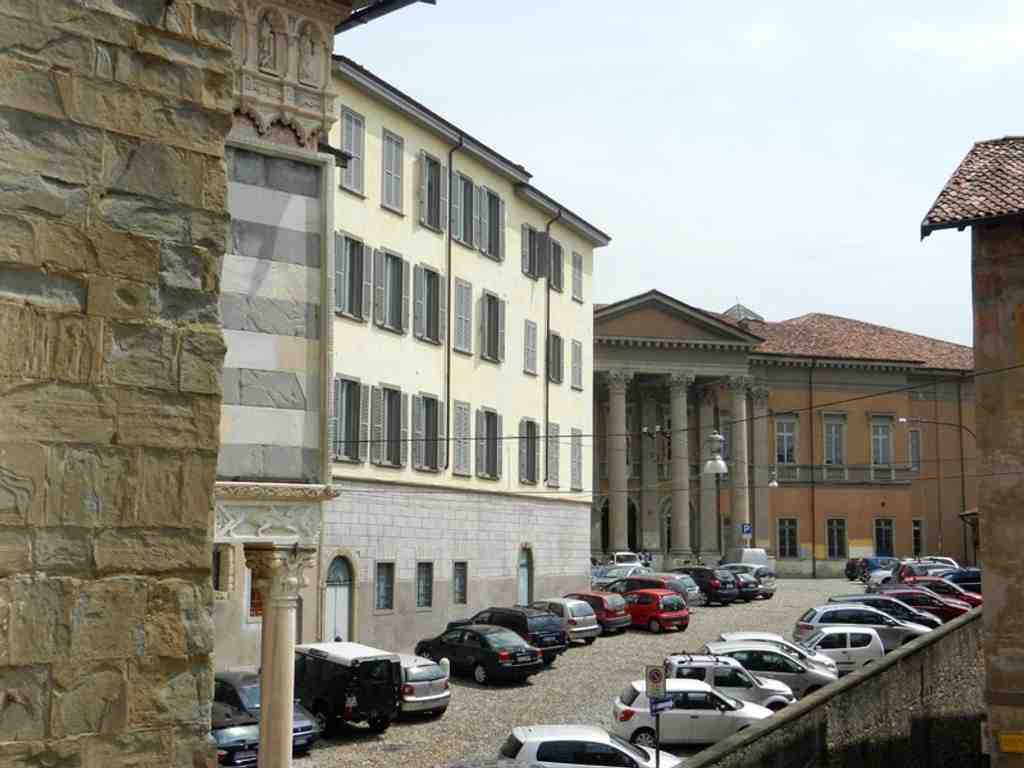
To spot the Paolo Sarpi Classical High School, just glance ahead for a grand, neoclassical building with an impressive porch supported by four giant Corinthian columns-it stands proudly at the far end of the square, slightly set back behind all the parked cars.
Now, let’s step into the world of knowledge, ambition, and maybe a little nervous sweating-welcome to the Paolo Sarpi Classical High School! If these stone walls could whisper, you’d hear Latin declensions drifting through the air and the murmurs of anxious students just before final exams. Founded in Bergamo’s historic heart, this school’s story is richer than a library’s special collection. Your eyes are now met with a regal neoclassical palace dreamt up in 1842 by architect Ferdinando Crivelli, finally finished in 1850-imagine the anticipation! It wasn’t until 1865, though, that the school took on the name of Paolo Sarpi, a sharp-witted Venetian theologian who probably could have debated his way out of a locked room.
Travel back in time-the roots of classical education in Bergamo stretch all the way to 1506, when the city’s thirst for knowledge kicked off with grammar, the humanities, and rhetoric taught by the “Congregazione della Misericordia Maggiore.” By 1566, these halls buzzed as the “Accademia della Misericordia,” only to be suppressed in 1610 (apparently, even schools need a sabbatical). But as resilient as a student pulling an all-nighter, the academy sprang back to life in 1617. Then the plague of 1630 swept through, leaving the school gasping for air. Slowly it recovered, morphing into the Collegio Mariano, where you could almost hear the giggles and groans of students filing in after renovation in 1663.
Fast forward to the 1800s and the Napoleonic era-imagine French uniforms, serious faces, and sweeping reforms. That’s when the school was officially born, on November 15, 1803, first finding shelter in cramped rooms nearby before moving here on the ruins of an old convent. Picture the demolition dust swirling as the old Convent of Santa Maria di Rosate came down in 1844, making way for this stately building with its dramatic U-shaped layout, stone and brick walls, and a sweeping entrance hall where the scurrying of feet echoes history. Pass through those giant columns and stretch your neck skyward-a playground for young minds, but also a parade ground for nerves before oral exams!
Strangely enough, the classrooms have seen transformations that would make even the most seasoned chameleon jealous. The old chapel was once repurposed as a gym, while science labs got a 20th-century makeover, balancing tradition and test tubes. A grand conservation project in the early 1980s brought back lost details and preserved its noble air.
But don’t let all that grandeur fool you. Sarpi is known for its tough love-the academic environment is famously strict. Imagine being an “A” student elsewhere, but here... 6 to 8 out of 10 is pretty common, and the professors guard those top grades like dragons with gold. Many students worry about being "sent to September" (no, it’s not a holiday, but summer study obligations!). Still, the school is a top performer-students have consistently outshone others in national exams, even prompting double-checks from the authorities, just to be sure Sarpi’s excellence wasn’t some sort of wizardry.
As you stand here, know that you’re looking at more than a school-it’s practically a movie star. These halls were the backdrop for films like “Call Me By Your Name” and “Gli Anni e i Giorni,” so if you sense some déjà vu, you might have seen its imposing portico on screen! Today, Sarpi even has its own museum, curated by students and teachers, filled with rare books and scientific treasures, testifying to centuries of local history and the endless pursuit of learning.
So, as you take in its quiet dignity, remember: generations have sweated, dreamed, and even filmed a scene or two right where you stand. If you listen closely, you might just hear the echoes of school bells, history lessons, and someone whispering, “I hope I pass!”
Ready to delve deeper into the statistics, architecture or the image gallery? Join me in the chat section for an enriching discussion.




