
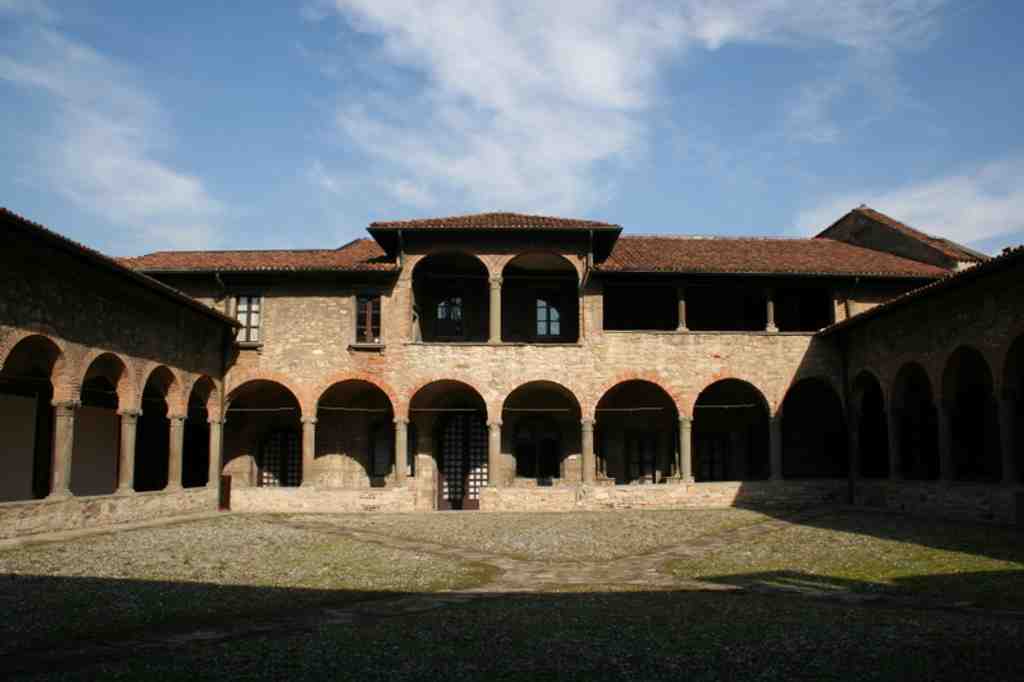
To spot the Convent of San Francesco, look for a broad rectangular courtyard framed with rows of elegant stone arches, topped by a rustic two-level loggia right at the center.
Welcome to the Convent of San Francesco! Take in the cool breeze on Sant’Eufemia hill and stand tall, because you’re in one of Bergamo’s most intriguing spots-just imagine monks quietly walking where you are now, the buzz of the old hay market nearby, and an incredible view that sweeps over the valley and lush mountains, the very same view that has greeted people for centuries.
Our story begins in the early 1200s, when a humble band of Franciscan friars arrived in Lombardy, carrying nothing but faith, a knack for hard work, and a tendency to sleep almost anywhere. At first, they moved from place to place-helping, praying, and probably wondering if someone could invent indoor heating. Legend has it Saint Francis himself may have wandered these hills! After a few hopping attempts, in 1230, the friars finally landed this plot, a generous gift from the Bonghi family. The convent grew, stone by stone, echoing with simple prayers and the sounds of medieval life.
Over time, this became not just any convent. It was a place where a traveling Saint Bernardino da Siena stayed, his visits so famous that even the frescoes in Bergamo record them-picture a wise, gentle man deep in conversation with wide-eyed young friars. A little later, in the 1500s, none other than San Carlo Borromeo called this place home for three action-packed months. Imagine him bustling about, perhaps muttering, “So many churches, so little time…”
But convent life wasn’t always peaceful. Fast forward to the late 1700s, and the air is crackling with excitement-and science! From the church dome and the bell tower, the scholarly Mascheroni and Tadini ran experiments to see how heavy objects fell, racing to test whether things dropped straight down or curved slightly east. It was a real high-stakes gravity show-take that, Newton!
Things took a dark turn when the French rolled in and set up the short-lived Republic of Bergamo. Out went the Venetian lions, and in came soldiers, order after order of religious houses closed, treasures “borrowed” (spoiler, nobody ever returned them), and all sorts of local drama. The convent was seized, its wealth carefully tallied, and-plot twist-turned into a prison for political troublemakers, and later down the line, for just about anyone unlucky enough to get caught. If these stones could talk, they’d whisper stories of hope, fear, and some pretty grumpy monks.
The original three-naved church, grand and bright, is long gone-torn down for a prison in the 1800s. Only the apse and three side chapels remain, but they still hold magical fragments of 1300s frescoes. Look closely and you might see vibrant scenes painted by mysterious masters like the Maestro dell’Albero della Vita and the Maestro della Cappella Bonghi. These fragments, full of gentle faces and deep color, were offerings, prayers in paint, clutching at mercy and beauty in tough medieval times.
Walk this cloister-the Chiostro delle Arche-where noble families once buried their dead. Its arcades, with lovely twin columns and carved Gothic capitals, circle peacefully. The smaller Chiostro del Pozzo, named after its big old well in the center, once featured bright frescoes of Saint Francis’ miracles, though those are mostly lost to time.
Through wars, plagues, prison bars, and even stiff competition for “best yard with a cloister,” the convent has survived. Today, it holds the Bergamo Museum of History’s archives and photos. The old stones may be silent now, but they’ve seen a thousand lives-just don’t try to sleep here overnight, unless you fancy ghostly monks or a stern librarian!
Wondering about the architecture, master of the tree of life or the image gallery? Feel free to discuss it further in the chat section below.




