
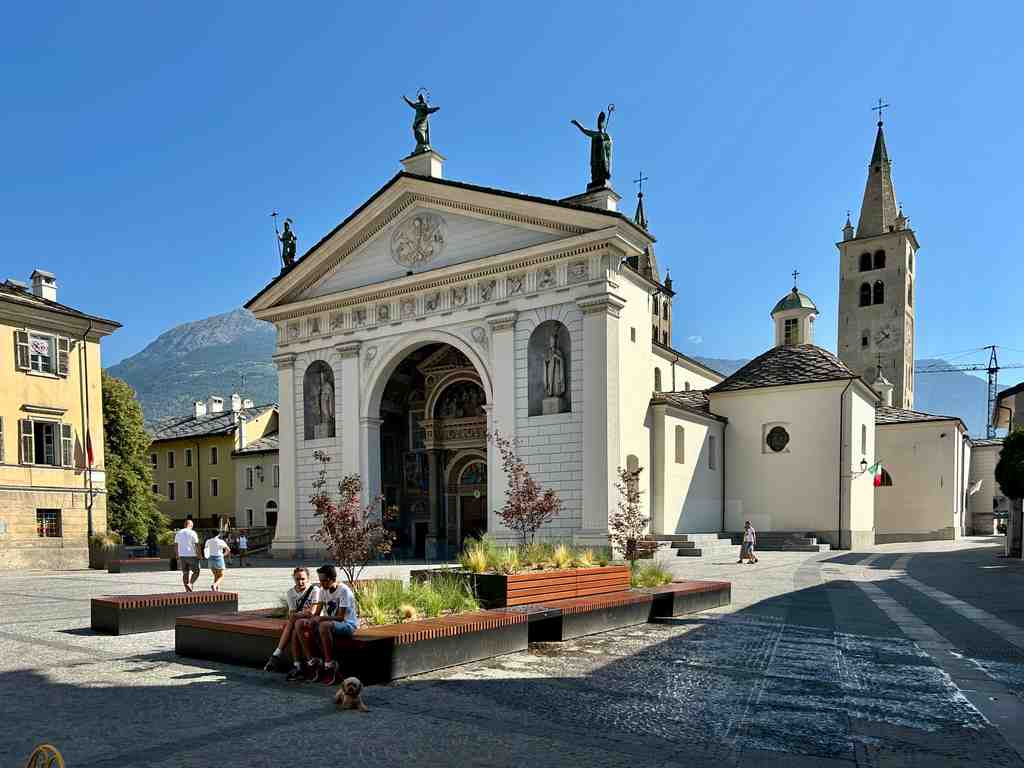
You’ll spot the Cathedral of Aosta by its impressive white neoclassical façade topped with three statues waving down at you like they’re at a very fancy parade-just look to the tall twin bell towers, the tallest in the city, and you can’t miss it.
Standing here, you’re about to enter a time machine hidden in stone and color. The Cathedral of Aosta, or Santa Maria Assunta, has roots that stretch back all the way to the 4th century, when a “Domus Ecclesiae,” an early Christian gathering house, stood right on this spot-imagine people in sandals and tunics whispering secrets of a brand-new faith. Fast forward to the 11th century, when Bishop Anselm I (not to be confused with the other famous Anselm from Aosta, who was a philosopher and later got his own saintly glow-up) rebuilt the church. His vision soared skyward with a Romanesque basilica, three naves, and twin bell towers that still reach above your head today, almost challenging the mountains behind them to a height contest.
If you listen carefully, you can almost hear the echo of monks’ footsteps on cold stone as they entered the cloister for prayer. Over time, the Cathedral was shaped and reshaped by different eras-like a noblewoman changing gowns for every important party. Here came the French-inspired Gothic style in the 13th century, with tall windows and soaring arches. Then the Renaissance gave us that lively, colorful façade you see under the porch, with its painted scenes from the life of Mary and Jesus framed by terracotta busts and figures so expressive they practically wave at you along with the statues above.
Inside, the drama unfolds just as powerfully. You’ll find a large wooden crucifix dating back to 1397 dramatically suspended between the nave and altar, its detail so striking it could almost make you gasp. The sunlight glimmers through medieval stained glass windows, scattering reds and blues onto the stone like confetti. Below your feet, ancient mosaic floors tell their own stories-the Cycle of the Months, showing bustling medieval life, and another with wild beasts, real and imaginary, who are apparently big fans of interior decorating.
Descend into the crypt beneath the main aisle, and you’ll find the oldest part of the church, with mysterious Roman columns reused to support its ceilings-some say it’s because the builders wanted extra strength against further collapse, but personally, I think they just knew how to upcycle. Up above, behind the walls, are medieval frescoes from the 11th century, only rediscovered in 1979, depicting scenes of miracles, plagues, and saints. If you’re lucky enough to catch a tour up to them, you’ll feel as if you’ve stumbled into a hidden art gallery sprinkled with a bit of medieval magic dust.
Through the centuries, the Cathedral has transformed-sometimes for prestige, sometimes for practicality. Nobles and bishops left their mark with fancy tombs and sculpted choir stalls, some complete with carved angels and hidden creatures (keep an eye out for those, you never know where a sneaky little stone lion might be resting). Even the organ here is legendary, once hosting some of Europe’s grandest musicians-a festival so powerful, the vibrations practically threatened the mountain.
So take a deep breath. Imagine centuries of prayer, art, celebration, and daily life swirling around you. Here at the Cathedral of Aosta, every stone whispers a story, every window casts colored light on secrets of the past. And don’t forget, the statues on the roof are still watching-maybe they’ll wave at you as you move on!


