
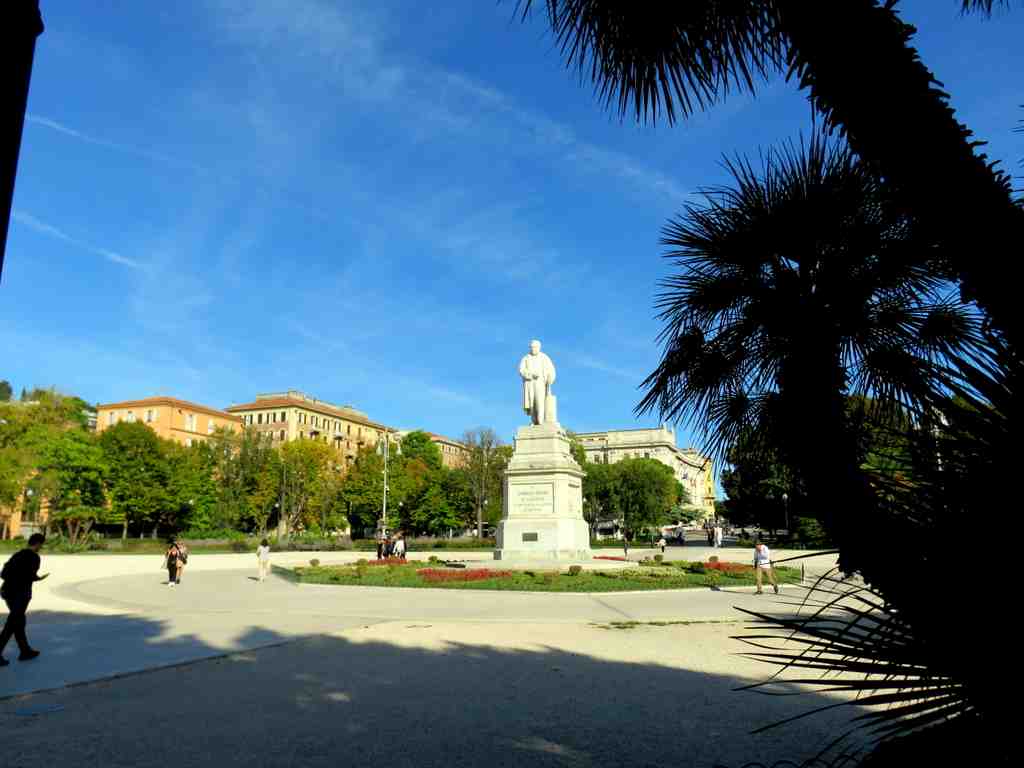
Look for a wide, sunlit square lined with trees and grand buildings, with a statue of a man standing tall at its center-Piazza Cavour is easily spotted by the prominent monument in the middle and the open paths radiating out from it.
You’re now standing in the heart of Ancona’s city life, at Piazza Cavour-a place with more stories than a mischievous grandparent! Take in the scene: wide avenues fan out around you, shaded by rows of old trees and punctuated by the imposing statue of Camillo Benso, Count of Cavour, staring off sternly as if daring the pigeons to come any closer.
Let's wind the clock back to the late 1800s. Ancona’s city planners, riding a wave of optimism after the unification of Italy, wanted to stitch together the growing neighborhoods from the 19th and 20th centuries. Inspired-some might say sneakily-by a vision dreamt up back in the papal days by an engineer named Bevilacqua, they decided that this spot would become the beating heart between “old” and “new” Ancona. The piazza was carefully mapped out, finally greenlit in 1862, and swung open to the public with great fanfare in 1868. At the center they placed Cavour’s statue-crafted by the famous Aristodemo Costoli-because what better way to impress your neighbors than plopping a giant statesman right where everyone’s eye lands?
If you imagine the sound of city horses and bustling traders from the past, you might just hear a ghostly in the air. Fun fact: those reliefs on the statue's pedestal? They capture two major moments from Cavour’s life-the Paris Congress and the proclamation of the Kingdom of Italy. Think of them as Instagram shots from the 1800s, but in bronze.
Originally, the plaza was all about grandeur and military precision. It was planned together with Corso Garibaldi, the elegant boulevard leading right up to it, designed to show off Ancona’s new “first-class fortress” status. The piazza once lay at the city’s very edge, backed up against the old walls and marked by a grand entryway called Porta Cavour. Step forward a few decades and the scene shifts again-in the early 1900s, city architect Guido Cirilli jazzed it up by adding garden beds shaped like a star, planting palm trees that gave the square its exotic edge (and a tiny taste of the tropics-no sunscreen required). The statue, tried its luck at being relocated, but in the end, it kept its prime spot in the middle.
The city’s appetite for expansion gobbled up those old walls in the 1920s, sending Porta Cavour to demolition heaven and stretching the square eastwards. Suddenly, Piazza Cavour was not just a backdrop for processions and proclamations but transformed into a lively bridge between the old quarters and the fresh “Rione Adriatico,” complete with leafy paths and shady benches. Imagine sitting on a stone bench, the famous platans and lime trees rustling above you, while a friendly breeze carries snippets of conversation and the occasional flamboyant pigeon coo.
Look around at the stately buildings: the elegant arcaded Terni and Società Anonima palaces with their fossil-filled footpaths, the grand Palazzo delle Marche, once a railway headquarters, and monumental structures like the Palazzo delle Poste and Palazzo del Popolo. Each side of the square tells its own tale, layering the history from once-formal Italianate gardens to the liberty-styled benches of the 1920s, and even a chic little 1930s fountain perching on stone spheres like four marble scoops of gelato.
Yet for all its grandeur, Piazza Cavour has weathered its fair share of ups and downs-imagine a classic movie montage, with the square bustling, then facing neglect, then springing back to life. Over the years, it saw elegant benches removed, dramatic protests about vanishing palm trees, and passionate debates about historic lamp posts and flowerbeds. But don’t worry-recent restorations have brought back its shine, with plenty of original benches and a thoughtful nod to both design and accessibility.
So as you wander, pause to soak up all these details. Piazza Cavour isn’t just a crossroads of city streets-it’s a crossroad of eras, styles, and stories, echoing with laughter, politics, and the shuffle of feet from every walk of Ancona life. And if you see a particularly opinionated pigeon eyeing that statue, just know-Cavour’s seen it all before!
Interested in a deeper dive into the palaces, vegetation and furnishings or the the 2016 restoration? Join me in the chat section for an insightful conversation.


