
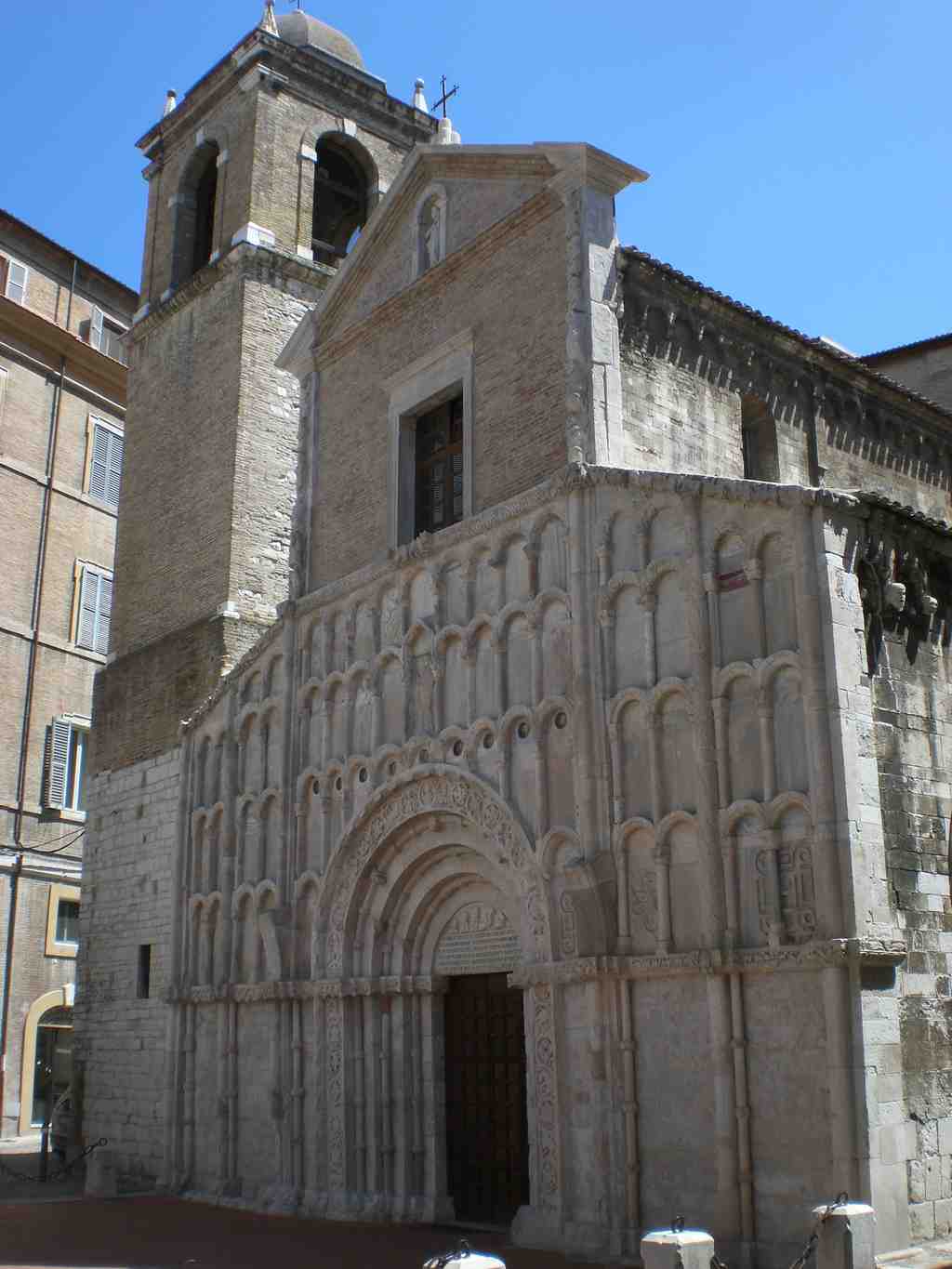
To spot the Church of Santa Maria della Piazza, simply look for a striking stone facade covered in rows of tiny arches and a tall bell tower rising just behind; it stands out among Ancona’s city buildings.
You’re standing in front of one of Ancona’s most spellbinding treasures-no joke, this church is packed with more stories than a gossiping grandmother! Imagine yourself in the ancient Porto district, with salty breezes drifting up from the old marshland and the busy marketplace once filling the square just outside. Right here, where you stand, locals haggled over herbs and fresh fish, and great ceremonies for the city’s leaders took place as Ancona’s lively community swirled around this very piazza.
Now, take a good look at the church’s intricate face. Built between the 11th and 12th centuries, it’s Romanesque at its finest-proudly sturdy, with three naves under a robust wooden ceiling. On the stone below your feet, you’ll spot rows of blind arches, each creating deep shadows in the sunlight, and right in the center, the Virgin Mary carved in Byzantine relief, watching over the church’s ancient portal. There are two more treasures in stone here-a proud peacock and the Archangel Gabriel-looking down as if they’re judging your choice of travel shoes.
But not everything you see is original. In 1690, the top of the facade came tumbling down during an earthquake. Picture stones crashing and dust billowing-a sound I imagine would have been quite dramatic, something like. The collapsed bit was recreated in brick, crowned with a big rectangular window. If this all looks a bit patchwork to you, you’re not mistaken-the church’s appearance changed with each catastrophe and each wave of careful restoration.
Oh, and that stunning entrance isn’t just decoration; the portal is a masterpiece in its own right, surrounded by a wreath of carved vines. There’s a secret: the sculptor, Maestro Leonardo, actually left his autograph on the inside frame, as if to say, “Yes, I made this-pretty good, huh?” And just around the right side, a smaller door shows off a Gothic sculpture of the Visitation, added on a whim a few centuries after the original church went up.
Step inside and you’ll spot another marvel under your feet-glass panels in the floor. Through them, layers of colorful mosaics peek out, swirling and glittering with ancient Christian symbols. Below lies the astonishing key to the church’s mystery: Santa Maria della Piazza was built atop a fourth-century paleochristian church! Imagine the hush and flicker of early candles as the faithful prayed in secrecy, mosaic floors echoing with ghosts of their footsteps. These ancient mosaics, some created after the chaos of the Gothic-Byzantine wars, were already being restored and admired centuries before the Romanesque church was even a sketch on parchment.
There are even older secrets below-ruins of city walls dating back to the Greeks, crumbling beneath layers of later Roman and Byzantine stonework. You’ll spot remnants: the well possibly used for baptisms or maybe just washing very muddy feet, pieces of porphyry columns, and the faint outline of where the city’s bishop once sat.
Scholars have spent years scratching their heads, whispering excitedly that this basement basilica might be the original sanctuary of Santo Stefano-Ancona’s very first cathedral. There’s an altar niche just the right size for venerated relics and a grave for a man named Stefano. Was this the very place Christians gathered while persecution still loomed and the city’s walls were still fresh from the quarry? The mystery hums in the air, waiting for each visitor’s imagination to join the centuries-old speculation.
Of course, all of this splendor almost vanished under layer after layer of later “improvements”-stucco smothered the walls, baroque altars cramped the spaces, and fake ceilings hid the old beams until one day, a team of ambitious restorers in the twentieth century peeled it all back to reveal the church’s original Romanesque heart. Renovations in 1980 opened those glass windows in the floor, finally letting the sunlight fall on ancient mosaics and faded walls once more.
So, whether you’re snapping photos of arches and peacocks or just wondering how Maestro Leonardo managed to get his signature in there, remember: every stone of Santa Maria della Piazza is stacked with stories, jokes, and more than a little ancient drama. Now, how about that for a piazza with personality?
If you're curious about the description, archaeological area of the early christian basilica or the is the early christian basilica the ancient church of santo stefano?, the chat section below is the perfect place to seek clarification.


