
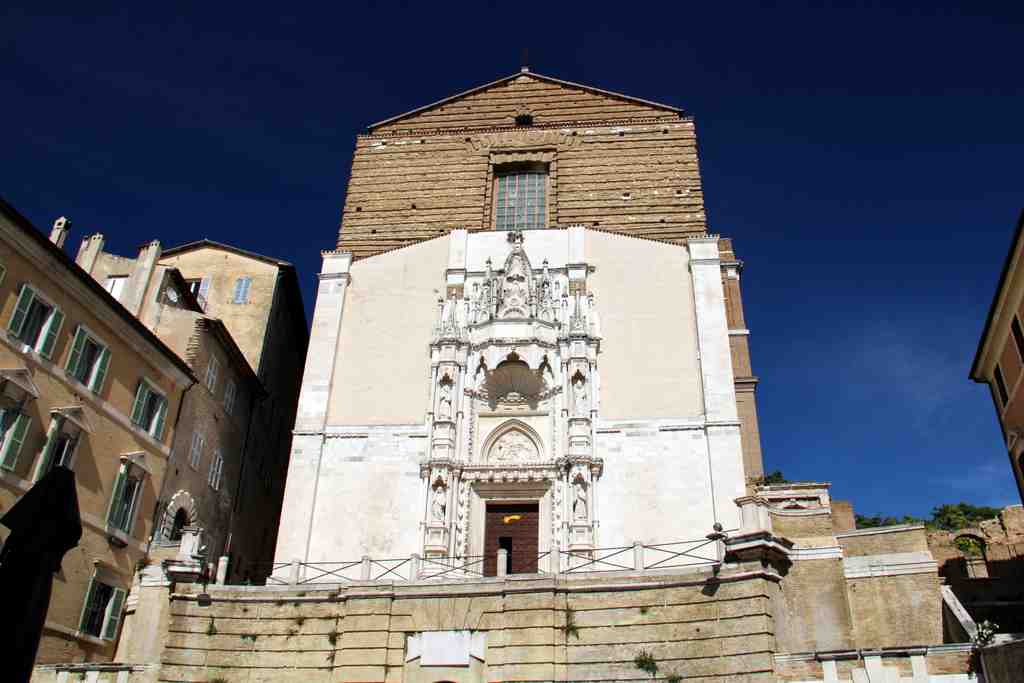
You’ll spot the Church of San Francesco alle Scale right in front of you-just look above the sweeping staircase for a striking white stone façade, crowned with a richly detailed Gothic-Renaissance portal that stands out against the brick upper half.
Standing where you are now, you’re on the very same Piazza San Francesco where, centuries ago, people gathered to witness the birth, and several rebirths, of this extraordinary church. Imagine it’s the year 1323. The city is abuzz as the humble Franciscan friars and Bishop Nicolò degli Ungari begin work on a church dedicated to Santa Maria Maggiore. In those days, this area was very different, but little did the townsfolk know that in 1447, a monumental staircase would sweep up across the entire square, changing its name-and the church’s destiny-forever. If these steps could groan, they’d have stories to tell of everything from prayerful pilgrims to people huffing and puffing, wishing there was an elevator!
It wasn’t long before the church got a fashion-forward facelift worthy of Renaissance Instagram. Enter Giorgio Orsini da Sebenico, a masterful architect-sculptor, who brought magic in 1454 to the very portal you see before you. He’d just worked in Venice, and if you look up, that intricate entrance might remind you of something extravagant you’d expect by the Doge’s Palace-except here, all those flowery Gothic elements are just being show-offs, flaunting their beauty for decoration rather than any boring structural reason. Up close, spot twenty carved portrait heads peeking from the stone, like a lineup of local celebrities frozen in time, and four little niches each holding statues of Franciscan saints including Saint Clare and Saint Anthony of Padua. You might think it’s a Renaissance competition for best spiritual fashion statement-these saints look ready for a heavenly runway!
Above the door, see a stunning relief of Saint Francis receiving the stigmata, while a huge stone shell and a dramatic semi-hexagonal canopy float high up-it's a cocktail of creativity, local stone, and a pinch of artistic ego. Inside, the story goes even deeper: masterpieces by Nicola di Maestro Antonio and a grand painting from Lorenzo Lotto once gazed over the faithful.
Yet, the centuries refused to leave the church alone. In the late 1700s, it was raised and stretched taller, only to lose its graceful medieval chapels. Not long after, during the Napoleonic whirlwind, the stairs were mostly destroyed hunting for water (whoops, turned out to be a real drain-literally and architecturally!). Later still, the church got carved up with new floors and pointy windows straight through its grand façade, becoming, for a time, a civic hospital-imagine getting your tonsils out surrounded by faded frescoes and old saints!
If you think that’s dramatic, in 1944 World War II bombings toppled its bell tower and wrecked the convent. But against the odds, from 1953 onwards, the church was lovingly restored-floors were removed, the original light spilled back in, and the revived portal now glows with its warm, precious Istrian stone. Inside, see if you can sense the resilience. It’s survived war, water-hunters, and modern “remodeling”-if only our homes could bounce back so stylishly!
So, in front of you stands a church that’s equal parts survivor, fashion model, and history book. Now, onward to our next landmark-where the next chapter of Ancona’s story awaits!


