
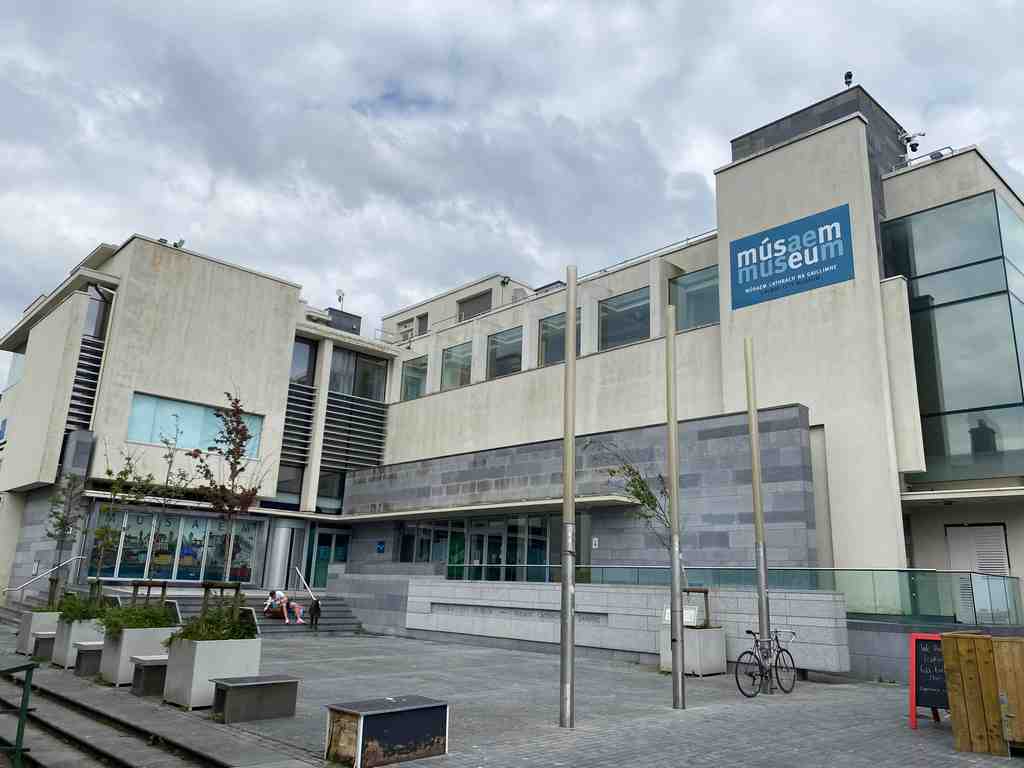
To spot the Galway City Museum, look for a large, modern white and grey building with a blue sign saying “músaem museum” overhead-just to your left as you’re nearing the river and Spanish Arch.
Welcome to the doorstep of Galway City Museum! Before we dive into its rich history, take a deep breath and listen-sometimes you’ll catch the hum of a busy plaza outside, and the swift footsteps of visitors eager to explore Galway’s amazing story.
Picture this: It’s the late 1970s, Galway is bursting with stories, and tucked inside an old private house called Comerford House, a collection of curious medieval stones is quietly gathering dust. This is where our museum began-back then, just a jumble of rocks gifted to the city by the remarkable Clare Sheridan, an artist who also happened to be Winston Churchill’s first cousin. Clare, a woman with stories nearly as colorful as the city itself, lived in Comerford House, which had housed families and transformed through centuries of Galway’s changing face.
Over time, in this cozy house along the Corrib, curators like Etienne Ryan, Michael Keaney, Bill Scanlan, and Jim Higgins began building a lively collection-pieces of Galway’s past from folk life, industry, and even the city’s old militia. The walls of Comerford House, originally meant for family dinners and maybe the occasional ghostly creak, soon echoed with the sounds of laughter, storytelling, and the shuffling of curious school children. I imagine if stones could talk, Galway’s collection would never stop gossiping!
Eventually, in 2004, the little house just couldn’t contain the centuries of stories piling up inside. The solution? A brand-new, modern museum building-right here behind the old museum-and opened in 2007 with a whoosh of excitement, right beside the ancient Spanish Arch. The designers, Ciaran O’Connor and Ger Harvey, set out to balance sleek architecture with Galway’s medieval spirit. They crafted the building as an ‘L’ shape, hugging the space to allow sunlight to pour down into the square between the museum and the old archway-at times echoing with city-wide celebrations or the wanderings of tourists with dripping ice cream cones.
Inside, the collection waiting for you is like Galway’s own attic, filled with treasures from every corner of its past. Wander through and you’ll find farm and industrial tools from the legendary DJ Murphy collection-over 300 bits and bobs, from straw-crafted oddities to forgotten metal implements. Peer into the Medieval Stone Collection and you’ll see chips of rock and carved plaques from actual 16th and 17th century buildings, some long gone. There’s the grand Atty Doorway, built in 1577, and ornate fireplaces from Galway’s lost mansions, their ancestral arms carved deep into the stone, hinting at old family rivalries.
On a quieter note, walk towards the Claddagh collection-ghostly, colorful aprons and shawls, a miniature village set up as if ready for fishermen to return. You might spot fishing boats, navigation books, and the legendary tools of John Reney, the last of the Claddagh boat builders. Imagine his hammering, saws singing out as he built boats once dragged right to these riverbanks.
But Galway’s history doesn’t stop with stones and sails! The museum brims with memories of the city’s shops, distilleries, and the rhythmic bustle of public houses from the 19th and 20th centuries-a reminder that Galway’s lively spirit didn’t come from the quiet, but from the clinking of glasses and the chatter of friends. There’s even a receipt book from the no-nonsense Magdalene Laundries: a glimpse into another chapter of the city’s story, sometimes solemn, sometimes full of hope.
Don’t miss the beautiful and haunting artwork-Tiger Lillies, Madonna and Child, and photographs from Derek Biddulph that freeze Galway life from the 1950s onward: children in doorways, shopkeepers in heavy coats, the city’s faces changing with the decades.
There’s an air of magic and mystery in the exhibitions here. Some include swords and maces fit for a Mayor, nearly lost paintings on loan from private collections, and delicate altar silver crafted by Richard Joyce, the original designer of the famed Claddagh ring. You can almost imagine the glint of ceremony and festivity, the proud clang of a mayor’s mace, or the clatter of coins and cannonballs during the city’s wilder days.
Today, this museum isn’t just a storehouse of dusty artifacts-it’s the keeper of Galway’s heart, gathering new stories every day from its bustling plaza. You stand before a window into the city’s deepest secrets and wildest adventures, a place where every corner holds a new tale that’s just waiting for you to discover.




