
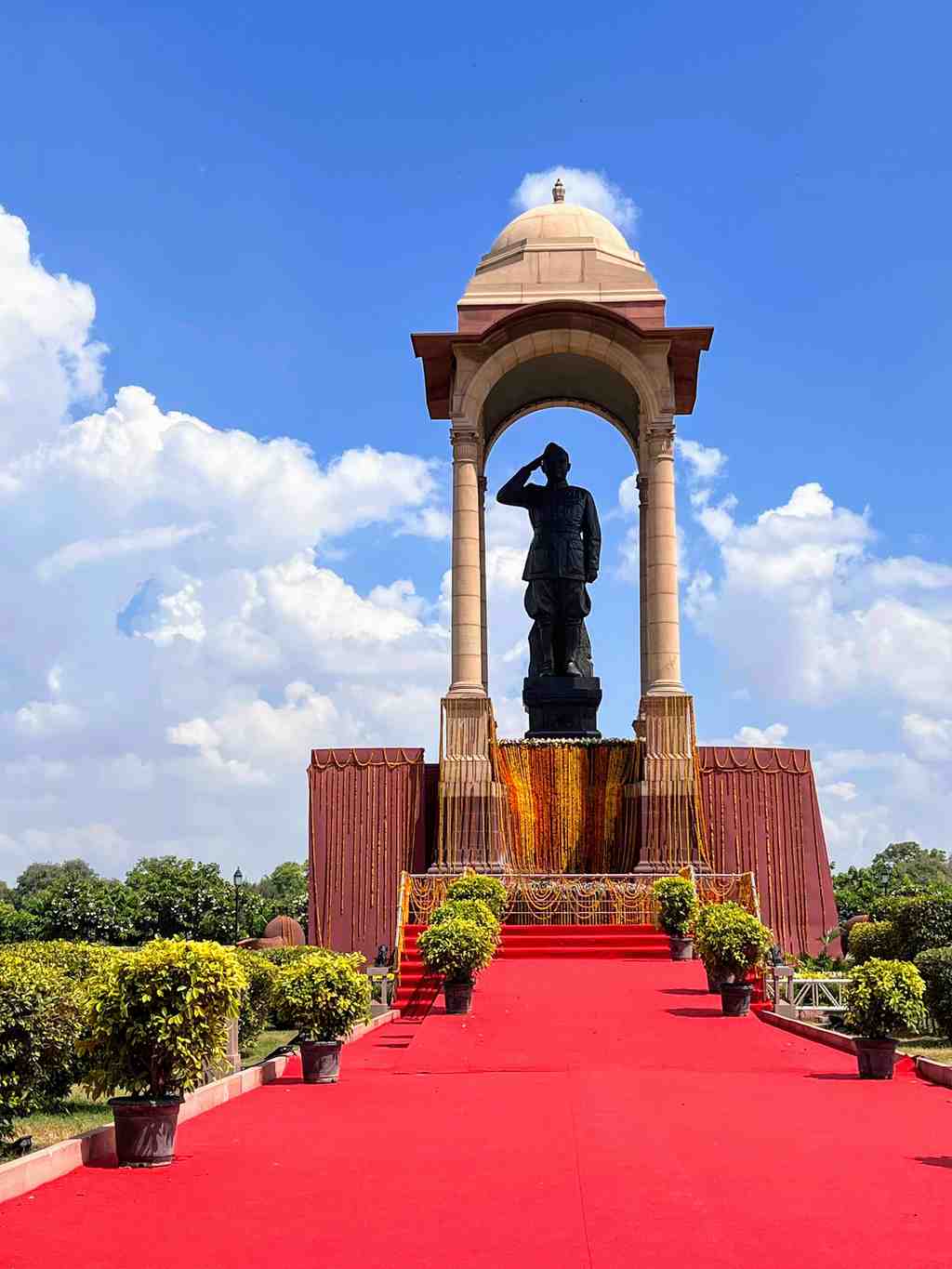
The Statue of Subhas Chandra Bose, also known as the Netaji's Statue, is a remarkable landmark made of black granite. It stands as a tribute to Netaji Subhas Chandra Bose, a valiant freedom fighter and the Commander-in-Chief of the Indian National Army. The statue reaches a total height of 28 feet (8.5 m), with a width of 8 feet (2.4 m).
Situated under a canopy behind India Gate in Delhi, the statue was skillfully sculpted by renowned artist Arun Yogiraj, hailing from Mysuru. Yogiraj has also created the impressive Statue of Adi Shankaracharya in Kedarnath.
At its dedication ceremony in 2022, esteemed individuals including Prime Minister Narendra Modi, his cabinet members, MP Hardeep Singh Puri, G. Kishan Reddy, and Arjun Ram Meghwal graced the event. Subhas Chandra Bose was an Indian nationalist who not only served as the second leader of the Indian National Army but also headed the Provisional Government of Free India.
Initially, Bose had joined the National Congress and was elected twice as its president. Later, he went on to form the All India Forward Bloc. However, in 1941, Bose was placed under house arrest by the British government, with constant surveillance on his residence by the CID. Despite this, he managed to escape to Germany via Afghanistan and the Soviet Union, finally arriving in Singapore from Germany.
In 1943, Bose revived the concept of forming an army for India's independence. During a meeting held in Singapore, Rasbihari Bose handed over control of the Indian Independence League to Subhas Chandra Bose. With his effective leadership, Bose was successful in reorganizing the army and garnering widespread support among the Indian diaspora in Southeast Asia.
Notably, the installation of a statue of King-Emperor George V on the canopy of India Gate in 1936 was met with opposition from Indians. Though the statue remained in its original position for two decades after India's independence in 1947, objections arose, particularly after the tenth anniversary of independence and the centenary of the 1857 Indian Rebellion.
On the night of August 12-13, 1958, George V's royal insignia and the Tudor crown atop the canopy were removed. Following mounting pressure from socialist members of Parliament, Deputy Home Minister Lalit Narayan Mishra announced in May 1964 that all British statues would be taken down from the national capital by 1966.
Two days prior to Independence Day in 1965, members of the Samili Samajtantrik Party forcefully gained access to the site, vandalizing the statue by defacing its royal crown, nose, one ear, and attaching a picture of Subhas Chandra Bose to the monument.
Eventually, in late 1968, the statue was relocated from its position under the canopy. In 2021, Indian Prime Minister Narendra Modi announced the construction of the Statue of Subhas Chandra Bose. The statue was intended to be placed on the canopy of India Gate as part of the 'Azadi Ka Amrit Mahotsav,' commemorating 75 years of independence and celebrating Bose's 125th birth anniversary.
On January 23, 2022, a hologram statue of Subhas Chandra Bose was installed during the 'Parakram Diwas' ceremony with Prime Minister Narendra Modi unveiling it. The statue was officially dedicated on September 8, 2022, by Prime Minister Narendra Modi, marking a significant moment in the nation's history. In the inauguration ceremony, the Prime Minister emphasized, "Today, when George V's statue is replaced by Netaji's statue, it marks the first instance of the abandonment of the slavery mentality."
Located at the center of the C-hexagon, the statue is surrounded by other notable attractions such as India Gate, Param Vir Memorial, National War Memorial, and Children's Park. It stands within a canopy and is situated in a water body adorned with fountains. The imposing black granite statue measures 28 feet (8.5 m) in height, 10 feet (3.0 m) in length, and 8 feet (2.4 m) in width, weighing approximately 65 tons (65,000 kg).


