
Hyderabad Audio Tour: A Journey Through Time
Under the watchful eyes of palace clocks still ticking after centuries, Hyderabad hides stories that shimmer just out of sight. This self-guided audio tour leads you through the grandeur of Chowmahalla Palace and the bustling chaos of Laad Bazaar, revealing secrets woven into alleyways and royal courtyards. Why did a palace clock become the symbol of relentless loyalty for generations? What scandal unraveled behind the glittering walls where royalty once held court? Who sparked a rebellion with nothing but a bangles stall as their stage? Step past glossy shopfronts and through marble halls to relive political power struggles, family betrayals, and curious mysteries long forgotten by guidebooks. Move from royal opulence to market vibrance and taste the thrill of discovery in every step. Ready to see Hyderabad’s hidden side shine brighter than its bangles? Press play and begin your journey into the city’s beating heart.
Tour preview
About this tour
- scheduleDuration 70–90 minsGo at your own pace
- straighten2.6 km walking routeFollow the guided path
- location_on
- wifi_offWorks offlineDownload once, use anywhere
- all_inclusiveLifetime accessReplay anytime, forever
- location_onStarts at Chowmahalla Palace
Stops on this tour
lock_open 3 free previews · 9 unlock with purchase
Once the bustling hub of the mighty Asaf Jahi dynasty, this palace reeks of history, mystery, and just a smidge of opulence. Built starting in 1769 under Nizam Ali Khan Asaf Jah…Read moreShow less
Once the bustling hub of the mighty Asaf Jahi dynasty, this palace reeks of history, mystery, and just a smidge of opulence. Built starting in 1769 under Nizam Ali Khan Asaf Jah II, it consists of four distinct palaces - hence the name "Chau Mahal", or "Four Palaces" - and yes, it’s as symmetrical as a math problem. Imagine this: you're in the presence of the grand Khilwat, the Darbar Hall where the Nizams held court. Picture a hall decked out with 19 dazzling Belgian crystal chandeliers - throw in a marble platform where the royal Takht-e-Nishan once sat, and you’ve got yourself a royal spectacle. Fun fact: the Chandeliers were recently reinstalled, probably to make us all gasp in awe - mission accomplished, right? The architecture is nothing short of a cosmopolitan cocktail - Mughal domes, Persian elements, and European columns all coalesce to give this palace its unique splendor. What’s cooler than that? Maybe the vintage Rolls-Royce chilling in the palace grounds - the original Uber for the Nizam Kings. Gaze at the two courtyards, adorned with fountains and lush gardens that could make your local park green with envy. Don’t miss the Bara Imam corridor - a long hallway with rooms that were once the palace's administrative nerve center. And right opposite? The Shishe-Alat, the mirror image that housed special guests - talk about five-star accommodations! Plan your visit timing just right, and you might catch a whiff of historical romance emerging from its restored sections, thanks to the meticulous restoration work completed in 2010. If you're someone like me who can’t resist checking the time every now and then, look up to the Khilafat clock in the palace's gateway. It's been ticking away since 1750, wound weekly by an expert family of horologists. Talk about dedication! Soak it all in, embrace the regal vibes, and maybe, just maybe, you’ll leave feeling a bit more royal yourself. Ready for the next stop? We’ve got plenty more treasures to uncover! Seeking more information about the southern courtyard, northern courtyard or the khilwat mubarak? Ask away in the chat section and I'll fill you in.
Open dedicated page →You’re standing in the midst of history here. This clock tower is not just any clock tower; it’s a work of art in Turkish style. Notice the four large clocks on its sides? They…Read moreShow less
You’re standing in the midst of history here. This clock tower is not just any clock tower; it’s a work of art in Turkish style. Notice the four large clocks on its sides? They ensure that no matter which way you’re coming from, you can always tell the time. It’s like the city’s very own omnipresent timekeeper! The tower stands proud in the middle of a quaint little garden, giving it an extra touch of charm. And guess what? You’re just west of the famous Charminar and not far from the bustling Laad Bazaar. So, you’re perfectly positioned to delve deeper into Hyderabad’s rich heritage. But hey, keep an eye on the time-pun totally intended-because we've got more spectacular stops ahead!
Open dedicated page →

Show 9 more stopsShow fewer stopsexpand_moreexpand_less
Ah, welcome to the grand Charminar-Hyderabad's own superstar monument! If the city had a fashion runway, this would definitely be the showstopper. Built way back in 1591 by…Read moreShow less
Ah, welcome to the grand Charminar-Hyderabad's own superstar monument! If the city had a fashion runway, this would definitely be the showstopper. Built way back in 1591 by Muhammad Quli Qutb Shah, the Charminar literally means "four minarets" in Persian, and let me tell you, those minarets are as iconic as they come. You see these four towers? They’ve been standing tall for more than 425 years, kind of like the wise old grandpas of Hyderabad's skyline. The top floor even features a mosque that has been a place of worship all this time. Constructed as a commemorative symbol for the eradication of the plague, the Charminar was designed right at the heart of the city, making it the ultimate centerpiece. It’s like the jewel in Hyderabad’s crown, surrounded by the bustling Laad Bazaar to the west and the majestic Makkah Masjid to the southwest. The Charminar is a fusion of elegant Indo-Islamic architecture with a sprinkle of Persian elements. Imagine it as a 16th-century architectural smoothie-deliciously intricate and forever stylish. And did you know it was built at the crossing of historic trade routes? Think of it as the Times Square of ancient Hyderabad. All roads lead here, folks! Ever heard of those grand festival celebrations like Eid? Well, the Charminar is often the life of the party, adjacent to Makkah Masjid where gatherings are vibrant and spirited. Plus, the local markets surrounding the Charminar are a shopper’s paradise. You can find everything from bangles to spices-just follow the swirl of colors and scents. So, there you have it-a monument with minarets, markets, and more history than you can shake a stick at. Let's continue our journey and see what other treasures Hyderabad has in store! Curious about the structure, surrounding area or the influences? Don't hesitate to reach out in the chat section for additional details.
Open dedicated page →Set up in 1783 AD by the second Nizam of Hyderabad, Nawab Mir Nizam Ali Khan, the Gunfoundry was not about art or culture but about firepower. It was a cannonball factory, right…Read moreShow less
Set up in 1783 AD by the second Nizam of Hyderabad, Nawab Mir Nizam Ali Khan, the Gunfoundry was not about art or culture but about firepower. It was a cannonball factory, right here in Fateh Maidan, to supply the Nizam’s imposing arsenal. Now, I know what you’re thinking: What does a cannonball factory look like? Imagine brick walls that once soared to 50 feet high, with square-shaped bricks assembled with lime mortar. It's like Lego, but, you know, for grown-ups who had a thing for cannonballs. Unfortunately, due to poor maintenance, those proud walls have sadly shrunk over time-like that expensive sweater you washed in hot water by accident. Housing monumental history, this foundry was one of several set up by French general Michel Raymond, who served the Nizam. Michel was the kind of military officer who didn’t just bring his A-game, he brought his whole alphabet of expertise. Out of all the foundries established, this is the lone survivor from the 18th century-a fascinating relic whispering stories of its molten iron past. If you gaze around, you'll see the Aliya High School for Boys and Mehboobia College for Girls across the road. I guess you could say they are in cannonball distance. Just kidding, don’t try that at home! So, my friend, as you stand here, take a moment to imagine General Raymond supervising the smelting process with all its sparks and smoke. Picture the red-hot metal being poured into molds, eventually cooling into deadly cannonballs. History definitely has a way of making even the most mundane places seem epic, doesn't it? Alright, let’s move on to our next stop. Get ready to clock some more steps and stories!
Open dedicated page →You’re standing outside the largest mosque in Hyderabad, and one of the largest in India, capable of hosting a whopping 10,000 people! Imagine the grand Friday prayers here, it's…Read moreShow less
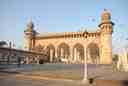
You’re standing outside the largest mosque in Hyderabad, and one of the largest in India, capable of hosting a whopping 10,000 people! Imagine the grand Friday prayers here, it's like a football stadium but without the footballs and cheers. Built in the 17th century, this mosque holds a prestigious spot in the history and culture of the Old City. Muhammad Qutb Shah, the sixth ruler of the Qutb Shahi dynasty, wasn’t just any ordinary builder - he had a flair for the dramatic. He had bricks made from soil brought all the way from Mecca, the holiest site of Islam, and used them in constructing the central arch. Talk about adding a personal touch! Construction of this impressive structure began in 1617, and it was finally completed in 1693 under Mughal Emperor Aurangzeb's watchful eyes. Fun fact: around 8,000 workers were employed to bring this masterpiece to life. It took five years just to quarry the stone for the three-arched facades - that's patience and craftsmanship! As you marvel at the grandeur, consider the words of Jean-Baptiste Tavernier, a French explorer who visited during its construction. He noted that the effort to carve and transport that enormous stone required was so immense that it involved 1,400 oxen! No wonder the guy was impressed. One grim chapter in its otherwise grand history is the bombing incident of 18 May 2007, when a bomb exploded during Friday prayers, causing loss of life and injuries. However, the resilience of this mosque and its community shines through. Let's talk about its architecture. It’s not built from any old rubble or plaster-nope, only the finest dressed stone here. The prayer hall is vast, measuring 225 feet by 180 feet, and has a high ceiling that reaches up to 75 feet. The facade features five open arches flanked by minarets topped with domes. To your left, you'll see the sahn, or courtyard, complete with a historic sundial and remnants of a hammam. And don't miss the marble tombs of the Asaf Jahi rulers - though, funnily enough, the first and last Asaf Jahs are missing! The mosque’s minarets, each adorned with elegant, circular balconies and octagonal inverted platters, ascend until crowned by a majestic dome and spire. They’re like grand ushers guiding your eyes upward in awe. Well, that’s the scoop on Makkah Masjid! Ready to move on to the next spot? Watch your step as we head towards the Mahboob Chowk Clock Tower!
Open dedicated page →Greetings, explorer! And welcome to the Bhagyalakshmi Temple, standing right next to the iconic Charminar. This shrine is dedicated to the Hindu goddess Lakshmi, the deity of…Read moreShow less
Greetings, explorer! And welcome to the Bhagyalakshmi Temple, standing right next to the iconic Charminar. This shrine is dedicated to the Hindu goddess Lakshmi, the deity of prosperity and good fortune. You see, it’s a juxtaposition of history and belief where vibrant religious devotion meets the crossroads of historical preservation-a bit like when your smartphone needs an update just as you’re explaining an ancient landmark! Now, this temple stirs up quite the conversation. Its origins? Well, think of it as the celebrity whose birthdate is shrouded in mystery. Some say it popped up in the 1960s during a time of bustling local activity. It’s like saying, "No, my love for vintage vinyl records didn’t start with my Spotify playlist... honest!" Interestingly, there’s some passion-laden lore here. It was originally just a guard stone, meant to protect the walls of Charminar. However, around the 1965 mark, a transformation began: the plain stone was painted saffron, and an old woman became its first caretaker. Talk about a magical makeover! Forget “Queer Eye”-this was “Clear Eye,” seeing potential where no one else did. But there’s been a tug-of-war ever since. Divine devotion met bureaucratic binders when the Archaeological Survey of India (ASI)-think of them as the ‘historic guardians’-declared the temple unauthorized. Local and cultural interests clash with preservation laws like oil and water. Over time, each side said, “Stop in the name of love, before you break my shrine!” Yet, no expansion has been allowed since 2012, per the Telangana High Court’s decree. Amidst all the drama is a string of belief connecting back to old folklore and a rich historical tapestry. Perhaps the ultimate message here is that Hyderabad’s culture is as blended and composite as a perfectly made biryani-both religious icons and historical monuments coexist, echoing the unity and diversity of this vibrant city. So, as you stand here, think of all the layers of history, passion, and law that have shaped this small yet significant spot. And hey, maybe give a nod to Goddess Lakshmi for some extra good luck on the rest of your adventurous tour! Ready for the next stop?
Open dedicated page →This is no ordinary roundabout. You're in the presence of a 400-year-old fountain that's been through more transformations than a superhero in a comic book. Originally, this…Read moreShow less
This is no ordinary roundabout. You're in the presence of a 400-year-old fountain that's been through more transformations than a superhero in a comic book. Originally, this fountain was called "Char-Su-Ka-Hauz," perfectly situated in the center of the Guard's Square-also known as Jilu Khana. It started off as a 12-sided wonder, but much like a teenager trying out new hairstyles, it became octagonal and eventually evolved into the more circular shape you see today. Makes you wonder what shape-shifting magic was behind that! Imagine being one of the Nizam’s soldiers, parched from patrolling these parts, and being greeted by the fresh, quenching streams flowing from this very fountain. It was constructed by Mir Momin Astarabadi, the first Prime Minister under Mohammed Quli Qutb Shah, so you know it had to be top-notch! But wait, there’s more! This fountain doesn’t just rest on its ancient laurels; it got a makeover in 2023. So, you’re standing next to a beautifully refurbished piece of history. It’s kind of like a celebrity who has gracefully aged and yet still goes to the spa. So, take a moment to appreciate the blend of old and new right here at Gulzar Houz. And, if you're feeling thirsty, thank your lucky stars you're not a soldier from 400 years ago-finding a water bottle today is a lot easier! On to our next stop? Let’s keep this adventure rolling!
Open dedicated page →So, Char Kaman, meaning "four gates," consists of-you guessed it-four arches. Their heights are quite impressive at fifty feet each, surrounding an open square where a grand Qutb…Read moreShow less
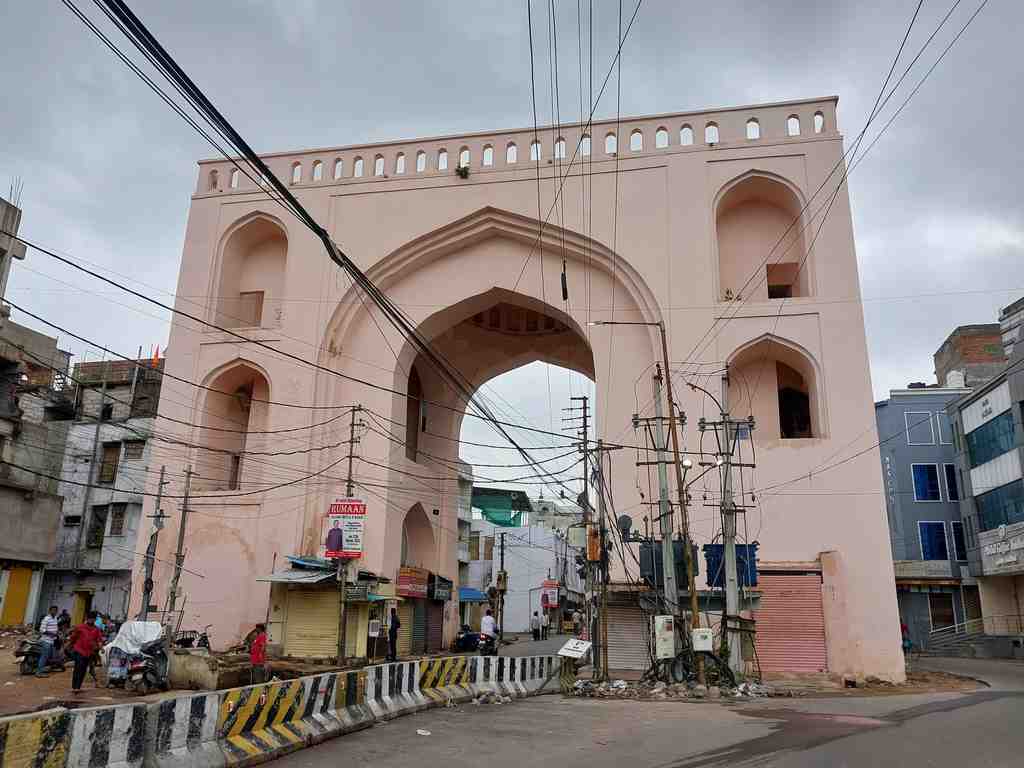
So, Char Kaman, meaning "four gates," consists of-you guessed it-four arches. Their heights are quite impressive at fifty feet each, surrounding an open square where a grand Qutb Shahi palace once invited royalty. The arches are named Charminar Kaman, Machli Kaman, Kali Kaman, and Sher-e-Batil-Ki-Kaman. Say that ten times fast! Interestingly, a scholar named Omar Khalidi mentioned these arches give a nostalgic nod to the Registan of Samarqand in Uzbekistan, built by the Timurids. Quite the international inspiration, don't you think? And here’s a fun tidbit: these arches received a facelift in 1858 from the fifth Nizam of Hyderabad, Afzal-ud-Daulah. It's like a historical makeover! As you look around, just imagine it’s 1592, and you’re standing where grand entrances and royal orchestrations once dominated this very square. Quite the sight for sore eyes, huh? Shall we keep moving to explore more treasures?
Open dedicated page →



Frequently asked questions
How do I start the tour?
After purchase, download the AudaTours app and enter your redemption code. The tour will be ready to start immediately - just tap play and follow the GPS-guided route.
Do I need internet during the tour?
No! Download the tour before you start and enjoy it fully offline. Only the chat feature requires internet. We recommend downloading on WiFi to save mobile data.
Is this a guided group tour?
No - this is a self-guided audio tour. You explore independently at your own pace, with audio narration playing through your phone. No tour guide, no group, no schedule.
How long does the tour take?
Most tours take 60–90 minutes to complete, but you control the pace entirely. Pause, skip stops, or take breaks whenever you want.
What if I can't finish the tour today?
No problem! Tours have lifetime access. Pause and resume whenever you like - tomorrow, next week, or next year. Your progress is saved.
What languages are available?
All tours are available in 50+ languages. Select your preferred language when redeeming your code. Note: language cannot be changed after tour generation.
Where do I access the tour after purchase?
Download the free AudaTours app from the App Store or Google Play. Enter your redemption code (sent via email) and the tour will appear in your library, ready to download and start.
If you don't enjoy the tour, we'll refund your purchase. Contact us at [email protected]
Checkout securely with 




