
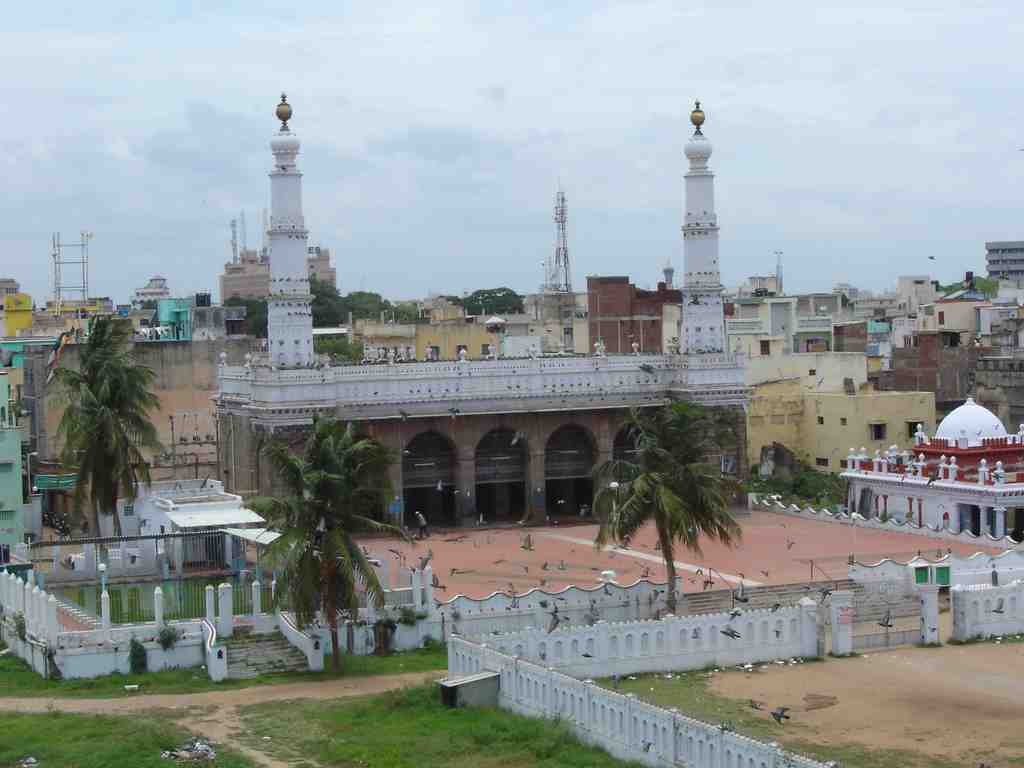
You are now standing at the Triplicane Big Mosque, also known as the Wallajah Mosque, located on Triplicane High Road in Chennai. This mosque, constructed in 1795, was built by the family of Muhammad Ali Khan Wallajah, the Nawab of Arcot. Designed in the Mughal architectural style, it features a large prayer hall, a tank, and a spacious ground in front. Remarkably, the entire structure was built using granite without the use of iron or wood.
The mosque highlights a spirit of cultural harmony, as evidenced by the Nawab’s friendly relations with Hindus, even appointing a Hindu as his chief personal secretary. A Persian chronogram inscribed by Raja Makhhan Lal Bahdur Khirat, the Hindu Munshi of the Nawab, can be found at the entrance to the prayer hall. The Big Mosque is not only the largest in Chennai but also one of the oldest, remaining active as a place of worship today. It is administered by the Prince of Arcot Endowments Trust, with a significant number of its administrative staff being Hindus, reflecting peaceful coexistence between the two religions.
Historically, the Nawab of Arcot was a staunch ally of the British and was granted Chepauk Palace for his administrative and military needs. When the Nawab moved to Chepauk in 1768, approximately 20,000 Rowther Muslims followed, forming one of the largest Muslim communities in South India after Hyderabad. The Nawab had judicial control over the region, with all cases adjudicated under Muslim Law.
This mosque’s construction added to the rich cultural tapestry of Triplicane, which was already home to the renowned Hindu Parthasarathy Temple and the Portuguese Christian stronghold of San Thome. Over time, modifications were made to the mosque, including the addition of golden finials to the spires during the regime of Azam Jah. The mosque incorporates a vast tank to the northeast and a large open ground, often filled with worshippers, especially during significant Islamic festivals like Bakrid and Ramzan.
The architectural style of the mosque, particularly its two minarets, reflects Mughal influence but does not adhere strictly to any single style. Scholars suggest this variation was due to the influx of North Indian Muslims in the area. Inside, the mosque houses an image of the Persian scholar Barool, who is believed to have come from Lucknow to educate the royal family.
As you observe this historical and cultural landmark, recognize its significance not just as a place of worship, but as a symbol of the harmonious mingling of diverse cultures in Chennai.


