
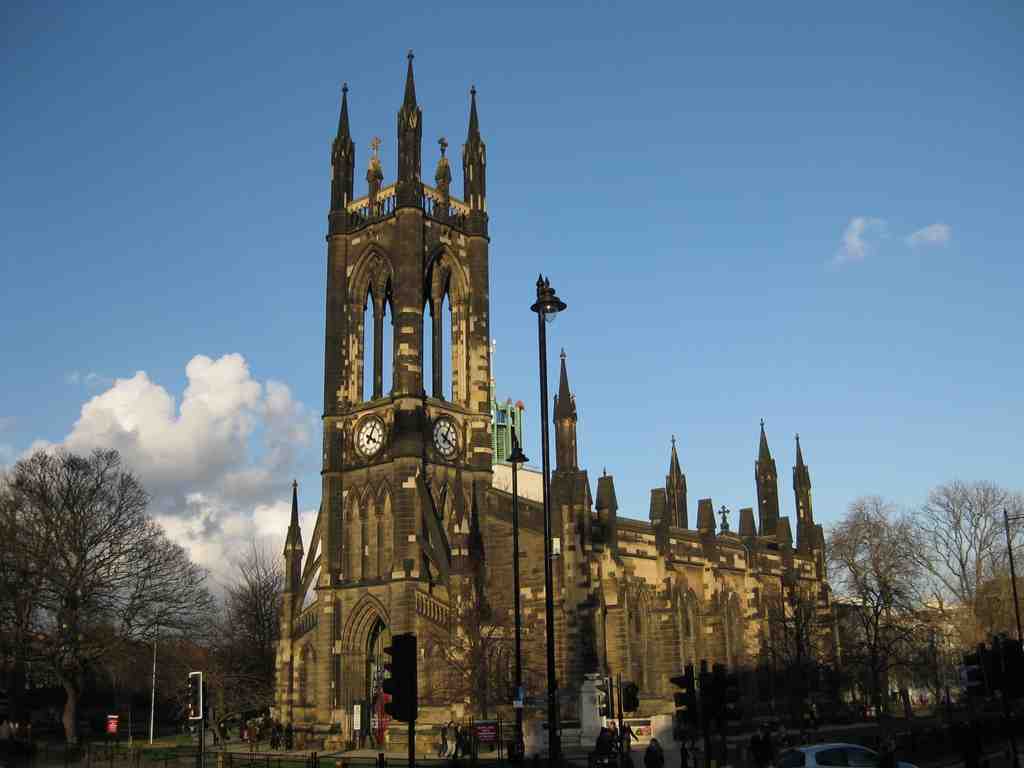
If you look just ahead, you can't miss it - the Church of St Thomas the Martyr rises dramatically above the busy Haymarket. Keep an eye out for its tall, dark stone bell tower with open archways and sharp spires that stretch skywards, almost as if they're trying to tickle the clouds. The church’s large gothic windows and clock faces are easy to spot, and the pointed pinnacles decorate the top like a crown. Surrounded by trees on one side and a bustle of city life on the other, it stands proudly at the crossroads.
Before you stands the Church of St Thomas the Martyr. Now, close your eyes for a second and imagine the world around you not full of city traffic, but the clatter of horse hooves and the murmur of medieval townsfolk.
This church has a story rather juicier than a detective novel. Dedicated to St Thomas Becket, its history is tangled up with knights, kings, and a bit of mystery. Back in 1170, the Archbishop of Canterbury, Thomas Becket, was hacked down by four knights who thought they were doing King Henry II a favour. Not exactly a royal order anyone wanted written down! Afterward, the knights were wracked with guilt and legend has it, one of them - Hugh de Morville - came north to found a chapel as a kind of spiritual apology. That tiny riverside chapel grew and changed over hundreds of years, battered by floods, fires, and one very determined chaplain who rented out the chapel cellars just to keep the place running - talk about entrepreneurial spirit.
Try to picture the drama: fire raging through Newcastle, the Tyne Bridge crumbling after a flood, and a chapel that somehow survives it all. Even the windmill profits were funneled in to help-imagine priests praying for a strong breeze, not rain!
Fast forward a few centuries, and by the early 1800s, the old chapel was looking a bit sorry for itself. Enter John Dobson, Newcastle’s answer to ‘Changing Rooms.’ He whipped up this striking Gothic marvel you see before you, finished in 1830-complete with spires, arches, and a clock for every “five more minutes, please” moment.
Today, it’s more alive than ever, filled with the laughter and energy of students and young people. It’s seen plague and pilgrim, marketplace chaos and quiet reflection, all under these very spires. If walls could talk, I daresay these would have quite a few stories-and maybe the occasional holy dad joke.




