
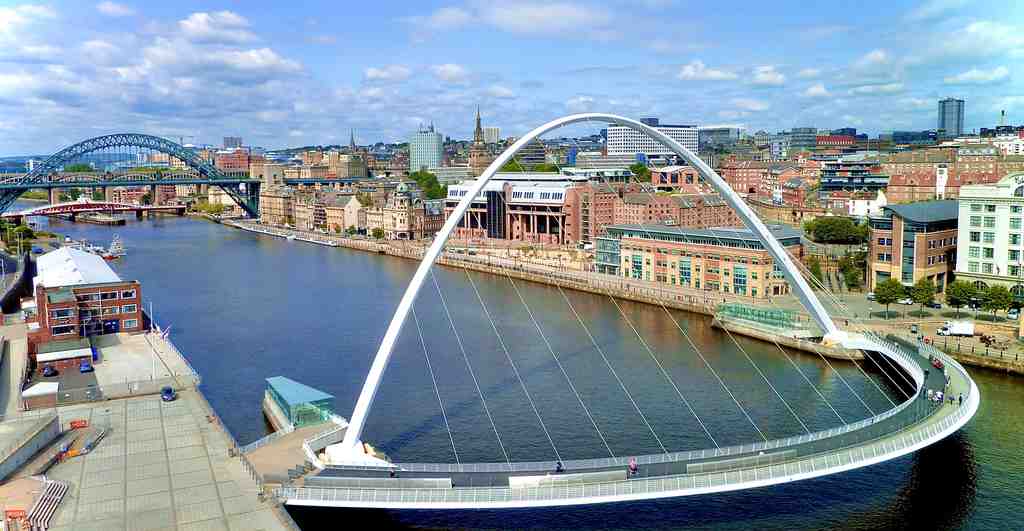
Keep your eyes straight ahead! To spot Newcastle upon Tyne, soak in the wide, flowing River Tyne, then let your gaze drift up to the bold white arch of the Gateshead Millennium Bridge. The city rises proudly behind, dotted with a mix of sturdy old stone buildings and glassy new offices. Notice the soaring metal arches of Tyne Bridge just a bit upriver-hard to miss, honestly, unless you’re distracted by the river breeze or a particularly aggressive pigeon.
Right now, you’re standing at the heart of Newcastle, surrounded by sights that have seen thousands of years of history, triumphs, and a fair few epic parties. Newcastle upon Tyne-locals just call it “Newcastle,” though if you want to sound very proper, it’s NEW-kah-səl-sits on the north bank of the River Tyne, always keeping an eye on Gateshead across the water.
But believe it or not, this roaring city started quietly enough as a Roman outpost named Pons Aelius, set up almost two thousand years ago. Imagine Roman soldiers marching along the riverbank, maybe a bit homesick, maybe just very tired of the cold British wind. At its peak, Pons Aelius held just two thousand people-a mere crowd compared to the busy streets you see now.
As you look around, picture a time when Hadrian himself, the Roman Emperor, may have stopped here. Bits of Hadrian’s Wall once snaked across the landscape, trying its best to keep pesky invaders out. In fact, some pieces of that wall can still be found not far from here, if you fancy a bit of ancient treasure hunting.
After the Romans packed their bags and left, Newcastle became Munucceaster-or Monkchester to its friends-ruled by the Anglo-Saxon kingdom of Northumbria. Then came the Danes, the Normans, and a wooden castle built by William the Conqueror’s son, Robert Curthose. Imagine the hustle of timber and stone as the castle took shape, and the clamor of market traders and hopeful townsfolk growing day by day.
The name “Newcastle”-funnily enough-comes from that ever-changing castle. They rebuilt it in stone in 1087, and again in 1172. The keep, tough and proud, still stands nearby today. Through the Middle Ages, this was England’s northern fortress. Rival Scots tried their luck at invading, but Newcastle held firm-a city so stubborn, even its walls are 25 feet high!
Coal, believe it or not, turned Newcastle into a powerhouse. In the 1500s, if you wanted coal, you bought it from Newcastle, and no one else. That’s where the old saying "carrying coals to Newcastle" comes from-why bother, when Newcastle already has so much?
So, as you stand here by the river, listen to Newcastle’s heartbeat-the laughter in the pubs, the footsteps on bridges, and maybe the ghostly whispers of Romans, monks, and kings all arguing over whose turn it is to buy the next round.
Every corner here is layered with old secrets and new energy, which is just how Newcastle likes it. Ready to wander deeper?
Interested in knowing more about the geography, culture or the media




