
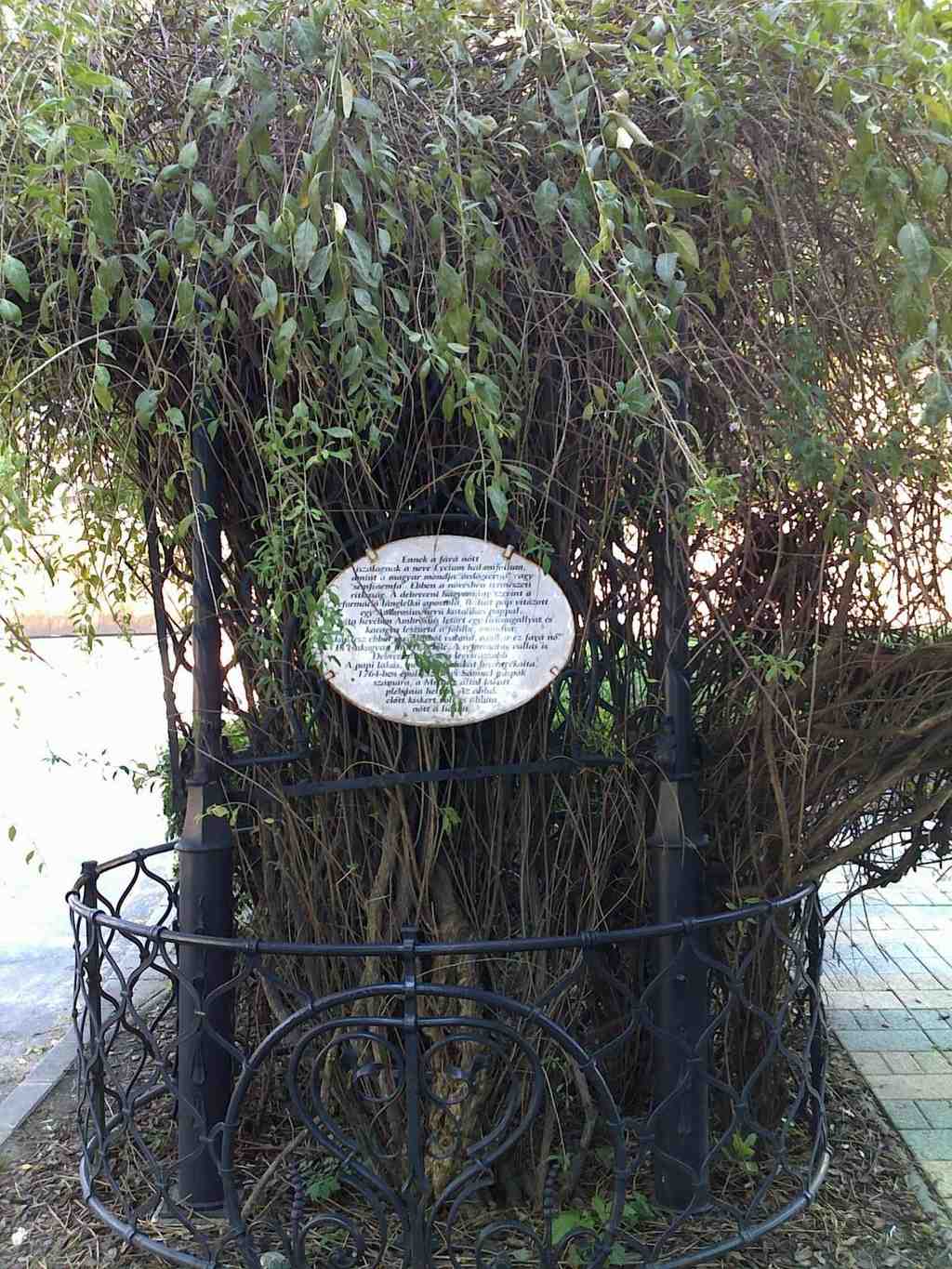
To spot the Debrecen Lycium Tree, look for a small, twisting tree with a thick, gnarled trunk and tangled branches, growing right behind a decorative wrought-iron fence near the corner of Museum Street and Calvin Square, with a round information plaque hanging on it.
Now, take a slow breath in-you’re standing in front of something far older and more storied than it first appears: the Debrecen Lycium Tree. At first glance, it might just look like an oddly-shaped bushy tree intent on doing acrobatics with its twisting trunk. But believe it or not, it’s a true survivor, a botanical rarity, and the star of a centuries-old legend!
Imagine it’s the 18th century, on a quiet corner by the then recently built bishop’s residence-this wasn’t always just a regular street corner. The tree you see began its life in the garden of a bishop’s house, twisting its way up and, over time, becoming one of the very few Lycium barbarum plants to ever decide “bush life is too easy, let’s try being a tree!” Most Lycium are happy as shrubs, but this one grew and grew, splitting into two thick branches at its base, and sporting a trunk you’d need a big bear hug to surround, if you want an idea of its size. Some believe this tree could be almost 200 years old, and some optimists say perhaps 250-making it practically the oldest local!
But our leafy friend isn’t just a marvel of fitness and longevity; it’s also a living monument to religious history. Way back, in the days of the Reformation, Debrecen was a hotbed of religious debate. And here’s where the legend blooms: the story goes that a fierce debate happened at this very spot. On one side was Bálint the priest, who had been “reformed” in his thinking, and on the other Ambróziusz, a Catholic canon who’d even seen Rome. Tempers flared, arguments buzzed, and words flew. The two continued their back-and-forth even after the official debate had ended, and finally-right here-Ambróziusz snapped a Lycium branch, jammed it into the earth, and declared, “Faith will only take root here when this weed becomes a tree!” Bálint, maybe with a wink and probably a good sense of humor, replied, “Well, then, a tree it shall be.” The little stick, the story goes, actually took them up on their dare and grew into the very tree before you-becoming a symbol of faith and the strong Hungarian Reformed tradition. True or not, you have to admit, it’s a story worthy of a blockbuster film… or at least a good campfire tale!
But wait, there’s more! This spot hasn’t had an easy time. Debrecen has seen revolutions and wars, and so has the Lycium tree. In 1956, during the Hungarian Revolution, a Soviet tank rumbled through, and in its confusion, nearly flattened our tree-not out of malice, just a little tank clumsiness. The tank dented the beautiful iron window grille that the tree had wrapped itself around and even bent the tree a bit. But, just like an old dog who takes a tumble and keeps on wagging, the Lycium tree stood strong.
Even in more recent times, geocachers have hidden treasure nearby, and in 2012 the tree competed for the title of “Tree of the Year” in Hungary-although, with so many beauties in the running, it didn’t quite make the finals. Still, how many trees can say they’ve made it into works of art, novels, travel books, and the hearts of local people? Famous writers like Szabó Magda and Móricz Zsigmond have woven the tree into their stories, while scientists and botanists have marveled at its persistence and uniqueness.
So here you are, in the company of one of Debrecen’s oldest living locals, a tree that’s heard whispered prayers, heated arguments, roaring tanks, curious botanists, and laughing schoolchildren. Rub your eyes, you’re not just looking at branches and leaves-you’re standing before a living legend whose roots run deep into the very soul of the city. Take a good look… and maybe whisper your own wish to the Lycium-it’s been keeping secrets for centuries!


