
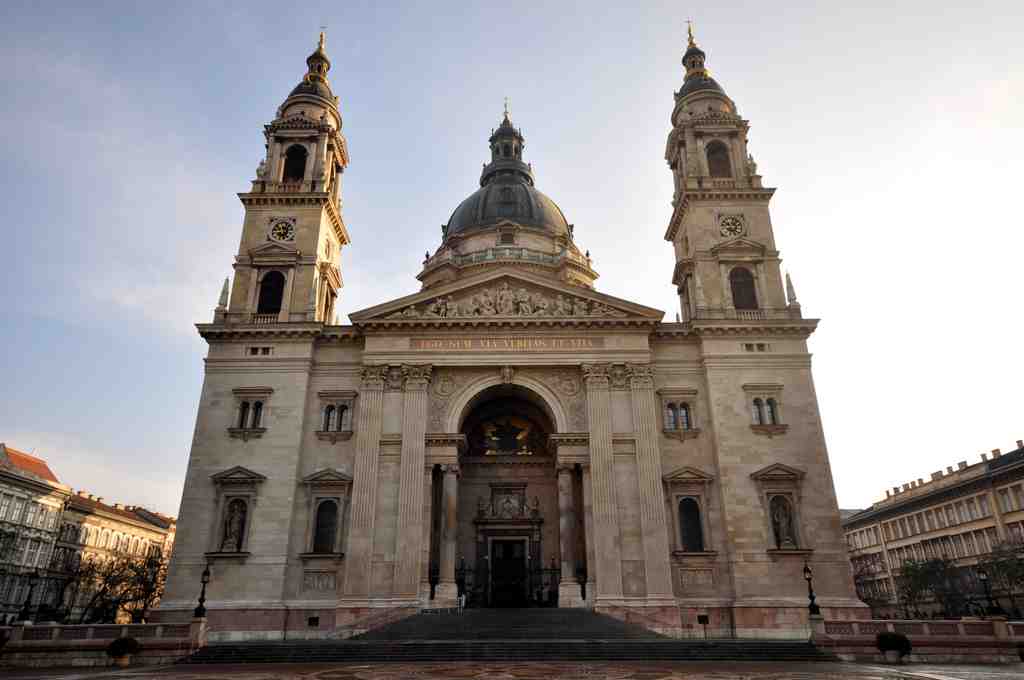
Look ahead and spot the grand building with a huge dome flanked by two tall towers, its creamy stone façade and Corinthian columns facing the wide plaza-if you see that, congratulations, you’ve found St. Stephen’s Basilica!
Take a moment to look up at this magnificent structure, stretching 96 meters tall into the Budapest sky. You might want to tilt your head back-don’t worry, you won’t lose your hat, but you might lose track of time imagining its past! Now, imagine yourself standing here more than two hundred years ago, when this very spot wasn’t so angelic. Back in the 18th century, there was a rowdy little theatre for animal fights-yes, before this was a sacred space, lions and bears were the stars of the show.
But Lipótváros was changing, and so were its dreams. As the area grew, the local citizens wanted something more inspirational than a bear wrestling match. Enter Zitterbarth János, who decided it was high time for a temporary church. By 1817, they’d founded a proper parish, and talk began of building a grand new temple. Then came the epic flood of 1838: water swept through Pest, but right here in the middle of St. Stephen’s Square, a natural rise provided shelter for hundreds. After they were rescued, the survivors wanted to build a church as thanks for their miraculous escape-a true promise born from panic and puddles.
Construction didn’t begin smoothly-this story has more twists than a Danube river barge. The renowned architect Hild József kicked things off in 1846, but history had other ideas. The revolution of 1848-49 brought chaos and delays, and when they got going again, disaster struck. In 1868, the already-built dome collapsed with a thunderous crash, forcing everyone back to the drawing board and sending many hearts (and hard hats) racing. It took the skills of Miklós Ybl, mastermind of grand Neo-Renaissance style, to reimagine and rebuild the basilica. Only in 1905-about sixty years after those original plans-was it finally consecrated, with the king himself laying the last stone. If patience is a virtue, St. Stephen’s Basilica should probably be a saint itself.
Peer at the twin towers: inside are six mighty bells, each with a story to tell. The southern tower holds Hungary’s largest bell-the Szent István bell, weighing a muscle-cramping 9,250 kilograms. Its deep, powerful toll is heard on national holidays, and only for major moments. Across from it is the oldest bell here, the Great Lady bell, built in 1863. And don’t miss the memory of war here-the biggest bells were taken for munitions during two world wars, and the current mighty bell was recast in Germany from grateful donations.
You might hear music floating from within or imagine the soaring organ echoing off mosaics and stained glass. Since its dedication, the basilica has been a center of musical life. Its famous choir, founded in 1909, still gives summer concerts; international organists love to shake the walls. Imagine that on a warm July night: you, a magical choir, and an audience that stretches all the way to Vienna, thanks to the basilica’s legendary acoustics.
Of course, the basilica isn’t all about heavenly tunes and towering stone. It’s also a house of relics-and no simple ones! Would you believe that behind those heavy doors rests the mummified right hand of Hungary’s first king, St. Stephen himself? Yes, you can thank him for the basilica’s name, and on August 20th every year, the relic is paraded through the streets in one of the city’s great traditions. Before 1971, this “Holy Right” had no fixed home and was displayed here and there. Now it rests in a splendid chapel, except on that grand day, when it takes its special walk. I don’t know about you, but that’s one way to give someone a “helping hand!”
Inside, the basilica dazzles with gilded domes and baroque flourishes. You’ll find treasures like bejeweled vestments, a dazzling organ and mosaics as bright as sweets in a Budapest candy shop. The chapels, the main altar, the soaring cupola-a dizzying feast for your eyes. And if you’re thinking, “I wish I could see more,” you’re in luck! There’s a panorama lookout atop the dome, offering jaw-dropping views over all of Budapest. Dare you climb so high for a bird’s-eye view of the city?
Through the years, the basilica has suffered bombings, collapsed domes, fires, and storms that have tossed its giant roof like a pancake. But every time, the people rallied, raising funds and working together to restore their beloved church-a little Hungarian magic and a lot of elbow grease.
So as you stand here, gaze at the marble giants-saints, kings, popes-witness to centuries of hope, calamity, celebration, and community. And don’t forget to listen: you might just catch the bells ringing out across Pest, reminding everyone that this basilica, born from survival and stubbornness, will stand as long as there’s a city around it.
Take a deep breath-the next chapter of this story is just a few steps away, waiting for you among the streets of Budapest!
For a more comprehensive understanding of the history, the building or the the bells of the basilica, engage with me in the chat section below.




