
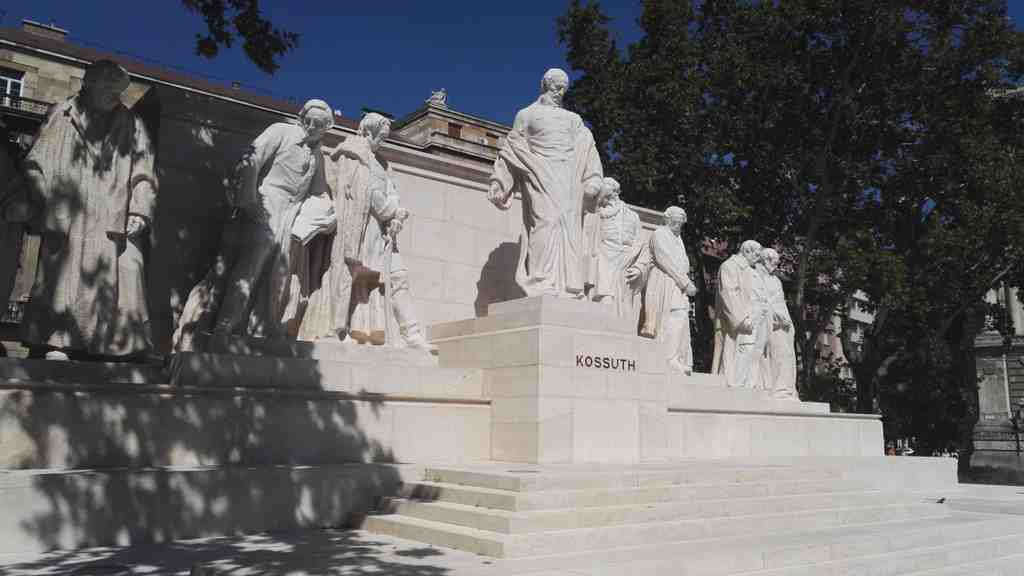
Look directly ahead and you’ll see a grand, creamy-white stone monument rising on steps, with a central figure flanked by a group of serious-looking men-all staring out over the heart of Kossuth Square.
Now that you’re standing here, let me spin you a tale fit for a hero and his crew. Imagine, over a century ago, the city bustling with excitement. The year was 1894, and as Lajos Kossuth-the beloved leader of Hungary’s 1848 Revolution-was laid to rest, the entire nation seemed to hold its breath. Crowds gathered, hats clutched, eyes shining with pride and wet with tears. Almost immediately, folks from all walks of life chipped in their hard-earned forints to honor Kossuth, collecting a mind-boggling sum for those days: 850,000 forints! I bet even Kossuth himself would have been tempted to count it.
By 1906, after many fiery debates, sculptor János Horvay got the job-though not everyone was happy with his vision. He set to work, chiseling away at stone until a whole government cabinet sprang to life. But in a twist fit for a dramatic novel, World War I slammed the brakes on everything. Marble for the pedestal was taken by invading forces, and the statues stood unfinished. Still, persistence pays off: by 1927, with makeshift limestone, the first Kossuth Memorial was unveiled before a crowd of 100,000! Picture the buzz: voices ringing through the chilly November air, politicians posturing, artists biting their nails. But critics were not amused-too gloomy! they cried, and the statues never quite won people’s hearts.
Move to 1950, and Hungary’s new rulers decided the memorial was too grim for their tastes. Down it came! In swooped sculptor Zsigmond Kisfaludi Strobl, who cast Kossuth as a charismatic leader with his hand outstretched, ready to lead Hungary toward tomorrow. The air was heavy with symbolism, and if those statues could have talked, they’d surely have gossiped about all the change.
Decades passed until-plot twist!-the government decided to turn back time in 2012. Out with the bronze, back in with history! After careful planning and a touch of magic, an exact replica of the original, somber group returned here in 2014, as you see now. Today, as you stand among the ghosts of revolutionaries on Kossuth Square, imagine the thunder of applause, the whispers of criticism, and the stubborn hope that refuses to fade. The statues might look serious, but hey, after all the adventures they’ve been through, maybe they’re just trying to hold a poker face!




