
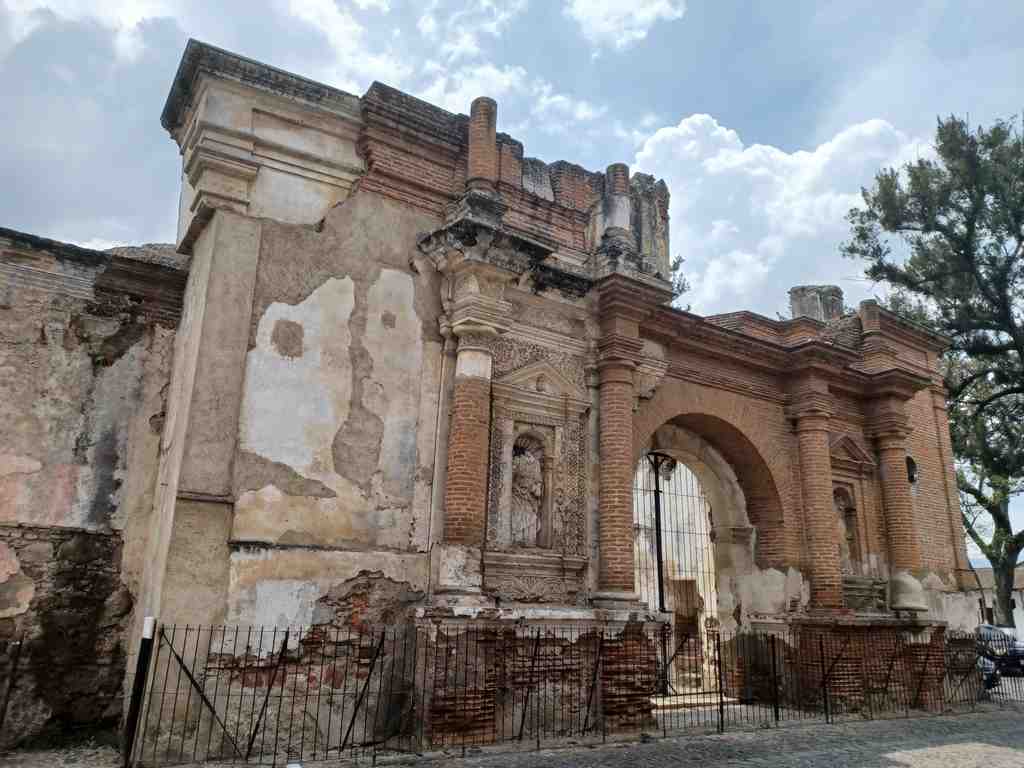
To spot the Parish of San Sebastián, look for an ancient, crumbling facade of rosy brick and stone, with ornate columns and an arched entryway still standing among ruins, right beside the street, as if stubbornly clinging to the past.
Welcome to the Parish of San Sebastián! If these battered walls could talk, oh, the stories they would tell-though with all the earthquakes, they might stutter a bit! Picture yourself in the bustling Antigua Guatemala, centuries ago, when this church was just a humble hermitage founded back in 1565 up on Cerro de San Felipe. You’d hear the soft chants of villagers and the tolling of church bells floating through the valley, calling the faithful to their sanctuary at the foot of the Cerro del Manchén. San Sebastián soon grew, and by 1582, with a little help from the determined Juan de Cuéllar, it moved down to this very spot, where it became the heartbeat of the La Joya neighborhood.
But, let’s be honest-living here was never boring. Antigua was a city that danced with volcanoes and lived in constant flirtation with earthquakes. In 1631, one mighty tremor nearly toppled the church. Imagine the street, packed with anxious faces, some holding tight to their hats and others to their prayers. It wasn’t until almost 60 years later, in 1689, that the church regained its full parish status-talk about perseverance.
Disaster struck hard in 1717, when the fierce Volcán de Fuego erupted. Picture residents glancing nervously at the churning volcano, as a strange darkness settled over the city. People cried out for protection from the heavens, rushing saints and the Virgin in dramatic processions. Priests’ voices echoed, bells tolled, and the ground trembled beneath their feet. The night didn’t offer much comfort either; a powerful earthquake struck just as dusk turned to darkness, driving everyone from their homes. The city shook, creaked, and groaned, but the faithful clung to hope.
Then, in 1773, came the infamous Santa Marta earthquakes-so destructive that even the government packed their bags and moved the capital to a new, safer spot. The city was left nearly abandoned, its grand churches, including San Sebastián, reduced to shadows of their former glory. But Antigua’s people, ever the optimists, didn’t just give up. For decades, they scraped together what art and artifacts they could rescue, using these ruined churches as temporary shelters for their treasured religious art.
The 19th century brought more chaos. In 1874, another earthquake hit with such force that one witness claimed the ground moved in waves, rising up almost a foot off the ground. People ran, the city echoed with the sound of falling stones and frightened prayers. The once-proud Parish of San Sebastián was abandoned. For a while afterward, only its imposing facade stood, like a stern old guardian over a city now called “ruined Guatemala.”
And about that facade-it nearly made it to modern days, battered but still beautiful with its columns and careful Baroque details. That is, until 1976, when yet another quake-let's just call it “The Big One”-brought much of it tumbling down, almost as if the earth couldn’t help but rearrange Antigua’s skyline one last time.
Through all this, the church found itself mixed up in other odd moments-like the creation of the Templo de Minerva in the early 20th century. Imagine the people of Antigua, scratching their heads as their new Greek-style temple with its chunky Doric columns rose up next to the battered old Baroque parish. They must have wondered if ancient Athens got lost and ended up in Guatemala for the fiestas Minervalias! As soon as the celebrations ended, the flashy temple just sat there, unused, and by the 1920s, it too was gone, leaving the ghosts of both Baroque prayers and pagan festivities drifting over this corner of the city.
As you stand here, take a moment. Run your eyes over the bricks-some from the 16th century, others added after countless quakes, patched in with more hope than mortar. Listen in your imagination for the soft music of processions gone by, the urgent footsteps during trembling ground, and a thousand whispered prayers for deliverance and for new beginnings. The Parish of San Sebastián is more than stone and ruin; it’s a testament to the stubborn spirit of Antigua itself-forever battered, forever beautiful, and always ready for the next chapter.


