
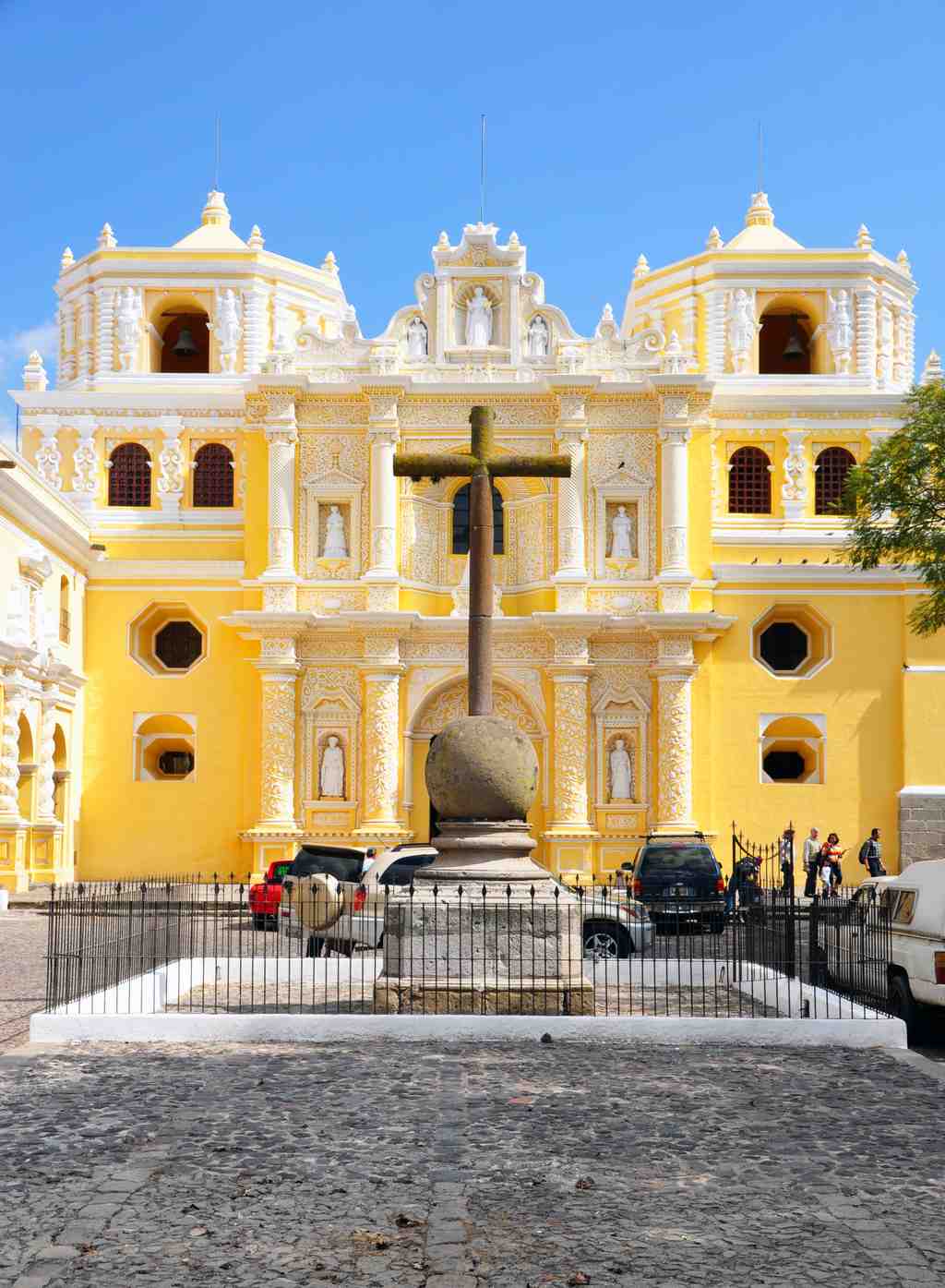
To spot La Merced Church, just look for the bright yellow building with all the intricate white stucco designs and its two bell towers rising on either side-if you see a facade packed with detailed sculptures and a cross out front, you’re in the right place!
Now, as you stand before this dazzling church, let me whisk you back in time-don’t worry, you won’t need a time machine, just a little bit of imagination! Picture Antigua in the 18th century, buzzing with the sound of hammers and the swirl of dust as master architect Juan de Dios Estrada and his team brought this stunning structure to life. Construction began in 1749 and, after years of hard work, La Merced finally opened her doors in 1767. And just in time, too-as if she knew trouble was coming, La Merced was practically brand new when the massive Santa Marta earthquakes hit in 1773. While much of the city crumbled, this church stood firm, looking almost smug in her resilience, showing off the clever new building techniques the Spanish brought to the New World.
The style you see in front of you is called Guatemalan Churrigueresque, which is basically Baroque turned up to eleven-bright, bold, and bursting with detail. The facade is like an open-air museum. Look up and you’ll spot St. Peter Nolasco, the founder of the Mercedarian Order, gazing serenely down from the top. Beneath him are the Virgin of Mercy and the grand Mercedarian shield. The saints standing guard-St. Raymond Nonnatus and St. Pedro Armengol to your left; St. Peter Pascual and St. Mary de Cervellione, the first Mercedarian nun, to your right-all seem ready to leap down and greet visitors. It’s quite the heavenly lineup!
But don’t just look up-look out into the courtyard to see the “Fountain of los Pescados,” a water lily-shaped marvel that measures a whopping twenty-seven meters across. It’s one of the largest colonial fountains in Latin America-and if you’re wondering why the architects picked a water lily, here’s a little Mayan mystery for you: in local mythology, the water lily is tied to creation itself. They believed the first gods rose from the blossom, making this fountain not just a decoration, but a symbol of divine beginnings.
La Merced’s story is packed with nearly as much drama as its facade. The Mercedarians arrived with the earliest Spanish settlers, led by the adventurous Friar Marcos Dardón, who trekked through places like Chiapas and the dangerous valleys around Antigua. They settled first in Almolonga, but when the nearby volcano let loose with a landslide, the order packed up and moved to the safer, lush Panchoy Valley-right here where you stand today. In those days, friars weren’t just praying; they were building schools for local children, running sugar mills, and riding out to the distant mountains to bring their faith (and sometimes their sweet tooth) to far-off towns in San Marcos, Huehuetenango, and Quetzaltenango.
La Merced wasn’t just a religious center-it was practically a headquarters for the region. But then along came the Bourbon Reforms: the Spanish Crown’s attempt to flex new royal muscles in the colonies. These reforms rearranged the whole administration, gave the king more power, and-gasp!-even tried to cut the church’s influence. Imagine priests suddenly having to hand over their parishes and a city grappling with new rules about tobacco, booze, and playing cards. No wonder the locals were a bit tense!
Then came the earthquakes-nature’s way of keeping everyone on their toes. When the city was devastated, the authorities decided to haul the most treasured religious image, Jesús Nazareno de la Merced, all the way to the new capital, hoping the faithful would follow. I can just picture the scene: heartbroken villagers clinging to their traditions and weeping as the sacred statue left town, parading out with much more emotion than any ancient king could command. But the spirit of La Merced never really left. When a new Nazarene statue arrived, it quickly became the star of Antigua’s legendary Holy Week processions, drawing crowds and filling the city with the scents of incense and flowers each year-a tradition that continues even today.
So here you are, standing where centuries of history, faith, and drama have all left their mark. If these yellow walls could talk, they might just sigh and say, “Earthquakes, kings, and even bureaucrats couldn’t shake me!” And with that, La Merced is still here-proud, bright, and full of stories, welcoming pilgrims and wanderers alike to experience a living piece of Antigua’s soul.
Wondering about the description, tourism or the holy week? Feel free to discuss it further in the chat section below.


