
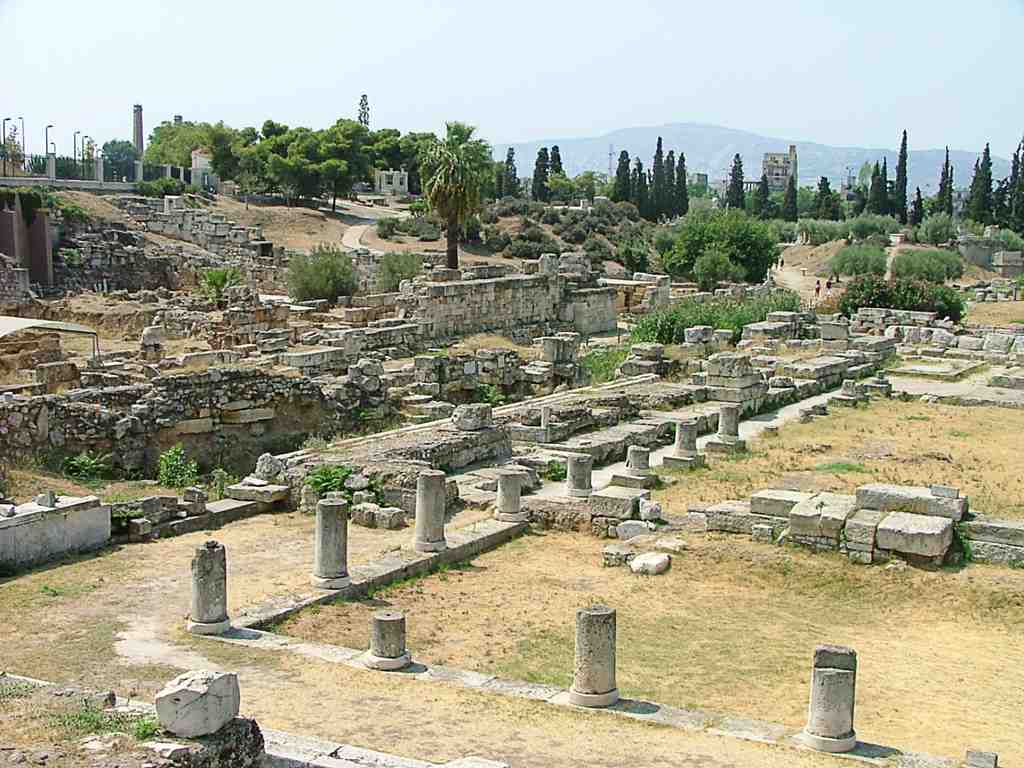
To spot the Ancient Agora of Athens, look ahead for a wide, open expanse filled with low, weathered stone ruins and scattered marble columns, set against grassy ground and framed by trees and distant hills.
Welcome to the heart of ancient Athens-the Agora! Picture yourself surrounded by curious voices, merchants calling out, and the lively shuffling of sandals on packed earth as people gather for business, debates, and maybe just a little gossip. This bustling hub was once the social and commercial soul of the city, lying in the shadow of the Acropolis to the southeast and bounded by hills that watched over every deal and drama.
Here, people came to shop, argue, celebrate, and maybe even run for their lives during an occasional chariot mishap. On the north side, you would have seen the Stoa Poikile, or Painted Stoa, adorned with vibrant murals and echoing with laughter as Athenians mingled and swapped stories-imagine it as the favorite coffee shop, minus the frappes. Not far off stood the Altar of the Twelve Gods, a sacred postal code everyone wanted, while the imposing Stoa Basileios held court for Athenian officials. And if you want to find some Roman flair, head near Hadrian Street where archaeologists uncovered the remains of an ancient Basilica.
Crossing to the east, you’d have noticed the grand Stoa of Attalos. Envision popping into shops lining a cool shaded walkway, outwitting haggling merchants, or just people-watching like a true Athenian philosopher. Today, the Stoa is reborn as the Museum of the Ancient Agora, preserving treasures from clay pots to political portraits. Nearby was the Library of Pantainos, offering more than just books-its maze of rooms gave scholars and merchants alike somewhere to brainstorm, conspire, or hide from the midday sun.
To the south, you’d meet the grand Middle Stoa, the largest monument of its age, as well as bustling markets, temples, and even a fountain house where women (and who knows, a philosopher or two) would pause to refill their water jugs and catch up on the latest city news. The west boasted civic buildings like the Bouleuterion where Athens’ democracy took shape and the striking Temple of Hephaestus, crowned with dazzling marble statues carved by masters like Phidias and Alcamenes.
Speaking of marble, the Agora was a sculptor’s paradise. In the 5th century BC, marble-workers busied themselves here, chiseling everything from statues of gods-watch out for falling noses!-to elegant sundials and even kitchenware. Phidias himself, the rock star of ancient carving, left his mark here, as did his associates and rivals. If the Agora had a “Walk of Fame,” it would be scattered with bits of marble, evidence of generations of artists at work.
There’s a softer side too: this was a lively stage for women, from savvy market sellers hawking perfume and fruit to priestesses leading grand religious festivals. Daughters of aristocrats could be seen making offerings at goddess shrines or leading rituals, proving the Agora wasn’t just a boys’ club after all.
As you stand here, close your ears for a moment-not to my great jokes, of course!-and imagine the sounds of history: the clatter of pottery, the lively banter, the stomp of marble-workers at their craft. After centuries buried and forgotten, the Agora was finally uncovered by determined archaeologists, with discoveries ranging from coins and statues to letters from a slave, giving us rare glimpses of life beyond the headlines.
Today, the Agora may look peaceful and sunbaked, but don’t be fooled-there are thousands of years of stories scattered among these ruins. Every stone, every column, every stretch of shade holds a secret. So, fancy yourself a citizen of ancient Athens for a moment and let your imagination run wild. Would you strike it rich, win a debate... or just get lost looking for a good olive?
Want to explore the buildings and structures of the classical agora, gender roles in the athenian agora or the marble-workers in the athenian agora in more depth? Join me in the chat section for a detailed discussion.


