
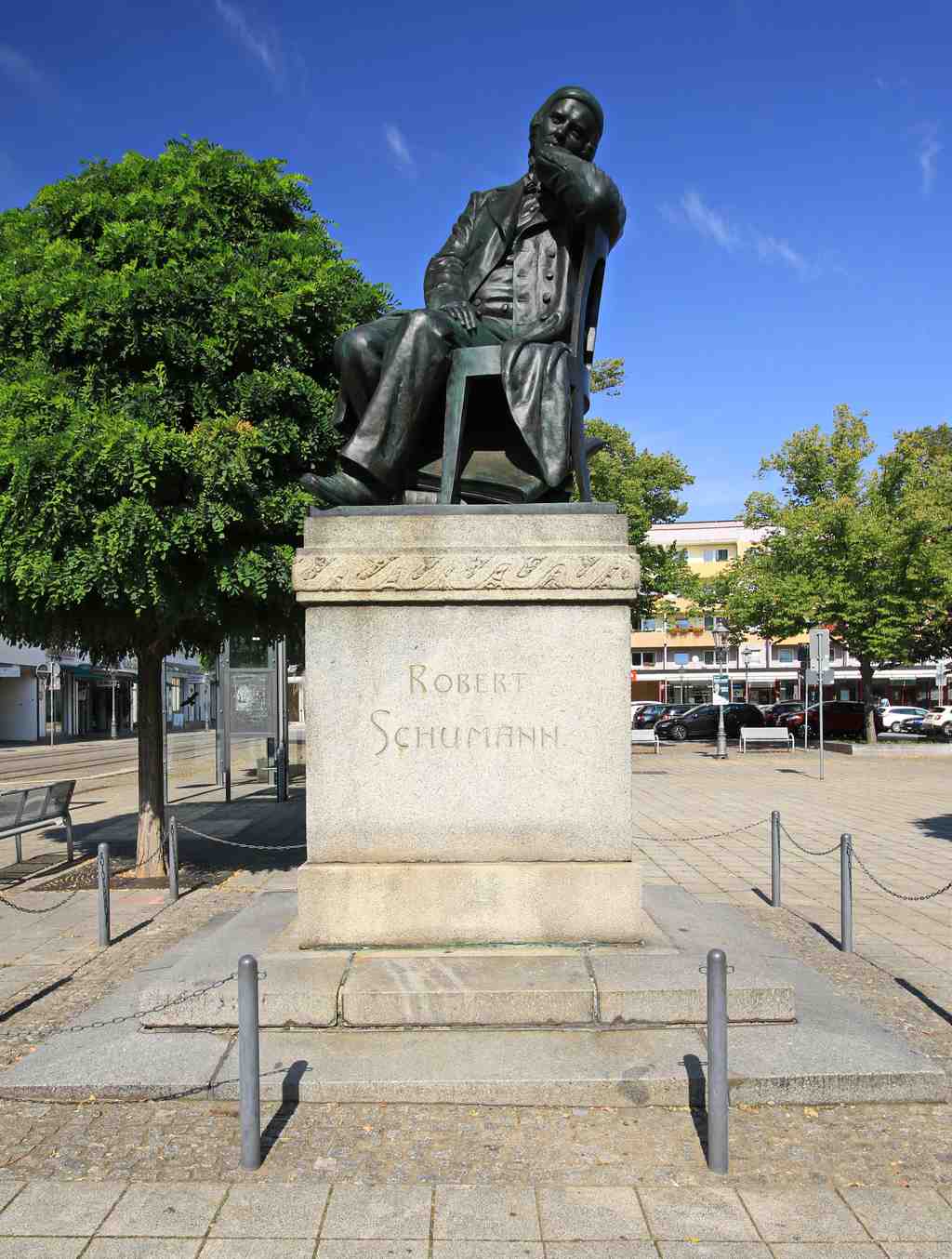
To spot the Robert Schumann Monument in front of you, look for a large bronze statue sitting thoughtfully on a chair atop a sturdy granite pedestal with "Robert Schumann" inscribed on the base-it’s hard to miss, as it stands prominently in the square with a dreamy expression gazing into musical history.
Alright, you’ve made it-here you stand in front of the Robert Schumann Monument, and imagine for a moment the echoes of music and applause that have rippled through this spot for more than a century. The statue before you isn't just any monument-it's Robert Schumann himself, larger than life, cast in bronze and lost in a world of melodies, right in the heart of Zwickau's Hauptmarkt. Leaning to the side, elbow propped and head resting on his hand, Schumann looks like he’s just been struck by a burst of musical inspiration-or maybe he’s just wondering where he left his piano. Either way, it’s a pose every dreamer might envy.
Let’s rewind the clock-back to 1885, when the idea for this monument was just a twinkle in the eyes of Zwickau’s music lovers. A committee formed, and their first mission? Gather enough money to turn inspiration into cast metal. People reached deep into their pockets, donating so much that within five years, they’d collected a whopping 35,000 Reichsmark. Even Schumann’s wife, Clara, was told about the project. She respectfully declined to chip in-well, composers’ families have budgets, too!
Fast-forward to the year 1901. Picture a sparkling summer’s day. An enormous crowd gathers: nearly 100 honored guests, over 100 musicians, hundreds of singers, and even Schumann’s three daughters. The mayor chooses the northeast corner of the Hauptmarkt for the grand unveiling, and suddenly, as the cloth falls away from the statue, sunlight glints off the bronze-and Zwickau’s favorite son is immortalized. Joseph Joachim and Carl Reinecke, old friends and maestro musicians themselves, are there to celebrate, music filling the square.
But even a statue with a prime seat isn’t immune to change. Soon after its unveiling, rumors ripple through the city: Should Schumann stand higher? Would he prefer a more peaceful backdrop? Before long, debates swirl, and with political tempests, the statue is on the move. Under the shadow of the Nazi regime, it’s shifted to Robert-Schumann-Platz in 1938-just in time for Schumann’s birthday again. As war brings air raids, a bombing in 1945 sends deadly fragments flying through the square-yet the stately figure of Schumann survives, battered but stubbornly upright.
Next stop: postwar Zwickau, with a ruined square and a city rebuilding. The Soviets order another move, and in 1947, the monument is placed by Schwanenteich, steps added back for good measure. By 1948, a Robert-Schumann Week brings music and crowds here once more, and for decades, the city ponders a return to the original heart of town. During East German times, the statue is even taken away for restoration-a quick spa visit to clean up battle scars, shed some environmental dirt, and get Schumann gleaming again.
Then comes the reunification of Germany-the 1990s, when old dreams are dusted off and reimagined. By the city’s 875th anniversary in 1993, Schumann is returned close to his original spot, the move paid for by public donations, and the mayor himself unveils the reborn monument to international fanfare.
Every year, Schumann’s birthday is still celebrated right here-even Monopoly Zwickau has a miniature version of him! In recent times, the statue’s been dressed up for jazz and rock festivals, cleaned and waxed to a shiny black sheen (no more green patina for Schumann), and even surrounded by little posts and chains for protection-after all, even the grandest composers need a little personal space.
So, as you stand here, think of the music, the festivals, the spirited debates, and all the gentle hands that have kept this memory alive. Maybe you’ll feel the magic, or maybe you’ll just feel inspired to take a thoughtful pose yourself-you never know when a great theme might strike!


