
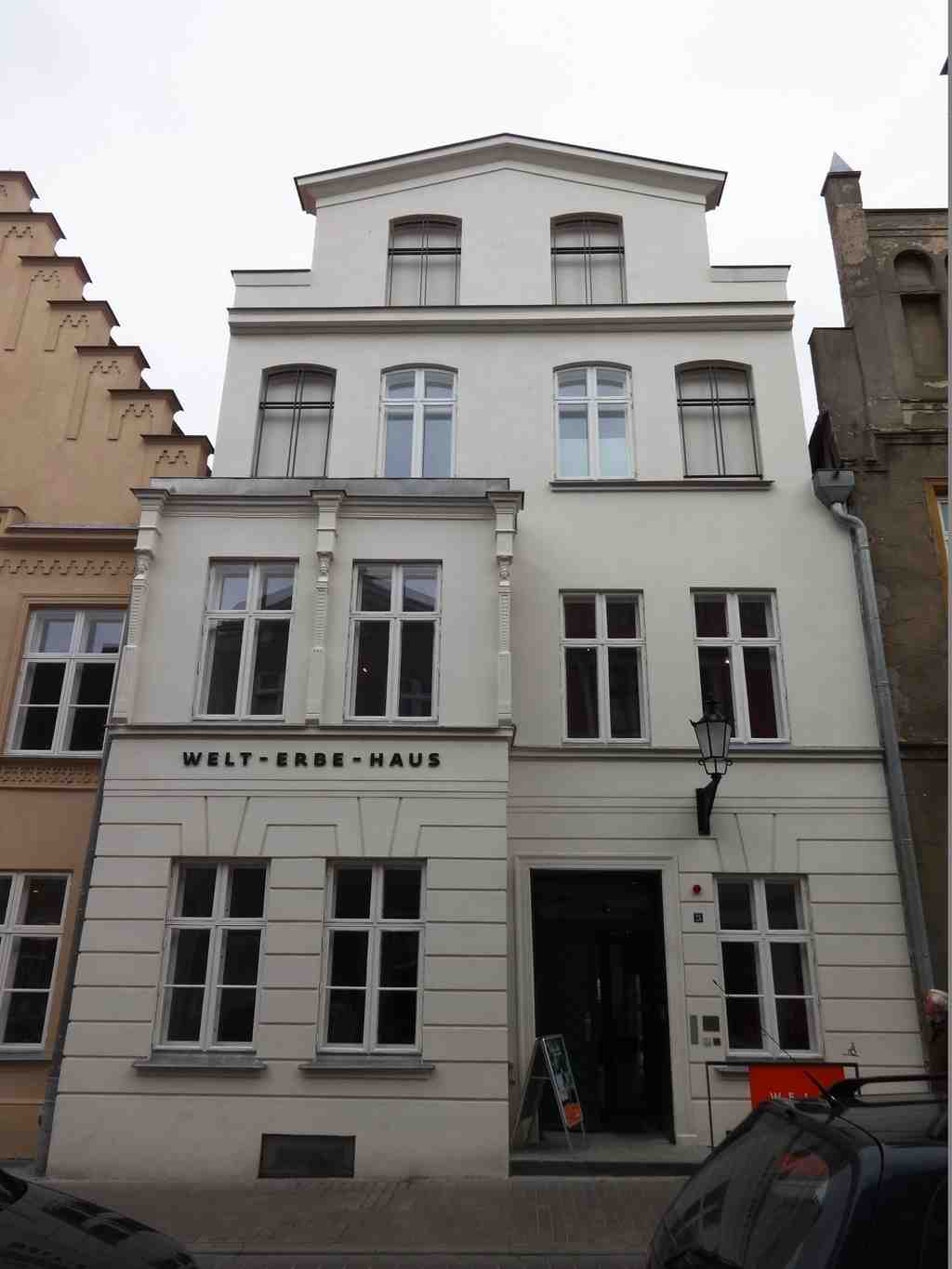
Right in front of you is a pale, cream-colored townhouse with three stories and the words WELT-ERBE-HAUS above the doorway; just look for the simple facade squeezed between its neighbors like a book on a shelf.
Now, as you stand here, let yourself imagine Lübsche Straße back in the year 1350. This wasn’t just any old street; this was the bustling east-west artery of medieval Wismar, alive with creaking wagon wheels, boisterous traders, and the salty tang of Hanseatic ambition in the air. The World Heritage House, this very building, stood right in the thick of it all. Picture its enormous ground-floor hall-a kind of medieval loading dock-where daylight poured through great street-facing windows as workers clattered in, ready to organize or transfer everything from barrels of herring to exotic spices.
Above your head would have been cavernous storage rooms, filled to the brim with goods. Down the side facing the courtyard stretched the “Kemlade”-a cozy living extension where, if you listen closely, you might hear the whisper of family dinners and laughter echoing through the centuries.
As time rolled forward, so did the life of this house. In the 1600s and 1700s, the owners traded their warehouse dreams for more comfortable living, lowering the once-soaring hall ceilings and expanding the living spaces above. City notables left their mark-a mayor named Gabriel Lembke pulled off a renovation in the 1800s so thorough the building could almost have changed its middle name. By 1924, the house became a hub for a merchant company, and not only did they run their business here, but they had a pub and even a little museum tucked inside, making it the medieval equivalent of a shop, an Airbnb, and a mini-history channel all under one roof.
Oh, but fate wasn’t always kind to our friend. After World War II, the Cultural Association of the GDR moved in, keeping the house busy until 1990. When they left, the poor building started falling apart, with each creak and crumble carrying a plea to the city, “Don’t let me become just another ghost!” Luckily, Wismar answered the call. When the city was officially recognized as a UNESCO World Heritage Site, the house got a rescue worthy of a fairy tale-an epic, four-million-euro renovation from 2013 to 2014, scrubbing away centuries of wear to reveal some head-turning surprises.
Picture this: as restorers worked away, they discovered behind a cluster of paint and dust in one corner a real rarity-a natural stone basin from the 17th century, nestled in a slim, once-colorful niche. It’s the very first of its kind uncovered in Wismar, a lost piece of domestic life chipped straight from history’s hidden pages.
Step inside, and you’ll find an exhibition across 400 square meters, celebrating UNESCO’s criteria for world heritage with international stories and a colorful city map underfoot, the World Heritage House itself popping out in bold hues. Wander to one of the audio stations along the way-just press play to have Hanseatic tales dance to life in your ears. Fascinated by ancient trade? Dedicated displays let you get up close to the goods and business that built this town. Just don’t try to barter with the mannequins-they’re notoriously hard to haggle with.
Then you’ll move into the Kemlade, where a casual peek behind a blue wooden ceiling revealed original artwork and-ta-da!-a trove of domestic artifacts: wooden dishes, old household items, even a wooden plank that once served as a book cover. There’s a hint of 18th-century rococo in the air thanks to delicate wall paintings that restorers uncovered after nearly 240 hours of careful scraping-talk about a wall with stories to tell!
If you go upstairs, the true showstopper awaits: a wallpaper hall clad in a rare, nearly 64-square-meter mural crafted in 1823 by Dufour & Leroy in Paris. The wallpaper tells the mythical adventures of Telemachus and the goddess Calypso, each sheet made by hand, with 2,027 different printing blocks and a dazzling 87 colors. It’s so special, matching panels live in the Metropolitan Museum in New York and even the Hermitage near Nashville, Tennessee.
And don’t forget the outdoor courtyard shared with the next-door house, where a concrete fountain, shaped like Wismar’s old city map, runs with water. The gentle trickling shows off the city’s historic water supply system, all inspired by an ancient plumbing plan from 1710. It’s fun to watch the little rills and imagine you’re a drop of rain taking the grand tour of Wismar yourself.
Every inch of this building whispers stories of merchants, families, legends, and survival. Just remember-if these walls could talk, they’d tell you not only where the city came from, but how it’s still thriving, layer by layer, for all to see. So take a moment. Let curiosity be your tour guide, and enjoy every echo of history around you.




