
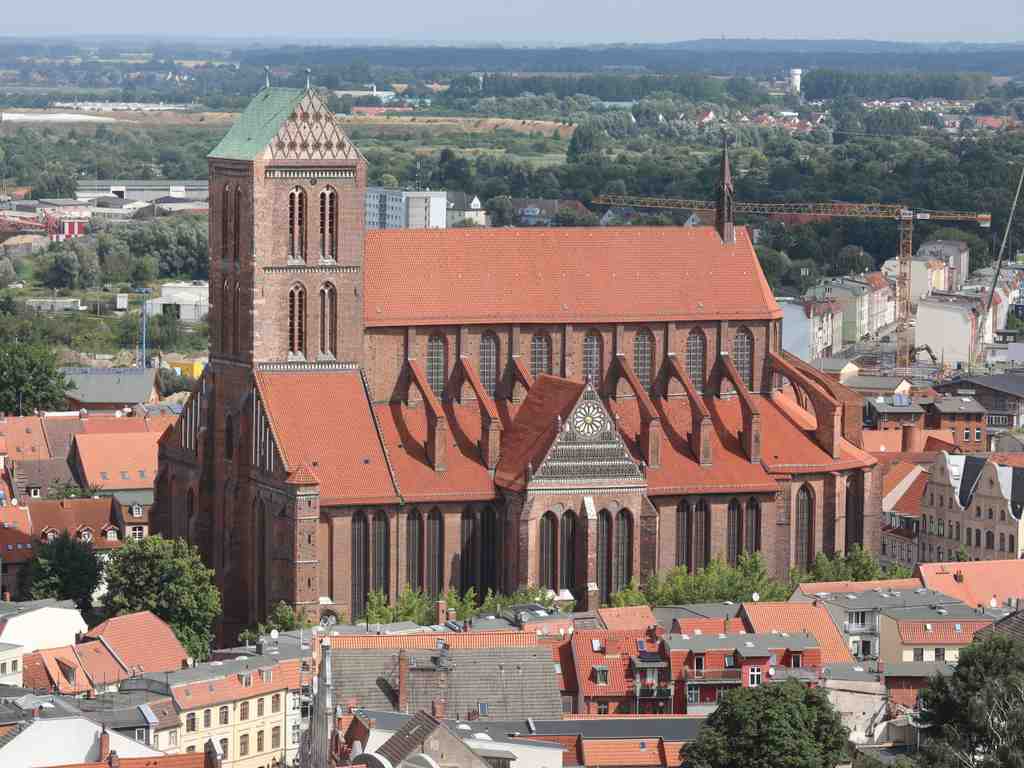
Look for a massive, red-brick church with a strikingly tall tower topped by a greenish roof and rows of pointed gables along its sides-it’ll be towering above the rooftops just ahead of you.
Welcome! You’re standing before the mighty Nikolaikirche of Wismar, a church that has watched over the town for more than 600 years. Imagine the salty sea air mingling with the scent of fish-once upon a time, this place was alive with sailors and fishermen bustling around, their heavy boots echoing on these very stones. Built between 1381 and 1487, the Nikolaikirche became the spiritual home for those who braved the dangers of the Baltic Sea-an enormous, high-arched sanctuary meant to bring them hope and comfort.
But this isn’t just any old church-look up! With its 64-meter tower and soaring roof, Nikolaikirche was a true architectural daredevil of its time. If you feel a bit dwarfed, that’s no accident-the nave, that central hall, is the fourth highest in all of Germany, reaching up to 37 meters. When it was built, late gothic architects stacked up over three million bricks, with special stones sent from far-off Lüneburg (talk about an express shipment in the Middle Ages!).
Now scan the glorious southern gable. See all those decorations in brick? You’ll spot a mosaic of faces-dragons, lions, the Virgin Mary, and Saint Nicholas himself keep watch with stony eyes. And just above, a rose window made of brick glows warmly in the afternoon sun. The real trick, though, is to picture the church as it once was. The tower used to reach nearly double its current height, but in 1703, a monstrous storm-not unlike the ones that sent sailors scrambling for shelter-ripped off the entire spire. The crashing timbers smashed through the church roof and wrecked the medieval interior. For years, repairs and renovations crawled along, with craftsmen trying to recapture that soaring original feeling.
But Nikolaikirche is no museum frozen in time-it’s a patchwork of centuries. Step inside (in your mind, at least) and imagine sunbeams streaming through tall, narrow gothic windows, illuminating stories from many vanished Wismar churches. After bombs in World War II damaged St. Georgen and St. Marien, their treasures took refuge here. There’s an altar so huge-ten meters wide!-it’s the biggest on the entire Baltic coast, and a mysterious Schifferaltar or “Sailors' Altar”, once worshipped by those hoping to survive treacherous journeys.
And then there’s the Thomas altar, a kind of medieval comic strip carved and painted with tales of adventure, miracles, family betrayal, and even prison escapes! You’ll see Thomas of Aquin refusing to eat at a wedding feast in India (spoiler alert: he’s attacked by a lion), or monks sneaking him out of a tower with a rope when his mother tries to keep him from joining the friars-some say Harry Potter had it easier!
All around, relics and artwork from ages past tell of faith, hope, and human struggle. There are ancient baptismal fonts, one so heavy it sits on the backs of three kneeling boys cast in bronze, and another guarded by a wooden angel dangling from a pulley-perhaps in case of a heavenly water shortage!
But Nikolaikirche also bears scars: gravestones engraved for aged priests and noble ladies, stately altars missing their brightest paints, fragments of stone and wood battered by storms and time. On quiet days, you can almost hear the muffled echoes of centuries-prayers, organ music, and the faint shiver of ghostly sails overhead.
So, as you stand here, imagine hundreds of years of anxious sailors running in, children gawping at glowing stained glass, and townsfolk whispering beneath impossibly high ceilings, all hoping-just maybe-that St. Nicholas is listening. After all, in a city shaped by the sea, who’s more important than the patron saint of sailors?
Want to explore the building description, equipment or the bells in more depth? Join me in the chat section for a detailed discussion.




