
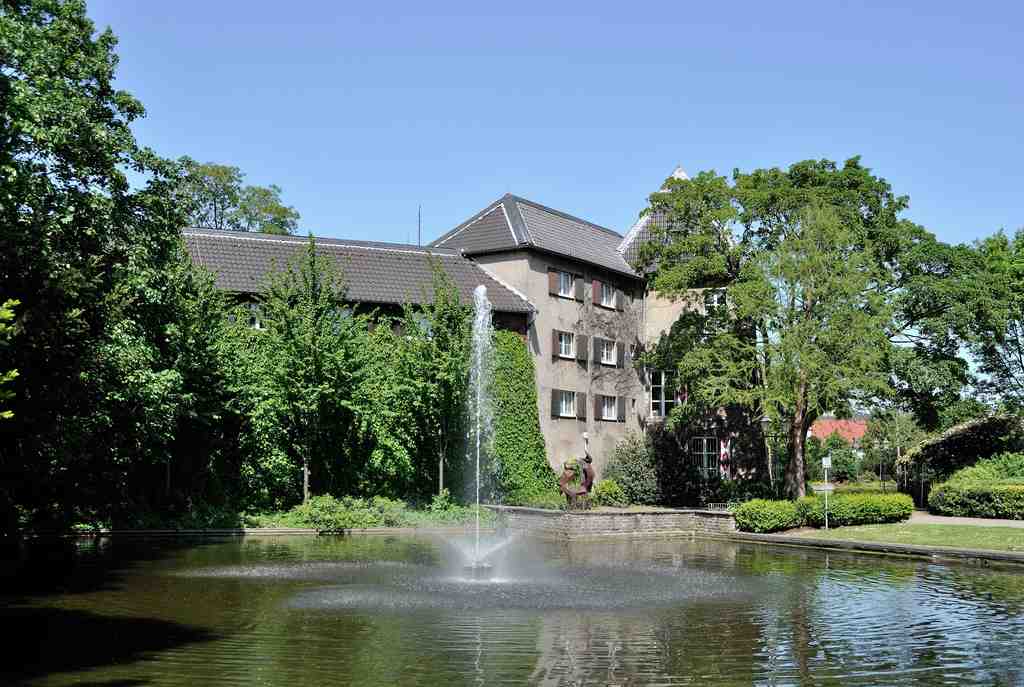
To spot Dinslaken Castle, look just beyond the round pond and the spraying fountain-there you’ll see the castle’s sturdy walls trimmed with ivy and a tall, slanted roof peeking above the lush trees.
Now, take a good look at this spot, because you’re standing where centuries of drama, intrigue, and, believe it or not, several cases of very inconvenient fires have unfolded! Picture yourself on a small rise, surrounded by marshy lands and waterways, just like it was almost a thousand years ago. The castle you see before you might look neat and quiet, but it has seen more than its fair share of excitement-some of it literally up in smoke!
Back in the Middle Ages, this place was one of the most important fortresses in the Duchy of Cleves. In those days, if you wanted to stay dry, you’d better have good boots-this castle once rose up like an island in a swamp, protected by broad moats filled by the Rotbach. Its beginnings are shrouded in a little mystery because the first written mention of someone living here, a certain Antonius de Dincelachen, comes from a document dated 1163-a document that just might be a fake. But historians agree that the original castle was probably a motte: a wooden fortress on a mound, built to withstand attacks, wild animals, and maybe even the odd tax collector.
Jump ahead to the 13th century, and powerful families, including the counts and later dukes of Cleves, fought fiercely to control Dinslaken. There were tales of noble widows taking over the complex, favorites of the duke moving in, and the castle occasionally being pawned off like a family heirloom nobody could quite agree on. By the 1400s, the mighty round tower-once rising 40 meters-loomed over the scene, acting as both a symbol of power and, for less fortunate visitors, a prison tower. People were locked up here for witchcraft, heresy, or simply being a bit too chatty.
As the centuries rolled by, the castle traded intrigue for paperwork, becoming the seat for administrators and judges. Occasionally, things heated up-sometimes quite literally. Fires repeatedly damaged the castle, so much so that, in 1909, on the very night before a grand reopening, flames roared through the place yet again. Talk about bad timing! But, just as often, the people of Dinslaken rebuilt-reshaping the castle again and again, sometimes in grand style, sometimes in more practical form.
During the Thirty Years’ War, the castle faced threats but mostly just suffered from being old and a bit neglected. By the 18th and 19th centuries, it was used for everything from offices to a schnapps distillery-because, honestly, who doesn’t want a castle with a secret stash of booze? There were even plans for a mental asylum and a training school, but those never quite worked out.
World War II brought devastation here, with the castle nearly leveled in 1945. What rose from the ruins in the 1950s was a castle with a modern twist-look for the chunkier stone base, evidence of its medieval muscle, and the more contemporary upper floors. Only the southeast side holds original medieval features: stubby towers, a rectangular block, and a gate that looks like it could still handle a drawbridge or a battering ram.
Today, Dinslaken Castle stands as the city’s town hall, registry office, and archive-a place where people now argue over wedding cakes, not wars. And while the original moats are mostly gone, the pond before you is a playful echo of the former waters that once protected this fortress.
So, next time someone says “keep your home safe,” just know you’re standing in front of a place where that meant ramparts, moats, and a tower that doubled as a prison. Before you leave, take in the peaceful scene-don’t worry, the only siege happening today is probably someone trying to find better parking!


