
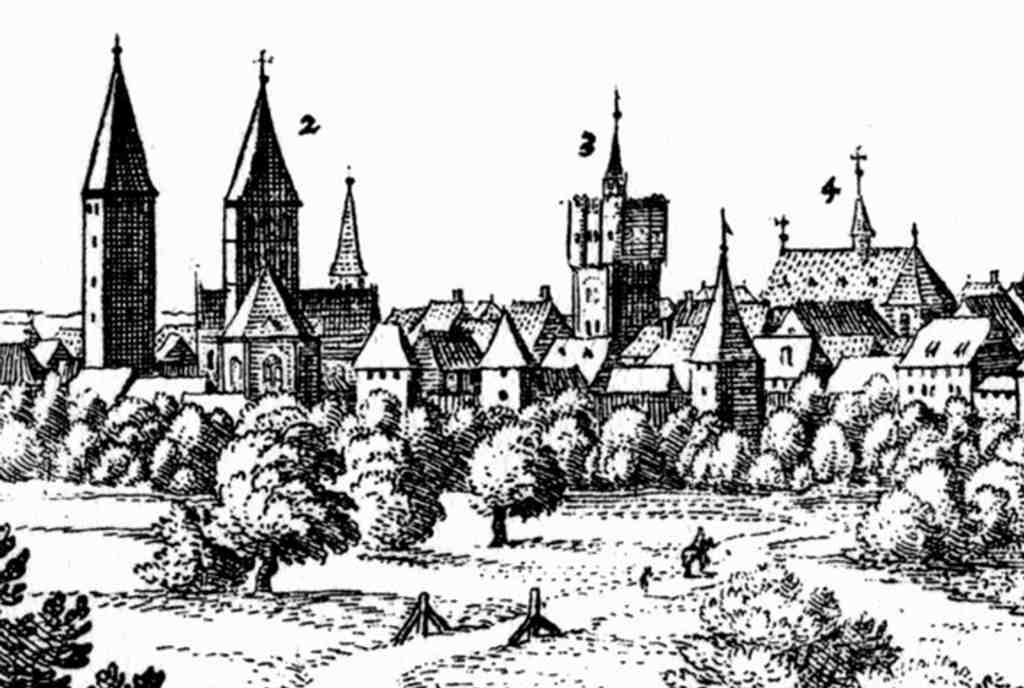
If you’re looking for the remains of the Franciscan Monastery, glance to your right at the broad open area where the modern hospital now stands-once, the impressive monastery stood there, marked by a square of historic alleys, with a pointed church roof rising up behind the city wall. The next time someone says, “You can’t miss it,” just remember: you’re searching for ghosts in the heart of Speyer!
Imagine yourself in the bustling town of Speyer nearly 800 years ago. Monks in rough brown robes walk by, bare feet padding quietly across stone streets-hence their nickname, the “Barefooted.” The air is filled with the distant sound of church bells, and in this very spot, you would have seen the thriving Franciscan Monastery. Its first stone was laid around 1230, right by the Moritz Church and near the Allerheiligenstift. Back then, the alleys around you would have thrummed with the life of a busy religious community.
It all began with Caesarius of Speyer, a local man and the first German leader of the new Franciscan order, which had only been founded in Italy in 1210. With the help of Bishop Konrad III and a generous canon named Mitter, the friars were offered a leprosy house near the city wall; what a real fixer-upper! On a September day in 1223, the friars gathered in their humble quarters for a meeting-imagine the creaking benches and the murmur of Latin prayers-where they planned the order’s future across Germany.
Soon, thanks to local support and a bit of persuasive preaching, they secured permission to build. Streets you now know as Ludwigstraße, Herdstraße, Allerheiligenstraße, and Brudergasse once outlined their plot. The friars even got a barrel of herring as a donation in 1260-so if you smell fish, you know you’re on holy ground. The Franciscans became a beloved part of the community-so much so that when the town expelled all clergy in 1421, the Franciscans and Dominicans were allowed to stay.
But Speyer was no stranger to trouble. Arguments broke out within the order-a classic fight between friars who wanted to keep everything and those who wanted to give it all away. By the end of the 1500s, the place had fallen on hard times. The few monks left were more interested in ale than prayers, leaving their church in disrepair and causing a scandal in town. The situation got so wild that even the local nuns started rolling their eyes! The pope himself eventually ordered the monastery closed in 1580, but the friars wriggled out of it with a little help from friends in high places. There’s nothing like papal drama to keep life exciting.
As the centuries turned and repairs always seemed just out of reach, the friars begged the bishop to let them collect alms to rebuild-imagine them, cap in hand, on rainy streets. By 1735, the new church was finished and the bells rang out in celebration.
Then came the chaos of the French Revolution in the late 1700s. Imperial troops marched in, taking over every monastery for barracks or hospitals-except for the Klarissen nuns, who dodged that fate but had to feed a squad of military bakers for their trouble! The Franciscans themselves were pressed for huge war payments; when they couldn’t pay up, their confessor was whisked away as a hostage. Soon Speyer swapped hands back and forth between French and German armies, and the monastery’s once tranquil halls echoed with marching boots and clattering hooves: picture 180 cannoneers and their horses tramping through the cloisters.
When the dust of wars and revolutions finally settled, the monastery was no more. Its church was sold and then torn down, and the grounds were divided and redeveloped. Today, only the names-Brudergasse and Mönchsgasse-whisper where the friars once wandered. And on old maps and prints, you can still see the monastery: a church with a pointed steeple, standing proudly by the city wall, forever a part of Speyer’s story.
So when you look around at the quiet hospital building and the cobbled lanes, remember-this was once the domain of barefooted friars, the echo of prayers, scandal, fish, and, on a wild night or two, perhaps a bit too much wine.


