
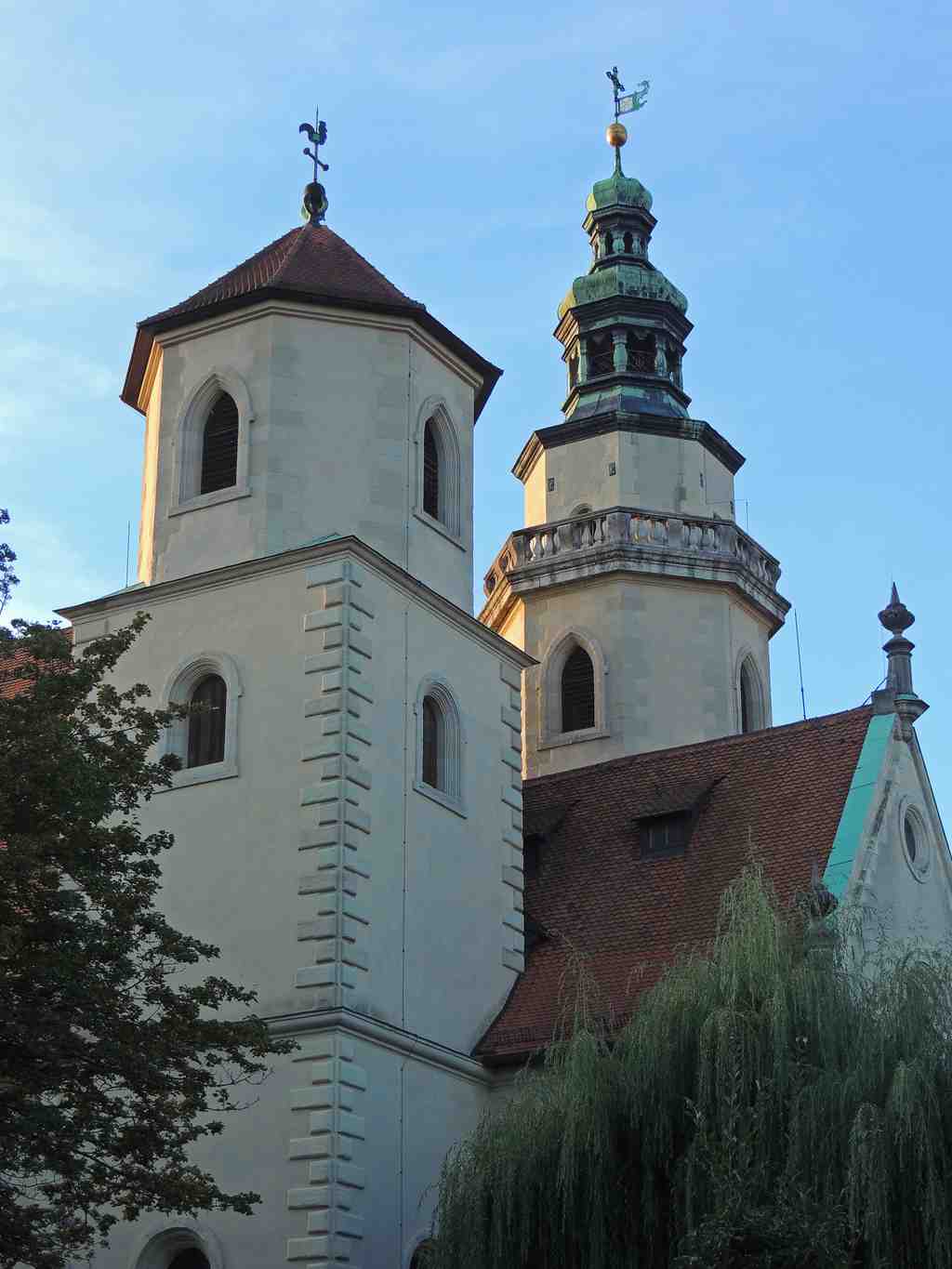
To spot the Holy Trinity Church, look for two distinct towers-one crowned with an octagonal lantern and green copper dome, the other simpler and topped by a reddish roof-rising boldly above the street ahead of you, framed by some leafy trees.
Now, let’s step back in time to the early 1600s-Regensburg is bustling, but tensions fill the air. Imagine the dusty streets echoing with distant clanging armor and the urgent clip-clop of horses. The Thirty Years’ War is raging, and in the midst of all this chaos, a band of determined Protestants decides they want a church of their own. What could go wrong, right? Spoiler alert: almost everything.
Construction on this early Baroque masterpiece kicked off in 1627 under the master builder Hanns Carl, but talk about bad timing! The city was wrestling with armies, mercenaries, refugees, and a serious shortage of coffee breaks. The Holy Trinity Church-back then called the Church of the Holy Trinity-became the first major Protestant church rising in Bavaria, and an architectural rebel too, with its grand hall completely free of columns. Step inside-if only with your imagination-and picture a sea of pews, over a thousand seats, all with a perfect view of the altar. Fancy a sermon? No pillars blocking the view!
But wait, there’s more: step into 1631 and the church is almost finished. The northern tower’s done, the walls are so solid they look ready to withstand a siege, and excitement is building. Suddenly, disaster! Bavarian troops, defeated and battered, rush into Regensburg, pillage the city coffers, and leave the second tower unfinished-a bit like leaving your IKEA furniture 80% built because you lost the screws! The chaos means the south tower only gets three stories and a quick roof. But the people of Regensburg soldier on. This new church becomes a beacon for exiled Protestants from Austria and Bohemia, who pitch in for its construction and, later, even find their final rest in the churchyard-a patch of history just beyond these walls.
There’s a bit of a mystery, too. The church’s grand portals were supposed to be decorated with striking sculptures-think of them like holy bouncers making sure you admired the building. A famous artist, Leonhard Kern, got the contract, but the sculptures suffered endless delays, partly thanks to the war. By the time some arrived, no one quite knew what to do with them. So today, the statues meant for the church hang out at the Old Town Hall instead, like misplaced party guests.
Engineering here was a marvel: to keep the sightlines open, the whole vaulted ceiling was suspended from the roof, and instead of heavy ribs, innovative hollow decorations made from fabric and glue were used. Pretty crafty, though they turned out to be a bit of a magnet for damp and mold-a historic “uh-oh” moment in church maintenance.
Jump forward a century or two, and you’ll find noblewomen like Princess Therese of Thurn and Taxis negotiating their own private box-a kind of VIP balcony, because every great church deserves front-row seating for the aristocracy. A little further down the line, it becomes the stage for grand concerts and the powerful sounds of a mighty organ-today, a special “Bach-Orgel,” built just for the stirring works of Johann Sebastian Bach.
With every step on its worn stone floors, you’re brushing shoulders with soldiers, nobles, refugees, musicians, and everyday townsfolk-each leaving their own quiet echo. On a summer day, climb the northern tower and feel the wind whip over Regensburg’s rooftops, the city and river unfurling like a painted panorama. Whether stormed by armies or shaken by renovations-even mysterious ceiling collapses-Holy Trinity Church has endured as Regensburg’s resilient, beautiful rebel, always pointing skyward and forward.




