
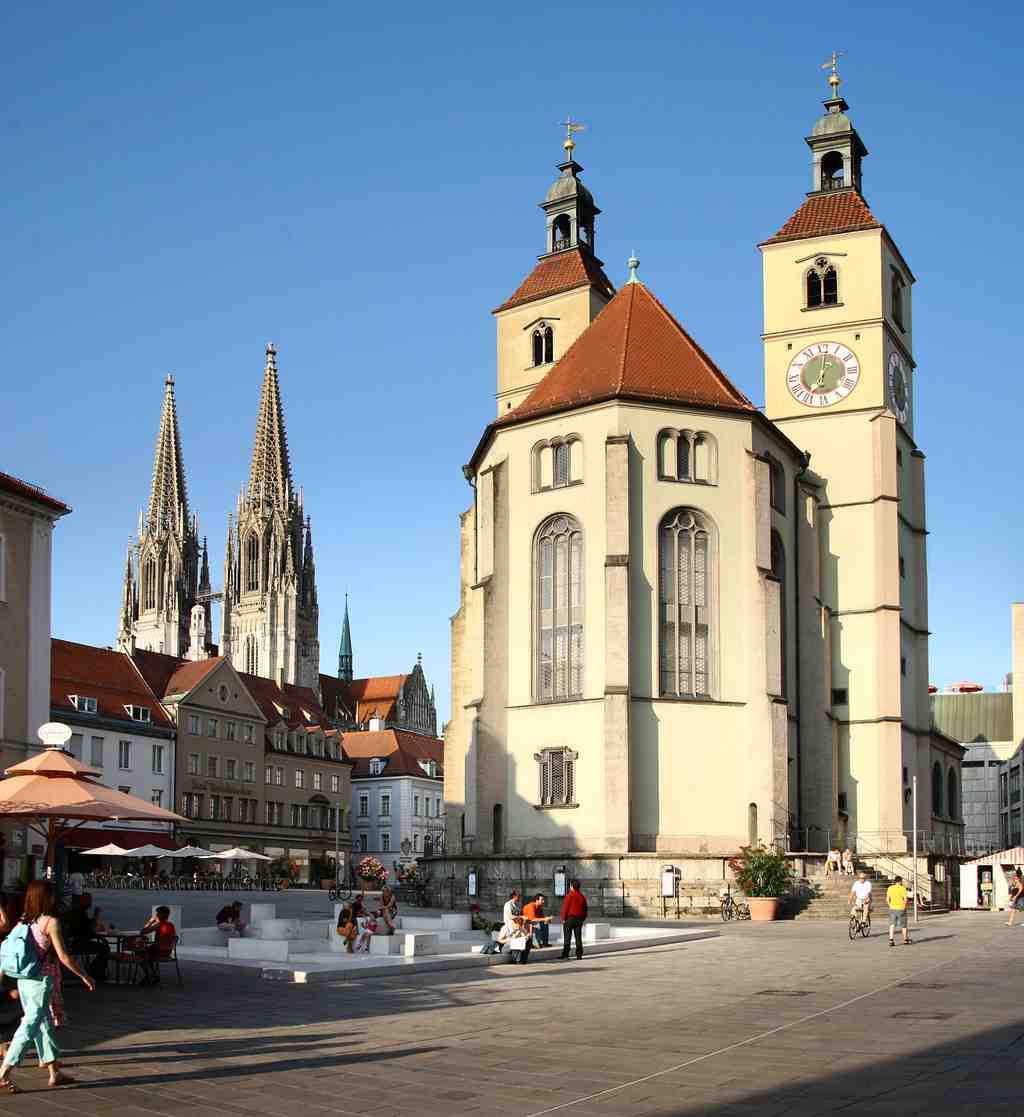
To spot the Neupfarrkirche, look for a cream-colored church rising above Neupfarrplatz with two symmetrical towers capped with red roofs and clock faces, standing proudly in the middle of the square, almost as if it’s wearing a pair of pointy hats and keeping perfect time.
Now, as you stand here, let’s step back in time and breathe in the charged air of medieval Regensburg-though, for your nose’s sake, I promise not to describe the smells too vividly! Picture this square in 1519: bustling, noisy, packed with traders, townspeople, and suddenly, a shocking event. On this very spot once stood the heart of Regensburg’s Jewish community, one of the largest and most important in medieval Germany. Suddenly, political machinations and financial desperation led to their sudden and tragic expulsion. The entire Jewish quarter, including their centuries-old synagogue, was demolished almost overnight, the gravestones stolen, the memory bulldozed. The city council didn’t quite waste time-where the synagogue had been, they planned a towering church, the “Schöne Maria.”
Talk about adding insult to injury; soon, miracle stories began to swirl, like the tale of the clumsy stonemason who survived a terrifying fall thanks to - who else? - the Virgin Mary! This miraculous reputation spread like wildfire, stoked by early printers and canny city officials eager for funds. Pilgrims descended en masse, rattling coins in wooden alms boxes and hammering on the doors to glimpse the wonders. The site became home to one of the biggest pilgrimages in the German-speaking world-just imagine the sound of hundreds of feet shuffling, prayers offered, merchants shouting “miracle books, get your miracle books here!”
Of course, the church they tried to build was enormous-but as the pilgrims’ excitement faded, so too did the city’s bank accounts. Construction was halted. All that stood was the choir, two unfinished towers, and a half-church with dreams bigger than its stones-well, at least the church could say it was halfway to heaven! Crowdfunding wasn’t an option back then, so the city had to settle for a much smaller, makeshift finish. By the time the Reformation rolled in, the mood had shifted, and the church found itself with a new identity; rather than being a Catholic pilgrimage hotspot, it became Regensburg’s first Protestant parish church-a real plot twist in the story!
Inside, even the furniture got into the spirit of reinvention. The city never built the fancy stone altar they’d planned, opting instead for a wooden altar painted with vibrant, dramatic scenes. It became something of a celebrity, only to be moved about and eventually put on display in the museum. The current altar in the church is from 1617, and if you sneak a peek, you might spot one of Bavaria’s rarest treasures: a surviving “pulpit clock”-because nothing says ‘efficiency’ like preaching on a schedule!
And here’s a musical tidbit: Neupfarrkirche’s tradition of church organs sometimes teetered on the brink of bankruptcy, but in the end, the church always found a way to keep the music playing. The current instrument is a mighty pipe organ, built in the 1980s and tuned for the twenty-first century, a sound that fills the soaring single nave with music during services and concerts.
Today, the story continues. There’s an exhibition about Regensburg’s Jewish history and the Reformation at the back of the church, and if you peer downwards-or join a guided tour-you can see remnants of the lost Jewish quarter and even the foundations of the old synagogue, now marked with a sculpted outline on the square. So next time someone complains about building delays, just tell them about the Neupfarrkirche: five centuries, three religions, two towers, and one unforgettable city square!




