
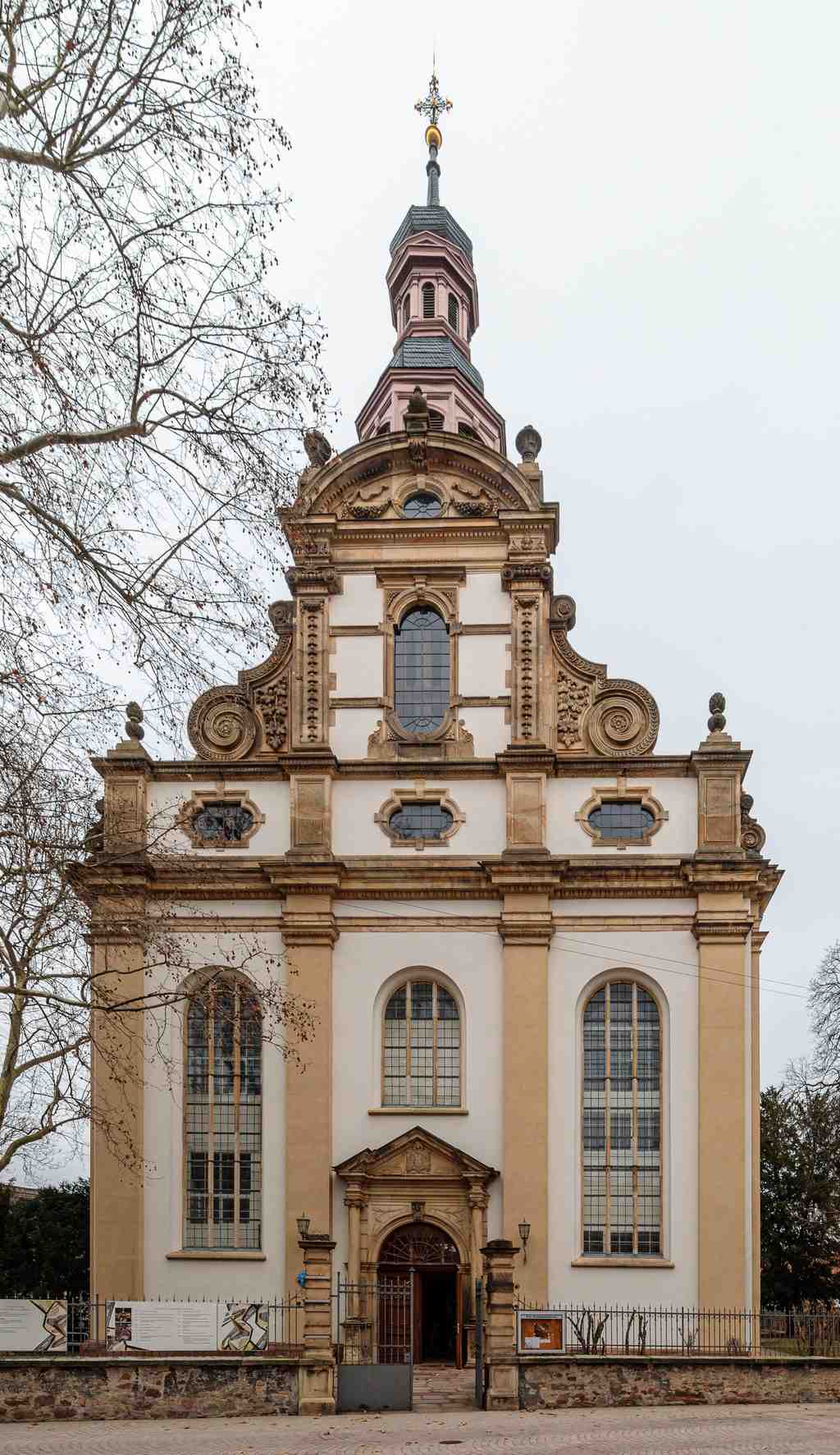
To spot the Holy Trinity Church in front of you, look for an elegant, buttercream-yellow Baroque facade with grand arched windows and a tall, richly decorated steeple rising up above the treetops.
Welcome to the Holy Trinity Church, Speyer’s very own Baroque “jewel”-a place where faith, history, and a touch of drama all come bundled together, almost like a medieval version of prime-time TV! If you stand quietly for a moment, you might almost hear the footsteps of past centuries echoing off these proud walls.
It all began after a firestorm-quite literally. In 1689, French troops, obeying the iron will of Louis XIV, tore through Speyer during the War of the Palatine Succession. Imagine a city in smoldering ruins, with its frightened townsfolk fleeing over the Rhine. Lutherans, who made up the majority here after the Reformation, scattered to distant places like Frankfurt, their churches and homes nothing but ashen memories. Only ten years later did some brave souls trickle back, determined to bring life to these ghostly streets again.
Now, while the Reformers got busy rebuilding the Heiliggeistkirche, the Lutherans set to work in the winter of 1700-01-clearing charred rubble with numbed fingers, laying the first stones of hope. Their foundation was poured in April 1701. Maybe you can picture their excitement-followed by the city council’s eager dash to get in on the act, laying a second foundation stone just days later, with a tin plaque almost shouting, “This church will shine for God’s glory and make Speyer beautiful again!”
The actual building was a community affair. Under the careful eye of Johann Peter Graber, the bold Mannheim architect, the walls shot up between 1701 and 1703, thanks in no small part to Paul Bagnato-an Italian mason who had so settled in, he renamed himself Paul Naß. But trouble didn’t let up: in 1703, the Spanish War of Succession threatened the city, so the Lutheran congregation moved their worship into the unfinished church for safe keeping.
Inside, construction slogged on-wood galleries in 1704, walls unfinished until 1717 (budget woes are nothing new)-but hope prevailed. There’s nothing like lending a hand and praying something will work out! The organ was installed in 1717, just in time for that mighty 200th anniversary of the Reformation. The church’s bare beams shimmered with candles and expectation as crowds filled the air with singing.
But the church’s luck, like life’s favorite soap opera, took another twist. In 1792, revolutionary French troops stormed Speyer. The last service of the ‘old’ days happened on Christmas in 1793-but then, the church was plundered: no more bells, no glittering chalices, not even the organ pipes survived. The building ended up as a makeshift hospital for wounded soldiers, the haunting groans of pain no doubt bouncing between the altar and broken pews. Services only started again in 1814, as Europe tried to catch its breath.
But here’s a silver lining: all that shared hardship drew once-divided spiritual families together. By 1817, reformers and Lutherans looked past old line-in-the-sand arguments and, with typical German efficiency, voted overwhelmingly to unite. A year later, the Palatinate’s churches officially declared Union with a grand service-one congregation at last! The Holy Trinity Church became the beating heart of Protestant life here, especially during cold winters, since the new Memorial Church didn’t have any central heating yet (the thought of frosty pews still chills the imagination!).
Peeking at the church’s design, you’ll find inspiration taken from Frankfurt’s Katharinenkirche-a wide, open space with a rare, flat wooden vaulted ceiling painted with vibrant biblical scenes. Forget the usual dizzyingly high Baroque ceilings; these panel paintings draw you in close, bringing the Word to every worshipper’s eye.
If you had super-hearing, you’d catch the bells overhead: their story is a wild ride. The original tower was just a stump for years, until new bells-cast in harmonies to echo the famous cathedral-made the place sing. But war and fire never spared anything for long: bells lost, recast, stolen for war, and recast again. The bell you’d hear now, the “Vaterunserglocke,” was cast in 1951. Inside, the majestic organ rests above the altar, though, as of 2020, silence reigns, waiting for a new restoration.
So as you stand outside, let your gaze wander up the beautifully restored 1891 facade, and think of the generations-from ruined beginnings to baroque beauty-who’ve built, rebuilt, and reinvented this grand old church. It’s the kind of place where faith isn’t just sung or spoken, but hammered, painted, and rebuilt, one determined century after another. And if buildings could talk, the Holy Trinity Church would surely wink, nod, and hum a hymn of triumph through the ages!




