
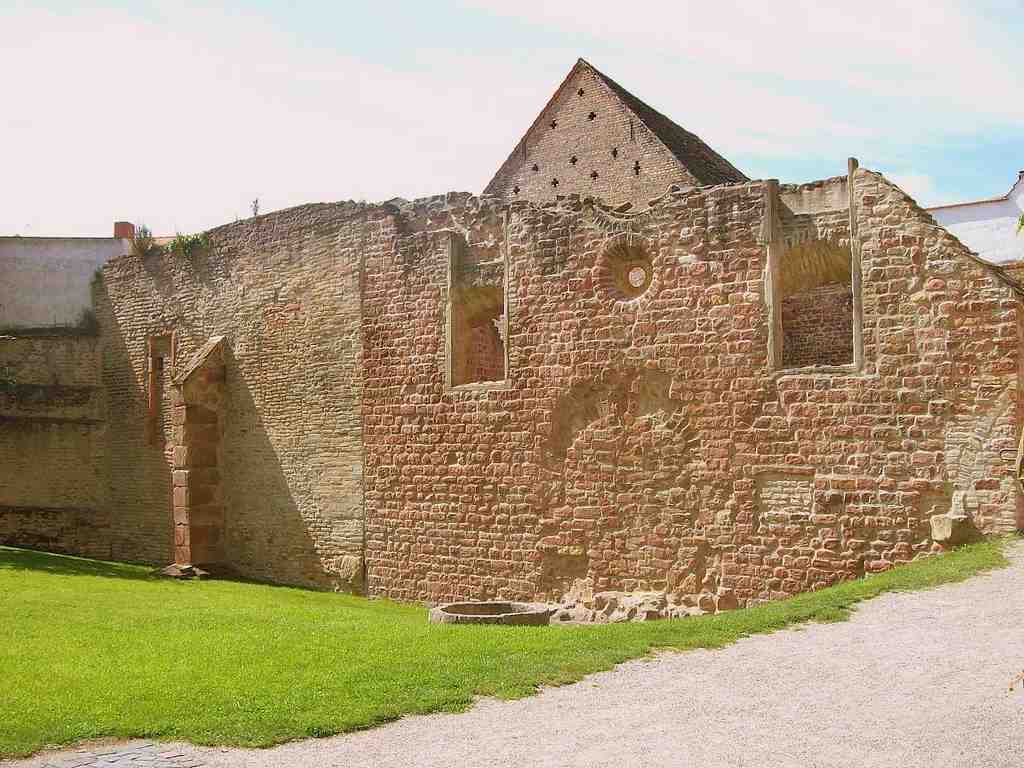
To spot the Jewish courtyard, look for a low, ancient stone wall in front of you, made of reddish sandstone and brick, with arched and circular window openings and a small grassy area at its base.
Alright, step right up! You’re now standing before the heart of medieval Jewish life in Speyer, and I have to say, if these old stones could talk-they’d probably tell you some pretty wild stories (and maybe ask you to dust them off). Imagine this quiet courtyard bustling with people nearly a thousand years ago: the shuffle of feet on stone, the murmur of prayers, the distant laughter of children who were definitely not supposed to be running during lessons. The air would have smelled of fresh bread from the communal ovens and maybe, just maybe, someone’s stew had gotten a bit out of hand nearby.
Back in 1084, the Bishop of Speyer, Rüdiger Huzmann, gave the Jewish families something precious: protection. Why, you ask? He wanted the city to thrive, and smart merchants and scholars would help! So, Jews fleeing danger in Mainz arrived, bringing hopes, dreams, and probably some truly excellent recipes. Soon after, Speyer became one of the most important centers of Jewish life in Europe; the “ShUM-cities” (Speyer, Worms, and Mainz) were legendary for scholarship and community spirit. Things were so good that even the Holy Roman Emperor, Henry IV, got in on the act by expanding those protections.
But building a community means building, well… buildings. Right before your eyes you’ll see the remains of a synagogue consecrated in 1104, built in tough, rose-colored Romanesque sandstone. The arched windows around a central circle were so stylish that they caught on in Ashkenazi synagogues far and wide. Now picture it in its heyday: lantern light gleaming through the glass, families gathering for Shabbat, and debates about ancient texts going late into the night.
To the east, hidden away for privacy, they dug deep to create a mikvah-Europe's oldest! Imagine tiptoeing down ancient stairs to a silent, cool underground pool, light slanting through intricately carved stonework. I bet even the stonemasons who built Speyer’s Christian cathedrals slipped over to admire their own handiwork-it was that impressive.
In the 13th and 14th centuries, this community didn’t just retreat to the past. They expanded: building a yeshiva for intense study and a new Gothic women’s shul just next to the synagogue. (The rib-vaulted ceilings in the women's section practically shout “Look at me, I’m fancy!”) By then, the place was buzzing with learning and celebration.
Of course, not every chapter was happy: a terrible pogrom in 1196 saw the synagogue burned, only to be rebuilt stronger. Through every golden age and dark cloud, this place was at the heart of it all.
Time marched on. By the 16th century, the Jewish community faded from Speyer. The synagogue became an armory, then the courtyard turned into humble huts and gardens-as if medieval history had just taken a nap underground. But in 2021, UNESCO woke everybody up: this wasn’t just old stones, but living memory.
So as you stand here, listening and maybe feeling a shiver of the past, remember how these walls sheltered hope, faith, struggle, and joy for centuries-and hey, if you hear a whisper or two, don’t worry. It’s just the stones having a brief chat!




