
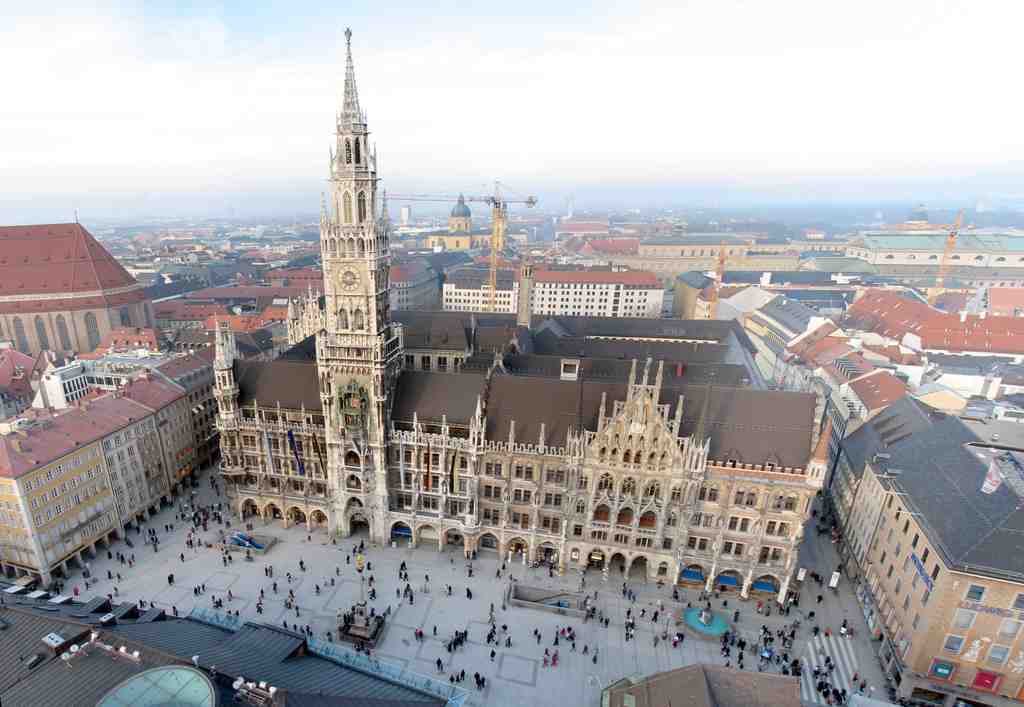
As you're approaching the Marienplatz, you'll certainly notice it on your slight-left. Look for a large open square that's bustling with activity. The north side of this square is dominated by a striking, elaborate gothic building with a tall, pointed clock tower; this is the New Town Hall (Neues Rathaus). The tower's intricate facade and the grand structure are hard to miss. The Old Town Hall (Altes Rathaus) is on the eastern side of the square, presenting a charming, historic contrast.
Now let's dive into what makes this place so amazing:
Der Marienplatz is the central square of Munich's inner city and part of the pedestrian zone. It lies in the old town at the intersection of two main axes: the East-West axis between Isartor and Karlstor, which was part of the salt road from Salzburg or Reichenhall via Landsberg am Lech to Switzerland, and the South-North axis between Sendlinger Tor and the Schwabinger Tor, which stood at what is now Odeonsplatz.
Centrally situated with the New Town Hall to the north and the Old Town Hall to the east, the south and west sides are lined with department stores and other commercial buildings, often featuring gastronomy. The square is about 100 meters long and 50 meters wide.
Since the founding of Munich in 1158 by Henry the Lion, Marienplatz has been the heart and center of the city. The two main roads met here, making it a crucial part of the city's development and life throughout the centuries. To this day, Marienplatz remains Munich's urban center.
In 1315, Ludwig the Bavarian, later the Emperor, granted Munich trade freedom on the condition that the then marketplace, now known as Marienplatz, remain undeveloped "for eternity." As a result, various markets for eggs, grain, wine, and fish took place here, and the square was simply called "Markt" or "Platz" for centuries. When grain was the primary commodity sold, it was known as Schrannenplatz, with the northeast corner by today's Fish Fountain traditionally hosting the fish market.
The square was also a site for executions and served as a venue for knight tournaments and festive receptions for the city, such as during the Emperor's visits in the 15th and 16th centuries. It wasn't until 1481 that buildings on the square, including a chapel, were demolished to create a rectangular open space.
In 1566, the construction of the landscape houses, where representatives of estates and landscapes had their seat with the Bavarian Duke, made Marienplatz a political hub, which it remains to this day. The political significance of Marienplatz was also closely linked to religious motives. In 1638, Elector Maximilian I erected the Mariensäule (Column of Mary) on the then marketplace in gratitude for sparing the city during the Swedish occupation in the Thirty Years' War. This column is now a Munich landmark.
In 1854, after the grain market moved to Schrannenhalle on Blumenstraße, Schrannenplatz was renamed Marienplatz as a gesture of dedication to Patrona Bavariae, seeking to protect the city from a cholera epidemic that broke out in July 1854. From 1888, trams ran through the square.
The construction of the New Town Hall on the north side of the square between 1867 and 1909 brought significant change. A total of 21 bourgeois houses with their arcades and fine stucco facades, which had characterized Marienplatz, were replaced by the neo-gothic colossal building designed by Georg von Hauberrisser. The Second World War heavily damaged the buildings around Marienplatz, including the historic structures on the southern side, such as the "Peterhof" with its fine baroque gable facade.
So, standing here, you are at the very epicenter of Munich's history and vibrancy, where tradition and modern life seamlessly blend together. Enjoy the bustling atmosphere and the rich historical tapestry of Marienplatz!
Intrigued by the lage, geschichte or the mittelpunkt der entfernungsmessung? Make your way to the chat section and I'll be happy to provide further details.


