
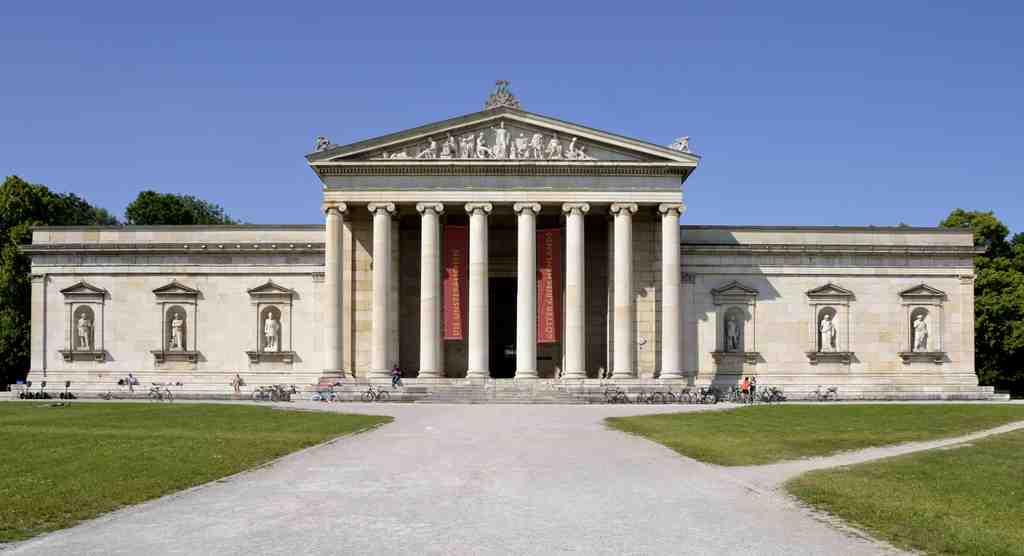
As you walk, keep an eye out to your right and you’ll spot a grand building that looks straight out of ancient Greece. That’s the Glyptothek! Designed by Leo von Klenze in neoclassical style, the building features a majestic portico supported by twelve Ionic columns. Atop the gable you'll see a sculpture group of Athena, which signifies the protection of the arts. You'll also see sculptures adorning the niches along the outer walls, giving it an air of ancient grandeur.
Now, let’s dive into the story of the Glyptothek-a museum with quite the royal endorsement! It was commissioned by Bavarian King Ludwig I, a man with a particular passion for all things Greek and Roman. Why? Because he wanted Munich to have its own "German Athens". He envisioned a place where culture and art from ancient Greece could be celebrated and remembered. Built between 1816 and 1830, the museum is the oldest public museum in Munich.
Inside, you’ll find sculptures dating from the archaic period around 650 BC to the Roman era around 550 AD. Ludwig’s spectacular collection includes incredible pieces like the Medusa Rondanini and the Barberini Faun. On the outside, tucked into those niches I mentioned earlier, you’ll see 18 stunning original Roman and Greek sculptures.
Bavaria’s ancient art collection didn’t escape unscathed from World War II. The museum itself was reconstructed, but sadly the vibrant frescoes inside didn’t survive. Post-war, the museum reopened in 1972 with simpler plastered walls, and has since undergone further renovations to preserve its magnificent structure.
If you ever wondered what a blend of Greek style and Bavarian passion looks like, the Glyptothek is your answer! It’s a treasure trove of ancient art right in the heart of Munich’s Kunstareal.


