
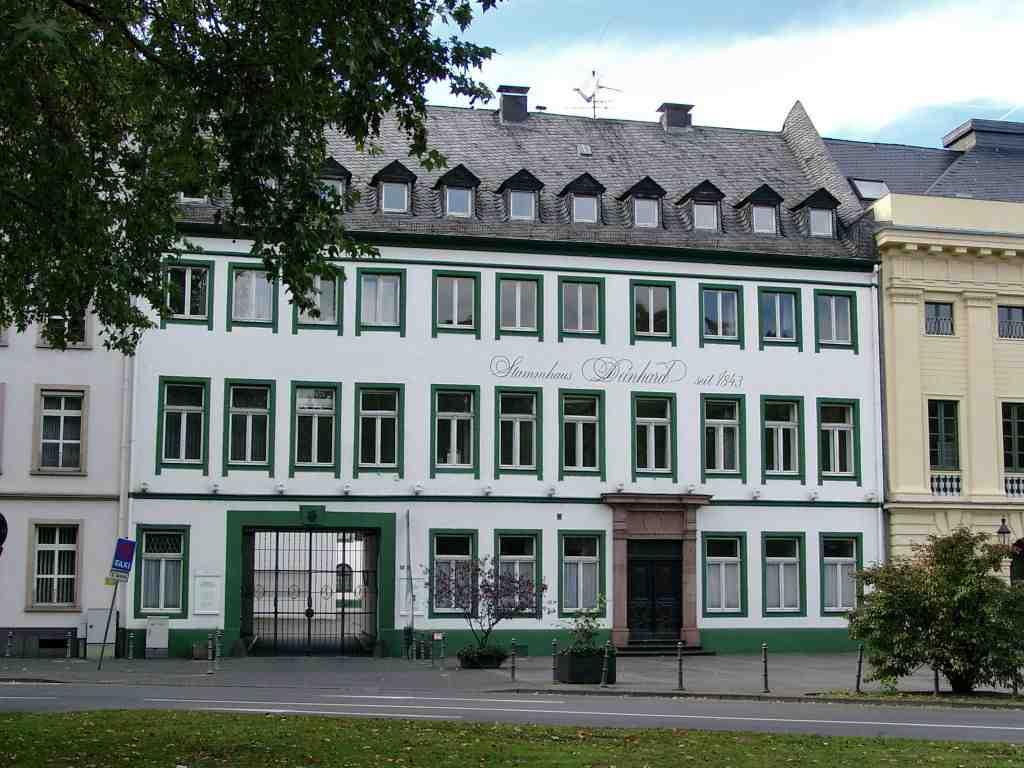
To spot the Deinhard, look for a stately white building with green trim and a slate roof right across the street, with a grand entrance and elegant rows of windows-a classic façade that proudly bears the words “Stammhaus Deinhard seit 1843.”
Alright, take a moment to admire that grand old building-home to secrets, celebrations, and more bubbles than a bath time for elephants! Welcome to the Deinhard Stammhaus, the original headquarters of one of Germany’s most beloved names in sparkling wine and tradition. Imagine it’s the late 1700s: carriages rattling by, the scent of crushed grapes mingling with the crisp Rhine air, and a young merchant named Johann Friedrich Deinhard, bursting with ambition, opens his wine shop here in 1794. Across the old city, the news spread as quick as the scent of fresh bread on baking day: “There’s a new wine in town!”
But talk about jumping in at a wild time-just a few months later, French troops marched right into Koblenz. You could practically hear the boots on the cobblestones. Everyone else might have panicked, but Johann didn’t flinch. He kept his doors open, and wine soon became his star attraction. Maybe it helped that he married well-his wife Ludovica’s father was not only mayor but also the highest-taxed citizen in Koblenz. A little family connection never hurts when building an empire, eh?
In those days, business was a family affair-and a competition! By 1805, Deinhard had hired his first traveling salesman. You can picture these wine merchants, clinking bottles as they set off by carriage to Cologne and beyond. Together with Karl Anton Tesche, who ran wine shops in two cities, their cellars filled up with promise-and with barrels, of course-in the vaults beneath the old Barbarakloster and a Jesuit cellar. It wouldn’t be Deinhard if mystery didn’t play a part; by 1812, in slipped another partner, Friedrich Wincelius, and the cast of characters kept expanding.
Fast forward to 1825: Deinhard wine makes its way to England, with young Anton Jordan-who outshone everyone by actually speaking English! He crisscrossed the channel, becoming the face and the voice of Koblenz wine in London. The company didn’t just survive-it flourished. Johann’s son August took over after his father’s passing, and soon Koblenz wine was landing on tables for both the well-heeled and the crowned heads of Europe.
Now, here’s where a little bit of fizz comes into play. Inspired by Tesche-who started making “country wines in the style of Champagne”-Deinhard launched its own sparkling wine factory in 1843, right behind these very walls. Think of that first cork popping as the start of a tradition that would stretch down centuries. Deinhard didn’t just keep up with France, it upped the ante! Their methods brought a new level of quality, making Deinhard bubbles the must-have drink for high society and parties everywhere.
Popularity boomed: by 1851, they shipped 176,000 bottles of sparkling wine, with England especially smitten by the “Sparkling Moselle.” Of course, it wasn’t always smooth sailing. Political chaos, changing borders, and, wouldn’t you know it, even river transport headaches tried to trip them up. In fact, August Deinhard himself juggled politics and business, sometimes looking less like a winemaker and more like a circus performer!
Innovations kept coming. By 1892, Deinhard was the first in Germany to use the “degorgier” process for sparkling wine-making it taste consistently great, no matter how many bottles rolled out the door. Then came international honors: a Grand Prix at the 1900 Paris World’s Fair. And when the company bought up part of the legendary Bernkasteler Doctor vineyard-paying 100 gold marks per vine-people thought they’d lost their marbles… but those vines paid off in golden Rieslings.
Through the stormy 20th century, Deinhard weathered wars, lost markets, rebuilt from rubble, and found new partners-sometimes through marriages, sometimes through sales, and sometimes through a sheer stubborn love of wine. After World War II, business picked up steam again and exports soared just in time for Germany’s big party years when Sekt sales shot through the roof.
The 1960s saw new cellars built, modern production lines fizzing to life, and the Stammhaus you see here continued as the heart of the Deinhard story-today, it’s protected as a cultural monument and is part of the UNESCO World Heritage. So, as you stand here, you’re in the center of two centuries of sparkling ambition, family drama, and one heck of a wine collection. Cheers to that-and watch your step, or you might just trip over a secret bottle or two hiding in the cellar!




