
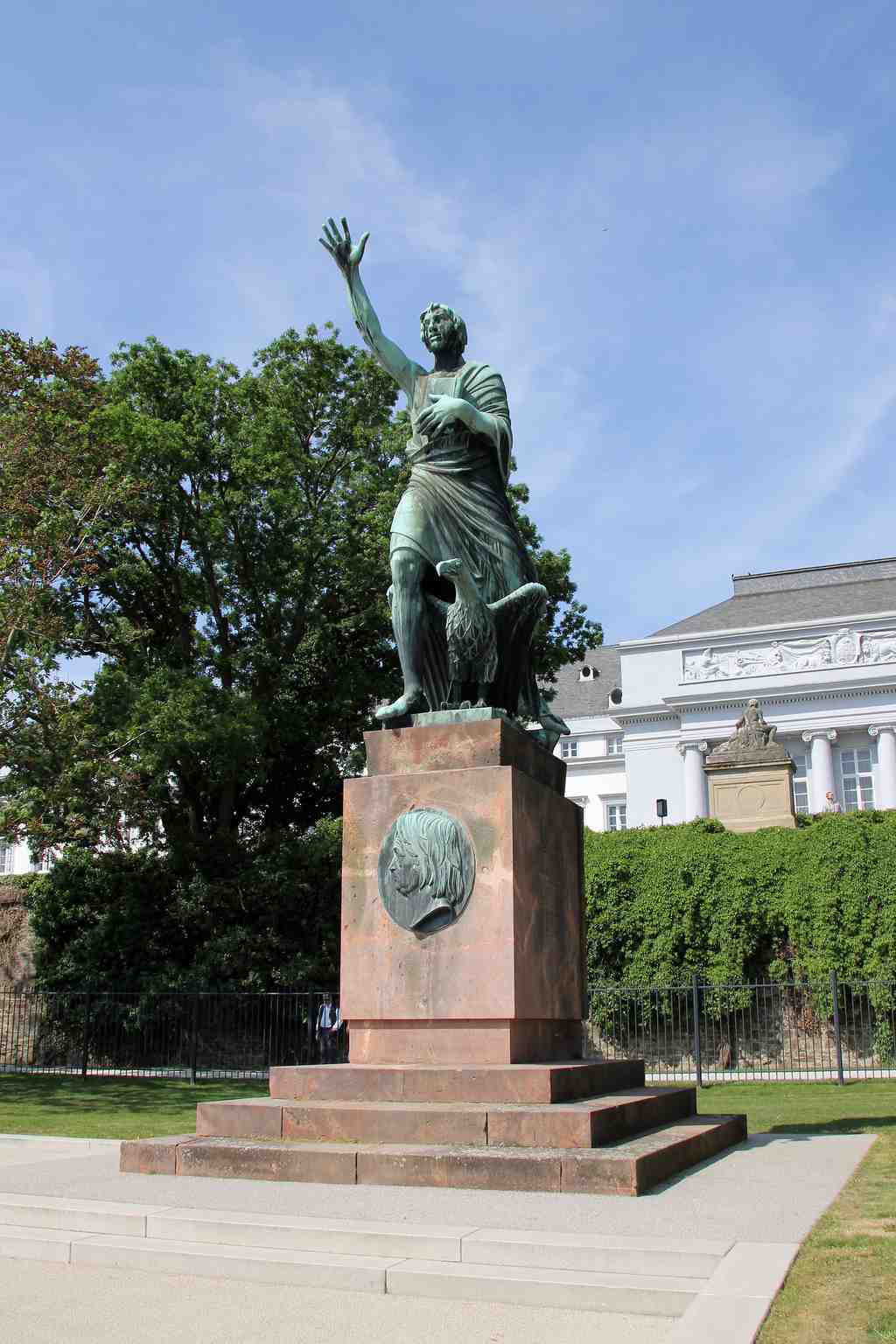
Directly in front of you, you’ll see a tall reddish stone pedestal topped by a striking bronze figure with one arm raised and a proud eagle at his side-just look between the grand palace behind you and the river for this dramatic statue.
Alright, let’s dive into the drama and dreams that brought this monument to life! Picture the scene: the 1920s, postwar Rhineland, freshly dusted off from years of turmoil and occupation. Here in this very spot, in the shadow between the grand Electoral Palace and the mighty Rhine, stands a monument not only to Joseph Görres, but also to the unbreakable spirit of the people of Koblenz and all those who love a good underdog story. Who was Görres? Born right here in Koblenz in 1776-a strange year for revolutions, right?-he grew up to become a firebrand journalist, a passionate champion of freedom, and, rumor has it, a nightmare for stuffy politicians everywhere.
But building him a monument? Oh, that was a saga worthy of its own drama! People wanted a tribute to Görres almost as soon as he died in 1848, but he was so controversial that the Prussian government said, “No statue for you!” Decades passed. Tempers cooled (a bit). After the First World War, when the Rhineland was under foreign occupation and German spirits needed a boost, the city council said, “Now let’s honor our hometown hero!” They wanted a monument that shouted, “The Rhine belongs to us!”... and what better place than here, where Görres was born during the reign of the last Elector-the very time this palace was brand new.
They formed committees so big, you’d think they were competing for Most Bureaucratic Group of the Year. Presidents, chancellors, archbishops-everyone with a fancy title pitched in. Local sculptor Richard Langer, perhaps after winning a game of rock-paper-scissors against several other artists, got the nod for the design. Of course, actually paying for the monument was another hurdle-people were trying to scrape together a living in tough times, so the collection plate didn’t really overflow. The city and state chipped in just enough to get construction started. They even had to delay putting the actual statue on top, since money arrived as slowly as a glacier on a lazy day.
Finally, in 1928, the bronze figure you see before you, all 5.23 meters high and looking like he could command the weather as easily as a crowd, was hoisted onto its four-meter pedestal of Rochlitz porphyry-a rock as tough as Görres’s spirit. This figure strides boldly, right arm high, as if rallying everyone to the call of freedom and justice. In his left hand, he clutches a book-because words, after all, can be more powerful than swords. At his feet crouches an eagle, never missing a chance to strike a dramatic pose.
The monument wasn’t just about Görres. It became a silent statement during nervous times-especially when the French occupation forces glared suspiciously at any hint of German pride. The French High Commissioner even banned the dedication speeches from being broadcast-talk about being sore losers!
But the statue dodged every drama-barely surviving WWII when many other sculptures along the Rhine were melted down for scrap, thanks to a mayor with enough charm and nerve to keep it safe. Even bombing raids left this monument standing tall. Through years of peace and reconstruction, the monument has remained a place to gather, to sit-and, for many, to remind themselves that no matter how hard things get, there’s always a voice like Görres’s ready to shout for freedom.
And next time you walk past, look at the words carved into the sides: “The Rhine is Germany’s pulsing artery.” Not bad for a bronze guy with a book and an eagle! I’ll be here with more stories as we head to our next stop.
Eager to learn more about the location, construction or the monument protection? Simply drop your inquiries in the chat section and I'll provide the details you need.




